Tod’s vs. Santoni: Which Italian Shoe Brand Is Better?
Three years from now, one of these pairs will be in a rotation and the other will be in the back of a closet, and the brand name will have almost nothing to do with which is which. You buy a Tod’s Gommino and a Santoni oxford on the same afternoon, wear the Gommino every weekend and the Santoni twice a year, and it is the casual shoe that turns out to be the better purchase despite costing the same and carrying less of a shoemaking reputation. The tradeoff compresses to a line: Tod’s is the stronger choice for refined casual wear, driving shoes, loafers, and easy everyday use; Santoni is usually better for polished dress shoes, richer leather finishing, and formal wardrobes. Neither is universally better. What decides it is the clothing you actually wear on a Tuesday, and how many Tuesdays a year the shoe will see.
How Tod’s and Santoni Occupy Different Parts of Italian Luxury
Start with what each house is actually good at, because the two brands get compared as if they were rivals in the same race. They are not. They occupy adjacent rooms in the same building.
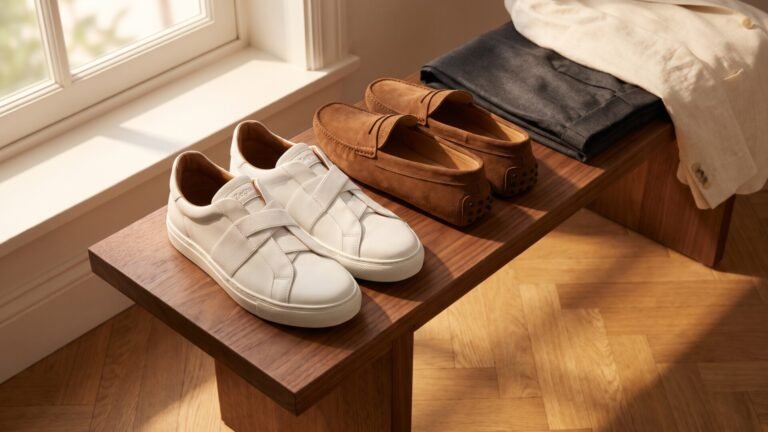
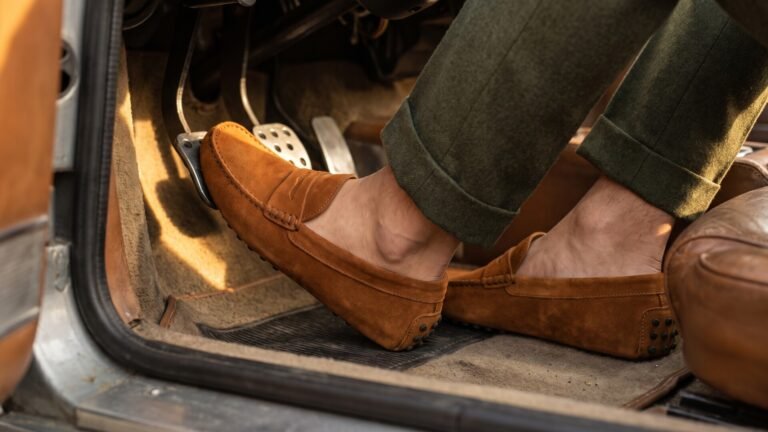
Tod’s built its reputation on Italian casual luxury. The Gommino driving shoe – the one with the rubber pebbles across the sole, gommino meaning "little rubber stud" – is the anchor, and everything else in the line reads from it: soft unstructured loafers, leather sneakers, minimal hardware, branding so restrained you sometimes have to turn the shoe over to confirm who made it. The design brief is a shoe that moves between an airport, a weekend lunch, and a relaxed office without anyone noticing the transition. Supple leather, flexible soles, a shape that follows the foot rather than correcting it.
Santoni sits in a dressier register. The house is known for elongated lasts, hand-finished color and patina, polished leathers, and a traditional luxury-shoe vocabulary: oxfords, monk straps, penny loafers, brogued styles. Where Tod’s hides its work, Santoni often displays it – the depth of color on a hand-painted vamp, the sharper taper of a toe, the visible polish on a heel counter. A Santoni is meant to be looked at as well as worn.
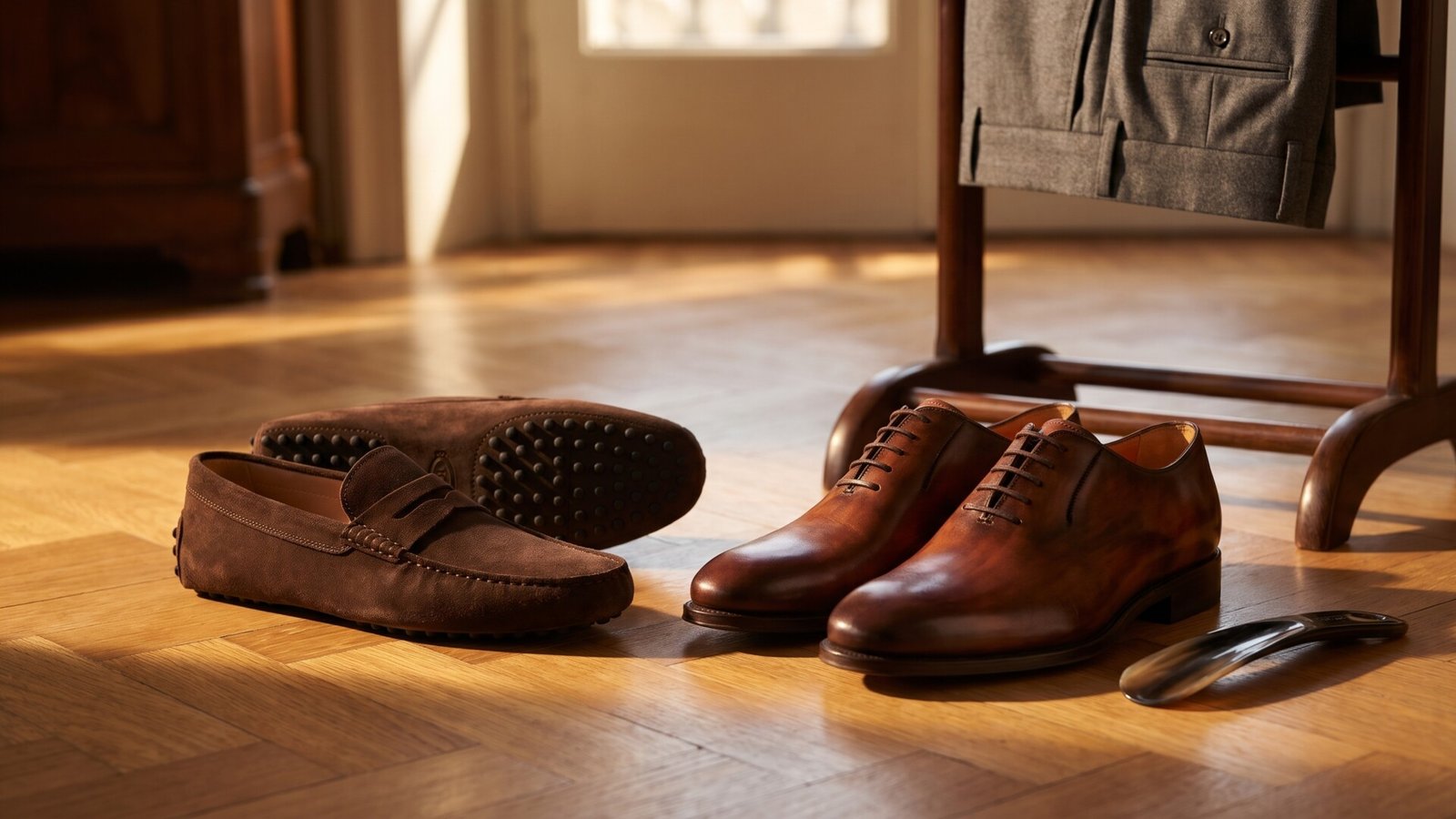
This is why direct comparisons go wrong so easily. Put a Tod’s Gommino next to a Santoni oxford and you have compared a driving shoe to a business shoe and learned nothing. The useful test is narrower: Tod’s formal loafers against Santoni loafers, or Tod’s leather sneakers against Santoni’s more casual offerings. Same use case, different execution. That is where the brands genuinely compete.
For the broader craft context behind both houses, [Internal: The Art of Italian Shoe Making] covers the techniques, and [Internal: Italian Designer Shoes: The Complete Guide to Luxury Footwear Craftsmanship] walks through how the category is built from the ground up.
Tod’s vs. Santoni: Design, Craftsmanship, and Materials
Design language and signature styles
Tod’s design codes are about restraint. The Gommino’s pebble sole is the one flourish, and even that is functional – it grips a pedal, flexes with the foot, and disappears under a trouser hem. Silhouettes stay soft and unstructured. Hardware is minimal or absent. The leather sneakers and the City Gommino, a cleaner and slightly more structured take on the driving shoe, push the same idea toward the city.
Santoni’s codes run the other way. Elongated dress-shoe shapes, rich patina, sculpted loafers, double monks, oxfords with broguing, and a level of surface polish that announces itself across a room. A Santoni penny loafer in a hand-finished brown is a deliberate focal point. A Tod’s loafer in the same color is background music.
That difference has a practical consequence. Tod’s integrates into more outfits because it competes with nothing. Santoni elevates an outfit but asks the rest of the look to keep up. If you wear denim and chinos most days, a heavily patinated Santoni can look overdressed in a way a Tod’s never does. If you wear tailoring, the reverse is true – a soft Tod’s casual shoe can read as slightly underdressed next to a good trouser.
The models worth putting side by side: the Tod’s Gommino, the Tod’s City Gommino, a Santoni penny loafer, a Santoni double monk, and a Santoni cap-toe oxford. Those five cover the real decision.
Construction and leather quality
Here is where you stop reading labels and start handling shoes. Country of origin tells you where a shoe was assembled. It does not tell you how. Both brands make shoes in Italy, and both have models across a range of constructions, so the only honest method is to assess each pair in your hands.
What to check, in order:
- Leather selection. Press your thumb into the vamp – the front upper that covers the top of the foot. Good leather creases in fine, tight lines and springs back. Cheap leather creases in broad, loose folds and stays creased.
- Stitching consistency. Run your eye along every seam. Stitch length should be even, the line should be straight, and the thread should sit flush rather than puckering the leather.
- Edge finishing. Look at the raw edge of the leather where the upper meets the sole. A folded and burnished edge is slower to make and wears better than a painted one. Run your thumbnail along it – if it catches on a rough painted edge, it was finished in a hurry.
- Lining. Turn the shoe over and look inside. A stitched leather lining holds its shape and breathes; a glued lining can lift and wrinkle with wear. Press the inside heel – if it shifts under your thumb, it is not properly attached.
- Sole attachment. Ask, or look, at how the sole is joined. A stitched sole can be replaced by a cobbler when it wears through; a glued sole usually cannot. This single fact decides whether the shoe is a five-year purchase or a fifteen-year one.
- Heel construction. A stacked leather heel can be rebuilt. A molded one gets replaced whole or not at all.
Tod’s soft leathers and flexible rubber details prioritize immediate comfort. That is a real virtue – you can wear a Gommino out of the box. But supple is not the same as durable. A very soft upper with light internal support will crease, stretch, and lose shape sooner than a firmer, better-structured leather, especially if you wear it hard and never rest it.
Santoni’s polished and hand-finished leathers reward formal wear but demand more care. A patina finish is a surface treatment, and surface treatments are the first thing to suffer from rain, salt, and neglect. That is not a defect. It is a maintenance commitment you are agreeing to at purchase.
One caution before you generalize: neither brand uses a single construction method across its whole range. A driving shoe and an oxford from the same house can be built completely differently. Judge the model, not the logo.
Tod’s vs. Santoni Comparison Table
| Category | Tod’s | Santoni | Best choice |
|---|---|---|---|
| Design character | Understated, refined casual, highly versatile | Polished, expressive, traditionally dressy | Depends on wardrobe |
| Best-known styles | Gommino driving shoes, loafers, casual leather shoes | Oxfords, loafers, monk straps, formal leather shoes | Tod’s for casual; Santoni for formal |
| Comfort profile | Soft, flexible, easy to wear from the start | Structured support that can improve with break-in | Tod’s for immediate ease |
| Formality | Casual to smart casual | Smart casual to formal | Santoni |
| Everyday versatility | Strong for travel, weekends, and relaxed offices | Stronger for tailored wardrobes and occasions | Tod’s for broader use |
| Maintenance burden | Moderate, especially for soft leather and pebble soles | Higher, especially for polished leather and patina finishes | Tod’s |
| Long-term value | Best when the model matches frequent casual wear | Best when formal shoes receive regular use and care | Model dependent |
| Best buyer | Minimalist buyer seeking one versatile luxury pair | Traditional dress-shoe buyer seeking refined finishing | Lifestyle dependent |
Prices vary by model, leather, construction, season, and retailer, so treat this as a buying framework rather than a rating. And do not judge a Santoni dress shoe against a Tod’s driving shoe on the same comfort or durability criteria – they were built for different jobs, and each will lose the comparison the other was designed to win.
What Most Buyers Get Wrong About Tod’s and Santoni
The most common error is assuming Santoni is automatically the better-made brand because its shoes look more formal and carry more visible finishing. More decoration is not more durability. A hand-painted patina is a beautiful surface treatment; it does not make the sole last longer or the leather stronger. Some buyers pay a premium for visible craft and then discover the finish is the most fragile part of the shoe.
The second error runs the other way: treating the Tod’s Gommino as a universal walking shoe. It is not. The flexible pebble sole and soft upper suit driving, travel, and light city use. They are not built for heavy daily pavement, long distances, or wet weather. Buy a Gommino expecting a commuter workhorse and you will wear through it and blame the brand for a job it never claimed.
The real comparison is model against model, not brand against brand. A Tod’s formal loafer may be the better office purchase for one reader; a Santoni penny loafer may be far more useful to another whose week is built around tailored trousers. The brand name settles almost nothing.
A repeatable decision framework:
- Choose Tod’s if the shoe must work with denim, chinos, travel clothes, and relaxed tailoring – and if you will wear it several times a week.
- Choose Santoni if the shoe must support suits, formal trousers, business wardrobes, and polished evening dressing – and if you will actually maintain it.
- Choose neither if you expect one soft luxury shoe to handle rain, hard commuting, and years of abuse without care. No Italian leather shoe survives that, and buying one for it is an expensive way to be disappointed.
Comfort, Fit, and Real-World Wear
Which brand is easier to wear?
Tod’s generally feels softer and more flexible from the first wear. Santoni’s formal models are often more structured, with a longer break-in as the leather and the last settle around your foot. Neither is better in the abstract – immediate softness is a genuine pleasure, and structured support is a genuine benefit over years.
But do not confuse softness with fit. A shoe that feels comfortable because the leather is stretching is a shoe that may become too loose in three months. The right fit is comfortable because the last matches your foot, not because the upper is giving way. If a Tod’s feels wonderful mainly because it is roomy and yielding, check that your heel still holds when you walk.
For the full method – heel hold, toe room, instep pressure, width, and how leather breaks in – [Internal: How Should Italian Designer Shoes Fit?] is the reference to read before you order anything online.
Foot shape and sizing considerations
Sizing varies by model within both brands, so no universal claim holds. What you can check is the same for either house:
- Heel hold. Your heel should stay put when you walk. Slip at the heel means the shoe is too long or too wide, and it will not fix itself.
- Width at the widest part. No pressure across the ball of the foot. If it pinches now, break-in will ease it slightly, not eliminate it.
- Toe room. Enough that your longest toe does not touch the front. A tapered Santoni last leaves less room here than a soft Tod’s driving shoe.
- Instep. The top of the foot should feel held, not compressed. A high instep in a low-cut loafer is a mismatch no amount of break-in solves.
Tod’s driving shoes and loafers tend to feel more forgiving because the uppers are flexible. Santoni dress shoes expose a width or instep mismatch faster because the structure holds its shape. If you are buying online, check the current brand sizing guidance and the retailer’s return policy, especially when converting between European sizing conventions.
Ownership scenarios
Match the shoe to the week, not the wardrobe in your head.
- Office commuting: Santoni if the office is tailored; Tod’s loafers if it is relaxed.
- Air travel: Tod’s, for packability and easy pairing. Pair with a weatherproof shoe if the trip involves rain.
- Restaurant and evening wear: Santoni, clearly.
- Long periods standing: neither, unless the specific model was built for it. Buy a shoe designed for standing.
- Rainy city walking: neither leather sole. This is a rubber-sole job.
- Weekend driving: the Tod’s Gommino, which is what it was made for.
- Formal events: Santoni oxfords or monks.
Tod’s usually wins for packed travel and repeated outfit changes because it pairs with almost anything. Santoni wins for a smaller rotation centered on tailoring. Neither should be chosen for long-distance walking if the model was designed for driving, formal wear, or occasional use – that is a category error, and an expensive one.
Durability, Care, and the Hidden Cost of Choosing Wrong
Wear points differ by category, and knowing them tells you what you are signing up for. On driving shoes, watch the pebble sole and the soft upper – the sole wears at the heel and ball, and the upper creases and can stretch. On formal shoes, watch the heel edges and toe caps, which take the scuffs, and the vamp, which creases with every step. Across both, moisture damage and sole wear are the two great destroyers, and a stretched loafer is very hard to bring back.
Santoni’s polished and hand-finished leathers need disciplined care: clean after wear, condition regularly, cedar shoe trees in every pair, proper storage away from heat. A patina finish left to dry out will crack and dull. Tod’s soft casual shoes are easier to live with day to day, but they can look tired fast if you expose them to rain, rough pavement, and overuse without rotation.
For the full routine, [Internal: How to Care for Italian Leather Shoes] covers cleaning and conditioning, and [Internal: Leather Soles vs. Rubber Soles: Which Is Better for Luxury Shoes?] explains what each sole type means for wear and repair.
A practical care framework:
- Use cedar shoe trees for structured leather shoes – they absorb moisture and hold shape.
- Rotate pairs. Never wear the same leather shoe two days running.
- Keep leather away from direct heat while drying. Radiators ruin shoes.
- Use brand-appropriate products, and send valuable or heavily finished shoes to a professional for repair.
- Before treating any pair as a long-term investment, confirm the specific model can be resoled or repaired.
Which Brand Still Makes Sense in Three Years?
Cost per wear is the only number that matters, and it is not the price tag. A $700 Tod’s loafer worn weekly for five years costs less per wear than a $1,200 Santoni oxford worn twice a year – by a wide margin. Run the arithmetic on your own habits before you buy.
Tod’s usually makes more financial sense when worn weekly with casual and smart-casual outfits. Santoni makes more sense when you regularly wear suits, tailored trousers, formal business clothing, or dressier separates. The craftsmanship can be equally good in both cases. The value depends entirely on how often the shoe leaves the closet.
On resale, be honest. Recognizable styles, excellent condition, neutral colors, original packaging, and a clear purchase history all help, and both brands have secondary demand for their classic models. But neither should be bought as an appreciating asset. Buyers who treat luxury shoes as investments usually discover they are not.
The strongest long-term candidates, by wardrobe:
- Tod’s Gommino in a versatile neutral leather, for casual wardrobes.
- Tod’s loafers for understated smart-casual wear.
- Santoni penny loafers or cap-toe oxfords for traditional office and formal wardrobes.
- Santoni double monks for buyers who genuinely wear statement dress shoes and will maintain them.
The contrarian conclusion: the best investment is often the less prestigious-looking pair that fits your real weekly routine. A slightly less decorated shoe worn three times a week beats a more impressive one worn three times a year, every time.
How to Choose: Tod’s or Santoni by Buyer Type
The versatile minimalist. Tod’s, especially the Gommino or a restrained Tod’s loafer, if one pair must work across travel, denim, chinos, and relaxed tailoring. [Affiliate: Explore the Tod’s Gommino collection]
The traditional business dresser. Santoni, especially a penny loafer, cap-toe oxford, or monk strap, if the wardrobe is built around suits and polished trousers. [Affiliate: Browse Santoni dress shoes]
The frequent traveler. Tod’s for packability, understated styling, and easy pairing – with the warning that driving shoes are not weatherproof travel footwear.
The formal shoe collector. Santoni for variety, hand-finished appearance, and alignment with dress-shoe collecting. [Affiliate: See Santoni’s formal collection]
The comfort-first buyer. Start with Tod’s soft casual silhouettes, but let fit decide. The softest leather is not automatically the most supportive over a long day.
The value-conscious luxury buyer. Buy the brand whose model you will wear most often, and factor in sale timing, repair costs, care supplies, and the likelihood of resale. [Internal: Are Luxury Italian Shoes Worth the Money?] works through the value question in more depth.
Buying Verdict: Which Italian Shoe Brand Is Better?
Tod’s is better for most buyers seeking one versatile Italian luxury shoe for casual, travel, and smart-casual wear. Santoni is better for buyers whose wardrobe requires formal, polished, traditionally styled footwear.
Best Tod’s starting points: the Gommino for relaxed versatility, and the City Gommino for a cleaner, slightly more structured casual profile – confirm the exact current version and sole details before you buy, since the line evolves. [Affiliate: Shop Tod’s loafers]
Best Santoni starting points: a penny loafer for broad dress-casual use, a cap-toe oxford for business wardrobes, and a double monk for a more distinctive formal option. [Affiliate: Shop Santoni loafers]
Who should skip each brand:
- Skip Tod’s if your priority is a hard-wearing formal business shoe, or a shoe for heavy wet-weather commuting.
- Skip Santoni if you want an effortless everyday shoe with minimal maintenance and have little interest in formal styling.
Decide by the clothing you wear most often, the surfaces you walk on, the maintenance you will actually do, and the number of wears the shoe will get in a typical month. Everything else is noise.
Conclusion
For most readers, the modest answer is the right one: you do not need both, and you probably do not need the more expensive one. If your week is denim, chinos, travel, and relaxed tailoring, a single pair of Tod’s – the Gommino or a restrained loafer – will earn its keep and then some, and the Santoni you were considering would spend most of its life in a box. Spend more only if your wardrobe genuinely demands it: if you wear suits and polished trousers regularly, and you will maintain a patina finish the way it needs to be maintained, Santoni earns its price in a way it never will for a casual dresser. Buy the shoe that matches your Tuesdays, and let the brand reputation follow.
For deeper brand-specific analysis, read [Internal: Santoni Shoes Review: Quality, Comfort and Value] and [Internal: Why Is Tod’s Gommino So Popular?]. If you have chosen a category but not a brand, the [Internal: Italian Loafers] and [Internal: Italian Dress Shoes] hubs are the next stop.
Frequently Asked Questions About Tod\'s Vs. Santoni Shoes
Are Tod's shoes better than Santoni shoes?
Generally, Tod’s is better for casual versatility and immediate wearability, while Santoni is better for formal styling, polished leather, and traditional dress shoes. The model and intended use matter more than any brand ranking.
Are Santoni shoes worth the money?
Santoni justifies its price when you wear tailored clothing often, appreciate hand-finished leather, will maintain the shoes properly, and prefer formal Italian design. It is harder to justify if the shoes will sit unworn, since even excellent craftsmanship delivers poor value in a closet.
Are Tod's Gommino shoes comfortable for walking?
Many wearers find the Gommino comfortable for driving, travel, and light city use. Its flexible casual sole is not automatically ideal for long-distance walking, rough pavement, or wet conditions, so treat it as a casual shoe rather than a walking shoe.
Which brand has better durability, Tod's or Santoni?
There is no universal winner. A well-maintained Santoni dress shoe can serve for years, while a frequently abused Tod’s driving shoe may wear quickly – and the reverse can also happen between specific models. Judge the construction and the use case, not the brand.
Which brand is more formal, Tod's or Santoni?
Santoni is generally the more formal brand, particularly in oxfords, monk straps, polished loafers, and dress shoes. Tod’s is stronger for understated casual and smart-casual footwear.
Do Tod's or Santoni shoes hold their value?
Condition, classic styling, neutral colors, original packaging, and demand for the exact model all support resale. Neither brand is a guaranteed financial investment, and you should not buy either expecting appreciation.
Should I buy Tod's or Santoni shoes for business casual?
Choose Tod’s for relaxed business-casual environments and Santoni loafers for business-casual wardrobes that lean toward tailoring. Let your office dress code and the specific leather finish guide the final choice.