Zegna Triple Stitch vs. Common Projects Achilles Low
The Zegna Triple Stitch and the Common Projects Achilles Low occupy the same shelf in the same kind of shop, and they solve the same problem in opposite directions. One is a slip-on in sneaker clothing, cushioned and banded and immediately recognizable. The other is a lace-up stripped to almost nothing, a blank surface where the only information is the leather itself. Buying one over the other is not a question of which is better made, or which is more Italian, or even which costs more. It is a question of which shoe your actual life will reach for on a Tuesday morning. The one that earns its price is the one that gets worn, and that depends on fit, sole feel, styling range, and whether your week runs through tailoring, denim, airports, or all three.
What Each Sneaker Is Designed to Do
Zegna Triple Stitch
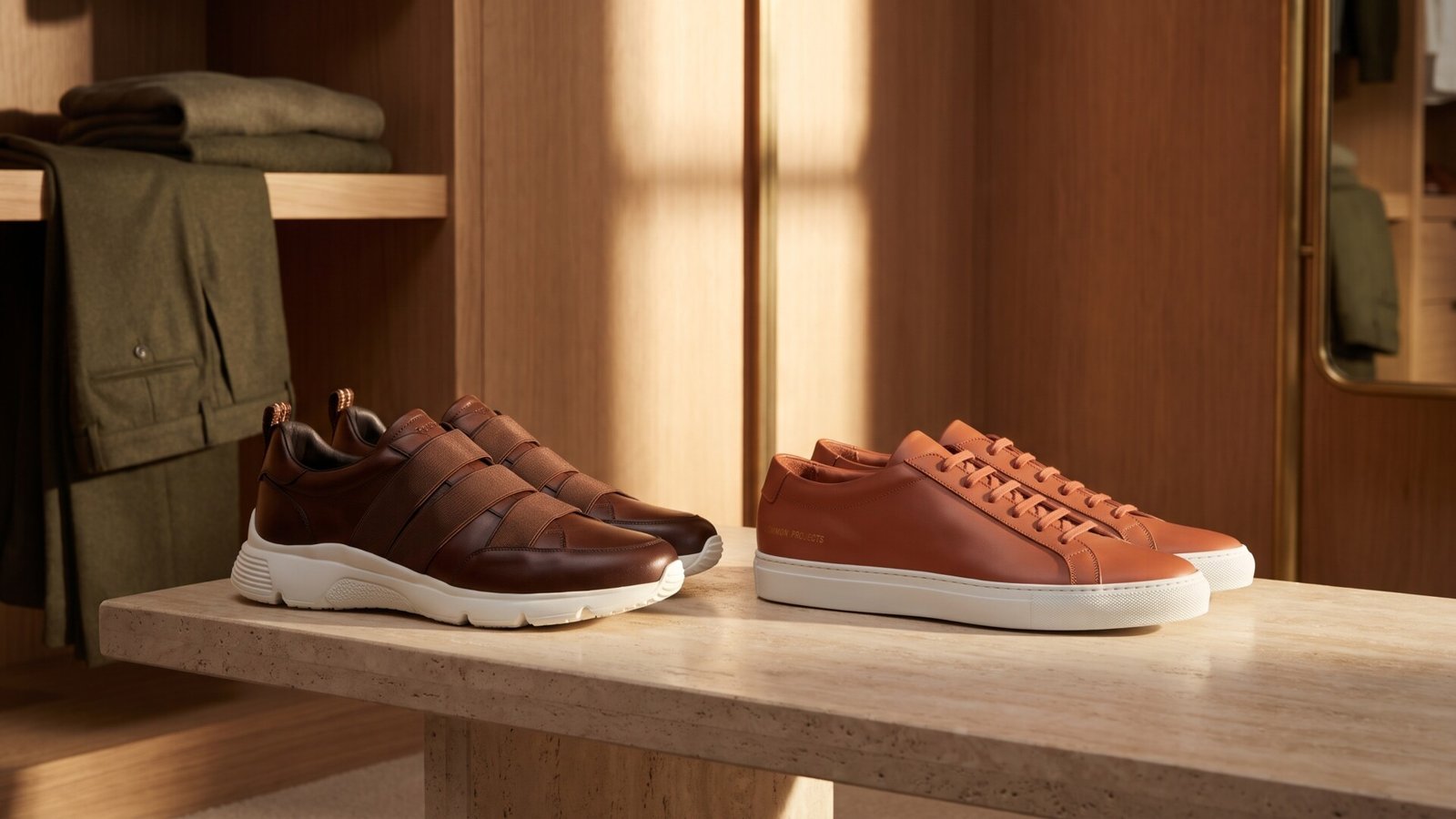
The Triple Stitch is Zegna’s signature casual shoe, and the name tells you the construction. Three elastic bands cross the instep in place of laces, running from the vamp to the collar, and the whole upper is built as a low-top with a cleaner, more streamlined line than a conventional trainer. It sits between a lace-up sneaker and a slip-on, and that middle position is the entire design argument.
You step into it. There is no lacing to adjust, no tongue to keep centered, no eyelets to fray. For a reader who travels, who moves between a car and an office and a dinner, that matters more than it sounds. The shoe goes on in a second and comes off in a second, and at airport security you are not the person crouched on the floor with a double knot.
Its strongest use case is elevated casual dressing: unstructured tailoring, knit jackets, pleated trousers, business-casual offices, and travel outfits that need to look considered at the arrival gate. It is not an athletic shoe and Zegna does not pretend otherwise. Treat it as a polished shoe that happens to have a rubber sole.
Common Projects Achilles Low
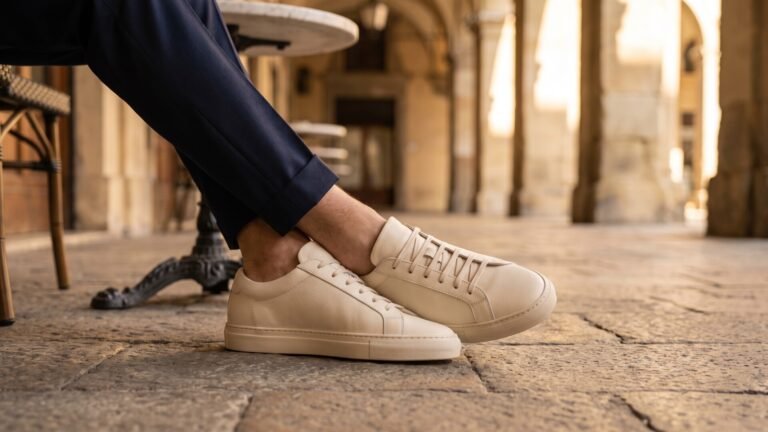
The Achilles Low is the opposite proposition. Clean upper, minimal paneling, a low-profile sole, and almost no branding except a small line of gold-stamped numbers on the heel counter – a serial-style mark that tells you the model and size and nothing else. There is no logo you would recognize from across a room.
That restraint is the point, and it is also the risk. When a shoe has no design detail to distract the eye, everything rests on the leather, the shape, the stitching, and how the toe box creases. A cheap minimal sneaker looks cheap immediately. The Achilles Low has stayed relevant for years because the leather and the proportions hold up to that scrutiny.
It is a lifestyle sneaker, not a walking shoe. The low-profile appearance and the reputation for everyday comfort are real, but they describe polished casual wear, not a twelve-mile day on cobblestones. For readers comparing more models in this space, [Internal: Italian Designer Sneakers: The Complete Guide to Luxury Casual Footwear] lays out the wider field.
Design, Materials, and Craftsmanship: Two Different Kinds of Luxury
Visual identity and branding
Put the two shoes side by side and the buyer psychology splits cleanly. The Triple Stitch announces itself to anyone who knows luxury menswear – the crossing bands are a recognizable signature, and the shoe reads as Zegna from ten feet away. That is a feature if you want your footwear to carry some of the outfit’s authority. It is a liability if you want to disappear into a room.
The Achilles Low rewards the buyer who prefers to be read as someone with good shoes rather than someone with recognizable shoes. The gold serial numbers are the only text on the entire upper, and most people will never notice them.
Visible branding changes long-term wardrobe flexibility. A shoe with a strong signature tends to get associated with a particular era of your wardrobe and a particular moment in fashion. The Triple Stitch’s design language has been stable for years, which helps, but it is still a shoe with a look. The Achilles Low’s anonymity means it does not date in the same way – there is nothing to look back on and wince at. On resale, the Zegna benefits from clear model recognition; the Common Projects benefits from long-standing familiarity. Neither advantage is decisive.
Leather and finishing
Here is where you stop reading and start handling. Both shoes use smooth full-grain leather on the upper – full-grain meaning the outermost layer of the hide, with the natural grain intact, as opposed to corrected-grain leather where the surface has been sanded and stamped to hide flaws. Full-grain takes a polish, creases honestly, and develops a patina. Corrected-grain looks more uniform on day one and worse on day five hundred.
Run your thumb along the inside edge of the collar on either shoe. If it catches, the edge was finished in a hurry – either painted over roughly or left raw. A properly finished edge is folded and burnished, or cleanly painted with the paint following the curve without pooling. Check the stitching along the vamp and the heel: consistent stitch length, no skipped stitches, no wandering line where the machine drifted.
Press the heel counter – the stiffened panel at the back that holds your heel in place. It should resist your thumb firmly and spring back. A soft, spongy heel counter will collapse within a season and let your foot roll inward.
Smooth white leather is the most demanding finish in either range. It looks extraordinary new and shows every scuff, every fold, and every drop of rain. Darker leather, textured finishes, and suede versions are easier to live with but change the character of the shoe entirely – a black Achilles Low is a different proposition from a white one, and a suede Triple Stitch reads more casual than the smooth leather version.
"Made in Italy" is not a complete quality guarantee on either shoe. Material selection, assembly consistency, and aftercare decide far more than the country on the label. Some Italian production is extraordinary and some is competent contract work. Judge the shoe in your hand, not the story on the box. [Internal: The Art of Italian Shoe Making] goes deeper into what the label does and does not tell you.
Sole construction and underfoot character
The Triple Stitch has a more substantial, cushioned sole. You feel it when you put weight down – there is material between you and the pavement, and the shoe has a bit of visual presence to match. That thickness improves day-to-day comfort and gives the shoe a slightly more relaxed, grounded look. It also means the Triple Stitch can feel heavy or clunky under very slim, tapered trousers, where a lower-profile shoe would look cleaner.
The Achilles Low sits flatter and firmer. The sole is thinner, the profile lower, and the shoe reads more elegant with narrow trousers and a trim silhouette. The trade-off is underfoot: less cushioning, more direct contact with the ground, and a firmer feel over a long day.
Neither shoe is a substitute for a technical walking sneaker. Their value is in polished casual wear, and judging them as walking shoes is the wrong test. If that is your priority, [Internal: Top 7 Italian Luxury Sneakers That Are Actually Comfortable] covers the models that genuinely hold up on distance.
Comfort, Fit, and Everyday Wear
Zegna Triple Stitch fit and comfort
The slip-on construction changes how the shoe fits. The elastic bands pull the upper across the instep and hold the foot without laces, and the heel is held by the shape of the counter and the tension of the bands rather than by a tied lace. For average-width feet, this works well. The shoe goes on easily, holds reasonably, and the cushioned sole makes long days more forgiving than a flat sneaker.
Do not assume the elastic solves sizing. Very narrow feet may find the bands do not pull the upper tight enough for a precise hold. Very wide feet may find the bands press across the instep before the shoe has broken in. The convenience of easy entry comes with a tradeoff in heel lockdown: if you prefer the firmly laced feel of a conventional sneaker, the Triple Stitch will feel less precise, especially at speed.
A sizing framework that works: start from your usual luxury sneaker size, then check the current retailer’s size chart rather than a conversion table you found elsewhere. Measure your foot length in the evening, when feet are at their largest. Account for the leather softening with wear, but do not assume dramatic stretch – leather breaks in, it does not resize. If you are between sizes and have a wider foot, take the larger. If you have a narrow foot and the retailer offers half sizes, take the smaller.
Common Projects Achilles Low fit and comfort
The Achilles Low fits close and low. That refinement is the appeal – the shoe hugs the foot and looks sharp – but it is less forgiving if you need generous forefoot volume or significant arch support. The break-in pattern is typical of good smooth leather: initial stiffness in the upper and the sole, then improved flexibility after a week or two of regular wear. What does not reliably disappear is a shoe that is genuinely too small. Buying a painful size on the assumption that it will stretch is the most common expensive mistake in this category.
When you try it, check three things. Heel slippage: your heel should sit locked without lifting as you walk. Toe room: you want a thumb’s width at the front, not a pressed toe. Creasing position: flex the shoe where your foot naturally bends and see where the leather folds – if the crease lands across the toe box rather than behind it, the shoe is too long.
Comfort depends heavily on socks, foot shape, and walking demands. A thin sock and a short commute is a different shoe than a thick sock and a full day on your feet.
Which is better for long days?
For airport travel, office commuting, and a day that moves between settings, the Triple Stitch is the easier shoe. Easy removal, more cushioning, and a slightly more relaxed feel make it the better travel companion. For a close, secure, traditional sneaker fit and a day spent mostly in offices and smart-casual settings rather than on extended pavement walks, the Achilles Low is the better match.
For serious walking, neither is the default answer. If that is your actual need, [Internal: Best Italian Luxury Sneakers for Everyday Walking] is the article to read before you spend.
Side-by-Side Comparison
| Category | Zegna Triple Stitch | Common Projects Achilles Low | Better choice |
|---|---|---|---|
| Design personality | Distinctive, recognizable, relaxed | Minimal, quiet, architectural | Depends on branding preference |
| Entry and convenience | Slip-on feel with elastic bands | Traditional lace-up | Zegna |
| Styling versatility | Strong with tailoring and smart casual | Strong with denim, chinos, minimalist wardrobes | Common Projects for neutrality |
| Comfort character | More cushioned and substantial | Flatter, firmer, more structured | Zegna for comfort-oriented buyers |
| Maintenance | White leather and elastic need care | Smooth leather shows creasing and scuffs | Tie, depending on color |
| Best long-term use | Travel, business casual, elevated casualwear | Everyday minimalist rotation | Depends on wardrobe |
| Value retention | Strong model recognition within Zegna | Long-standing minimalist familiarity | Close; condition matters most |
Prices vary by material, season, retailer, and sale availability, so check the current figure at the point of purchase rather than anchoring to a number you read six months ago. [Affiliate: See the current Zegna Triple Stitch collection] and [Affiliate: Browse the Common Projects Achilles Low range] for live pricing.
What Most Buyers Get Wrong
The first wrong assumption is that the most minimal sneaker is automatically the most versatile. The Achilles Low’s clean shape does work across a wide range of outfits, but its stark, formal visual language can look oddly severe against very relaxed or heavily textured wardrobes – a chunky knit, a washed-out denim, a soft flannel. In those outfits a slightly softer, more designed shoe often looks more natural.
The second is that the Triple Stitch is just a more branded Achilles Low. It is not. The slip-on construction, the elastic detailing, and the more substantial sole create a genuinely different ownership experience – different entry, different fit, different feel underfoot. Comparing them as two versions of the same white sneaker misses the point.
The third is that white leather is always the safe buy. It is the most versatile color and the most demanding finish. Worn several times a week, a white leather sneaker needs cleaning more often than most owners expect, and every crease shows. If you want low maintenance, a darker color in either model may serve you better than the classic white.
The fourth is that "comfortable" means comfortable for everything. A sneaker can be comfortable for a commute and unsuitable for serious walking, wide feet, or anyone who needs structured support. Interpret comfort claims against your own foot and your own week.
The test that cuts through all of it: name three outfits before you buy – one work, one weekend, one travel. The sneaker that works in all three will earn more wear than the one that looks better on the product page.
Styling and Wardrobe Compatibility
With tailoring and business-casual clothing
The Triple Stitch pairs naturally with unstructured suits, knit jackets, pleated trousers, and relaxed tailoring. The shoe has enough visual weight to sit under a fuller trouser, and the elastic detailing reads as deliberate rather than sloppy. It is the easier shoe to wear with tailoring because it looks like it belongs there.
The Achilles Low can work with tailoring when the suit is modern and informal – a soft-shouldered, unstructured jacket, a trim trouser, no tie. With heavily structured or traditionally formal suiting it can look too stark and slightly undersized, like a dress shoe that lost its sole. Trouser proportion decides a lot: a fuller trouser accommodates the Triple Stitch’s volume, while a narrow or tapered trouser emphasizes the Achilles Low’s slim profile. [Internal: How to Style Italian Shoes for Every Occasion] covers the wider principles.
With denim, chinos, and casual separates
The Achilles Low is the obvious match for monochrome denim, chinos, overshirts, fine-gauge knitwear, and restrained capsule wardrobes. It disappears into the outfit in the best way. The Triple Stitch suits denim, drawstring trousers, travel pants, soft tailoring, and outfits that benefit from a visible signature element.
Color changes the decision. White and neutral Achilles versions maximize quiet versatility. Darker Triple Stitch versions reduce cleaning pressure and make a more sophisticated travel shoe – a dark leather Triple Stitch is one of the more practical luxury travel shoes you can pack.
For travel and professional settings
The Triple Stitch is the more convenient travel shoe because of its easy entry, though you should still test heel security before committing to a long trip. The Achilles Low is the more discreet choice in conservative offices or settings where overt designer cues are unwelcome – nobody will clock it, which is sometimes exactly what you want. For a compact travel wardrobe, pack the shoe that works with the most outfits you are bringing, not the one you like most in isolation. [Internal: How to Style Italian Shoes for Fall] has more on building around a single pair.
Durability, Care, and Long-Term Value
What is likely to show wear first?
On the Triple Stitch, watch the area around the elastic bands – dirt collects where the bands meet the upper, and the elastic itself can lose crispness over years of use. Forefoot creasing and edge wear follow. On the Achilles Low, the toe-box creasing, heel wear, and sole flattening show first, and smooth leather exposes scuffs more readily than a textured finish.
Upper longevity is not the same as sole longevity. A pristine upper is useless if the outsole has flattened or worn through. Check the sole as carefully as the leather when you assess a used pair or your own shoe after a year.
Care burden
Rotate either sneaker rather than wearing it every day. Leather and lining need time to recover between wears, and rotation roughly doubles the life of both. Use a soft brush for dust, an appropriate leather cleaner, a clean cloth, and a neutral conditioner where the finish allows it. Use shoe trees cautiously – choose a shape that supports the upper without over-stretching the elastic bands on the Triple Stitch or distorting the low-profile upper on the Achilles Low.
Never use household detergents, excessive water, or aggressive whitening products on leather or elastic. They strip the finish and shorten the shoe’s life. [Internal: How to Care for Italian Leather Shoes] sets out the full routine.
Cost per wear and resale
Build the math honestly. Divide the purchase price by realistic annual wears. A sneaker worn three times a week for three years is a very different cost per wear than one worn twice a month. Compare that figure with the cost of replacing cheaper sneakers more frequently – the luxury shoe often wins on cost per wear, but only if you actually wear it.
Resale depends on condition, size, color, box and dust bags, seasonal relevance, and demand for the specific model. Neither shoe should be bought as an investment. Their real value is long-term wardrobe utility – the ability to stay polished across multiple settings for years. The Triple Stitch benefits from clear model recognition within Zegna; the Achilles Low benefits from long-standing minimalist familiarity. Condition beats brand prestige in both cases.
Which Option Still Makes Sense in Three Years?
Choose the Zegna Triple Stitch if
- You wear relaxed tailoring, business-casual clothing, or premium travel clothes regularly.
- Slip-on convenience and a slightly more cushioned, substantial feel matter more to you than the most discreet design.
- You want one luxury sneaker with a recognizable signature rather than a blank canvas.
- You accept that the elastic bands and white leather will need attentive cleaning.
Choose the Common Projects Achilles Low if
- You want the quietest and most wardrobe-neutral option.
- Your wardrobe is built around denim, chinos, knitwear, monochrome outfits, and minimalist proportions.
- You prefer a traditional lace-up fit and a flatter, cleaner silhouette.
- You are prepared to maintain smooth leather and accept that the shoe is less forgiving on long walking days.
Skip both if
- Your primary need is athletic support, high-mileage walking, running, or technical weather protection.
- You need a very wide toe box or substantial orthotic compatibility.
- You are justifying the purchase mainly by logo recognition rather than a clear place in your wardrobe.
- A lower-cost leather sneaker would give you the same actual wear for your lifestyle.
Buying Verdict
Best overall for a distinctive luxury casual shoe: the Zegna Triple Stitch, especially for business-casual wardrobes, travel, and buyers who value slip-on convenience. [Internal: Zegna Triple Stitch Sneaker Review: Why Every CEO Owns a Pair] goes deeper on the model.
Best overall for minimalist versatility: the Common Projects Achilles Low, especially for buyers who want a quiet sneaker that does not compete with the rest of the outfit.
Best for long walking days: neither by default. Consider a more supportive sneaker category, and read [Internal: Best Italian Luxury Sneakers for Everyday Walking] before deciding.
Best for a compact wardrobe: the Achilles Low if most of your outfits are minimalist; the Triple Stitch if your wardrobe includes relaxed tailoring and elevated travel clothing.
Best first luxury sneaker: the Achilles Low for maximum neutrality; the Triple Stitch for a stronger signature and more obvious differentiation from ordinary white sneakers.
Frequently Asked Questions About Zegna Triple Stitch Vs. Common Projects Achilles Low
Is the Zegna Triple Stitch more comfortable than the Common Projects Achilles Low?
Generally, yes – the Triple Stitch has a more substantial, cushioned feel underfoot. But comfort is fit-dependent. If you prefer a flatter, firmer shoe and your foot shape suits the Achilles Low’s close fit, you may find it the more comfortable of the two. Try both if you can.
Do Zegna Triple Stitch sneakers run true to size?
Sizing can vary by material, model variation, and foot width. Check Zegna’s current size chart and the specific retailer’s guidance rather than relying on a universal conversion. Measure your foot and account for width before ordering.
Do Common Projects Achilles Low sneakers run true to size?
The fit is close and low-profile. Pay attention to toe room, heel security, and width. Do not size down solely to achieve a cleaner silhouette – a too-small shoe creases badly and never becomes comfortable.
Can either sneaker be worn with a suit?
Both work with relaxed, unstructured tailoring. Neither belongs with highly formal suiting. The Achilles Low is quieter; the Triple Stitch is more visibly casual and recognizable.
Which sneaker is better for travel?
The Triple Stitch is more convenient to get on and off, which matters at airports. The Achilles Low is more secure on the foot for long walks. Weigh walking distance, airport convenience, and any office dress code you need to meet.
Are these sneakers worth the price?
Through cost per wear, construction, styling range, and care burden, either can be good value if you wear it regularly. Neither is good value if it sits in the closet. Do the three-outfit test before you buy.
Which one holds value better?
Condition, color, size, completeness, and marketplace demand usually matter more than original retail price. Neither is a guaranteed appreciating asset. Buy for wear, not for resale. The Triple Stitch is the more interesting shoe – more comfortable-feeling, more distinctive, and better suited to a wardrobe that includes tailoring and travel. The Achilles Low is the safer one – quieter, more adaptable, and easier to justify as a single pair. Neither is the wrong answer. The wrong answer is buying the one that photographs better instead of the one that fits the three outfits you actually wear.