Restoring the patina on natural Italian leather bags
For the first two years I owned my natural leather tote, I treated patina like a flaw. Every water spot felt like a personal failure. Every darkening of the leather around the handles looked, to me, like an imperfection I needed to hide. I remember standing in my kitchen, dabbing at a rain mark with a damp cloth, making it worse, then standing back and feeling that specific mix of frustration and regret that only comes from damaging something you love through sheer overcorrection.
Then I learned the truth. That darkening, that deepening of color, that map of tiny scratches and sun-kissed warmth — that was the bag becoming mine. Patina is not the enemy of a natural leather bag. It is the entire point.
But here is the nuance that took me years to understand: there is a massive difference between a beautiful, even patina that speaks to years of love, and a neglected, dry, splotchy surface that speaks to years of neglect. One is a story. The other is a problem. And knowing how to coax the first while fixing the second is the difference between owning an Italian leather bag for five years and owning it for thirty.
This article is about that difference. I am going to walk you through what patina actually is, why it matters so much in the luxury market, and — most importantly — how to restore it when life has been a little harder on your bag than you intended. I will share the exact products I use, the mistakes I have made so you do not have to, and the honest math on whether you should do this yourself or hand it to a professional.
Let me save you the years of trial and error.
Understanding Patina
Let us start with a definition, because the word gets thrown around a lot. Patina, in the context of leather, is the sheen and color change that develops on the surface of the material over time. It is caused by a combination of factors: exposure to light, the natural oils in your hands, friction from daily use, and the slow oxidation of the tanning agents in the leather.
Here is the thing — patina is not a defect. It is a chemical reaction. And it is a reaction that the best Italian tanneries actually design for.
When you buy a bag made from natural, vegetable-tanned leather — the kind of leather that brands like Bottega Veneta, Brunello Cucinelli, and countless small Florentine workshops use — you are buying leather that has been tanned using tree bark and plant extracts rather than harsh chromium salts. This is an ancient process, and it produces a leather that is incredibly responsive to its environment. It soaks up oils. It darkens in the sun. It develops a warm, honeyed glow that no factory finish can replicate.
I learned this the hard way. My first natural leather bag was a beautiful, pale cognac color. I babied it. I kept it in its dust bag. I avoided wearing it in the rain. And for a year, it looked exactly the same as the day I bought it. I was proud of that. Then I met a woman at a dinner party who had the same bag, but ten years older. Hers was a deep, rich amber. It had a glow to it, a depth, a warmth that made mine look flat and lifeless by comparison. She had not babied it. She had worn it. And that wearing had given it something I could not buy.
That is the paradox at the heart of natural leather. The more you use it, the more beautiful it becomes. But that beauty requires maintenance. The oils that create patina also attract dirt. The light that darkens the leather also dries it out. The friction that smooths the surface also creates scratches.
Patina, left completely unchecked, becomes grime. And that is where restoration comes in.
The Importance of Maintaining Patina
Let me tell you why this matters beyond aesthetics. Because it is easy to dismiss leather care as vanity, and it is not. It is preservation.
Natural Italian leather is an investment. A well-made bag from a serious house can cost anywhere from $1,500 to $5,000 or more. And unlike a trendy nylon bag or a printed canvas tote, a natural leather bag is designed to last for decades. It is meant to be repaired, reconditioned, and passed down. But that only happens if the leather is maintained.
Here is the reality: leather is skin. It is an animal product. It has pores, it has fibers, and it needs moisture to stay supple. When leather dries out, it becomes brittle. When it becomes brittle, it cracks. And when it cracks, no amount of conditioning will bring it back. The structural integrity of the bag is compromised. The handles start to fray. The corners start to peel. The bag that was meant to last a lifetime dies an early death.
Patina maintenance is not about vanity. It is about preventing that slow, silent deterioration.
There is also a financial dimension to this that I think is wildly under-discussed. The luxury resale market has exploded in the last decade. Sites like The RealReal, Vestiaire Collective, and Rebag have made it possible to sell your used bags for serious money. But here is the secret that resale platforms do not advertise: the condition of the leather is the single biggest factor in determining resale value. A bag with a beautiful, even patina and supple, healthy leather can sell for 60 to 80 percent of its original retail price. A bag with dry, cracked, splotchy leather sells for 20 to 30 percent.
That is a difference of hundreds, sometimes thousands, of dollars. And it is entirely within your control.
I remember the moment this clicked for me. I had a vintage Gucci Jackie that I had bought secondhand. The leather was dry. The color was uneven. I paid $400 for it because it was in rough shape. I spent an afternoon cleaning, conditioning, and polishing it. Three months later, I sold it for $1,100. The leather was the reason. The patina I restored was the difference between a bargain-bin bag and a collectible.
Restoring Patina: Key Considerations
Before you touch your bag with any product, you need to stop and think. Restoration is not a one-size-fits-all process. What works for a vegetable-tanned tote will not work for a chrome-tanned, painted leather bag. What is safe for a light-colored bag might stain a dark one.
Here are the three factors you need to consider before you start.
The type of leather. Natural, vegetable-tanned leather is the most forgiving. It absorbs oils and conditioners readily, and it responds well to polishing. Chrome-tanned leather, which is more common in mass-produced bags, is more resistant to conditioning and can look blotchy if you over-oil it. If you are not sure what kind of leather your bag is made from, do a simple test: place a drop of water on an inconspicuous area. Vegetable-tanned leather will absorb the water quickly and darken slightly. Chrome-tanned leather will bead up and resist absorption.
The current condition of the bag. Is your bag simply dry and dull, or is it actually damaged? Dryness and dullness are reversible with conditioning. Scratches are partially reversible with polishing and filling. But deep cracks, peeling, or structural damage to the leather require professional intervention. Be honest with yourself about what you are dealing with. Trying to condition a bag that needs structural repair is like putting a bandage on a broken arm.
The desired end result. Do you want to restore the bag to its original color, or do you want to embrace the patina and simply even it out? This is a philosophical question as much as a practical one. Some people want their natural leather bag to look as close to new as possible. Others want to preserve the history and character of the bag while making it look healthy. There is no right answer. But you need to know which one you want before you start, because the products and techniques are different.
I will tell you my bias: I am firmly in the “embrace the patina, even it out” camp. A natural leather bag that looks brand new is a bag that has not been lived in. The beauty of this material is its ability to record your life. I want my bags to look loved, not untouched. But I also want them to look healthy, not neglected.
Steps to Restore Patina on Italian Leather Bags
Alright. You have assessed your bag. You know what kind of leather you are dealing with. You know what result you want. Now let us get to work.
I am going to walk you through the exact process I use, step by step. These are the products I have used for years, and I have included them because they work. I am not going to tell you to buy a dozen different bottles. You need four things: a cleaner, a conditioner, a polish or dye (depending on your needs), and a protector.
Cleaning the Leather
The first step is non-negotiable. You cannot condition leather that is dirty. The dirt will trap the conditioner on the surface, creating a sticky, grimy film that attracts even more dirt. It is a vicious cycle.
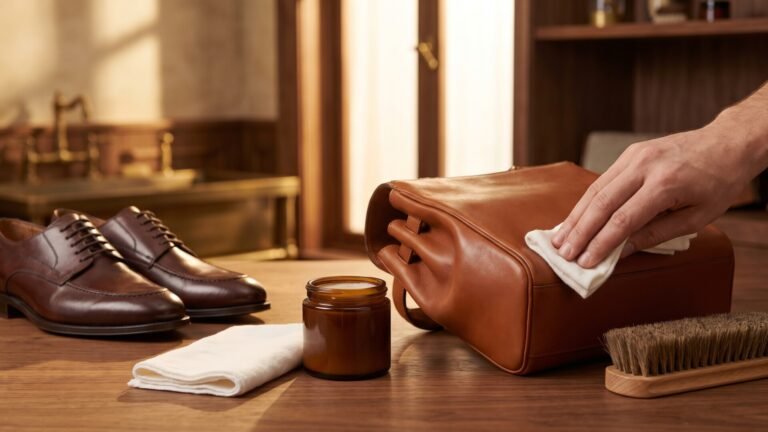
Start by wiping the bag down with a soft, dry cloth to remove surface dust. Then, use a dedicated leather cleaner. I have been using [Affiliate: Saphir Leather Cleaner] for years. It is a gentle, pH-balanced cleaner that lifts dirt and grime without stripping the natural oils from the leather. It is also safe for use on natural, vegetable-tanned leather, which is not true of all cleaners.
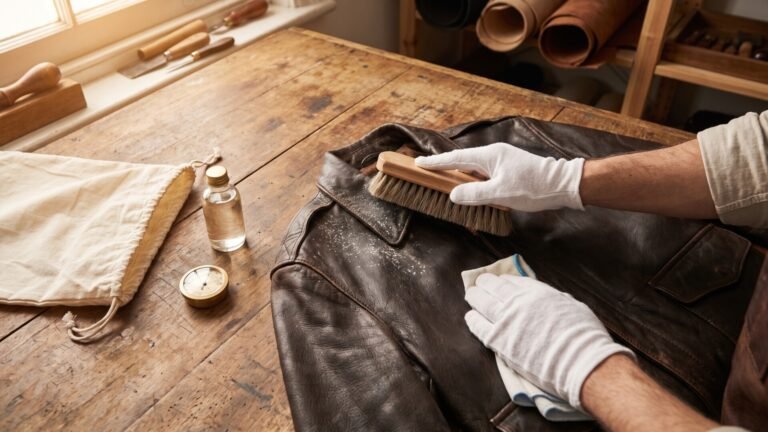
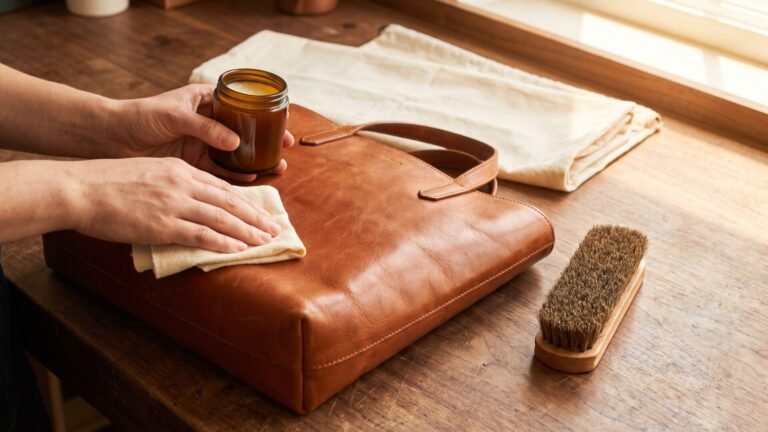
Apply a small amount of the cleaner to a soft, damp cloth. Work it into the leather in small, circular motions. Pay extra attention to the areas that get the most contact: the handles, the corners, the flap. These are the areas where dirt and body oils accumulate. Wipe the cleaner off with a clean, dry cloth. Then let the bag air dry completely. This can take a few hours, so do not rush it.
Here is a mistake I made the first time: I used too much cleaner and too much water. The leather soaked up the moisture, and the bag darkened significantly. When it dried, the color was uneven. I had to wait a week for the leather to fully dry and the color to settle before I could proceed. Learn from me. Use a small amount of cleaner. Wring out your cloth thoroughly. Less is more.
Conditioning the Leather
Once the bag is completely dry, it is time to condition. This is the step that actually restores the health of the leather and encourages an even patina.
Conditioning replaces the natural oils that have been depleted by time, sun, and use. It softens the leather, restores its flexibility, and gives it that supple, luxurious feel that made you fall in love with it in the first place.
I use [Affiliate: Leather Honey Leather Conditioner]. It is a deeply penetrating conditioner that is made from natural ingredients, and it does not contain any harsh chemicals or silicones. It is also incredibly concentrated, so a little goes a long way.
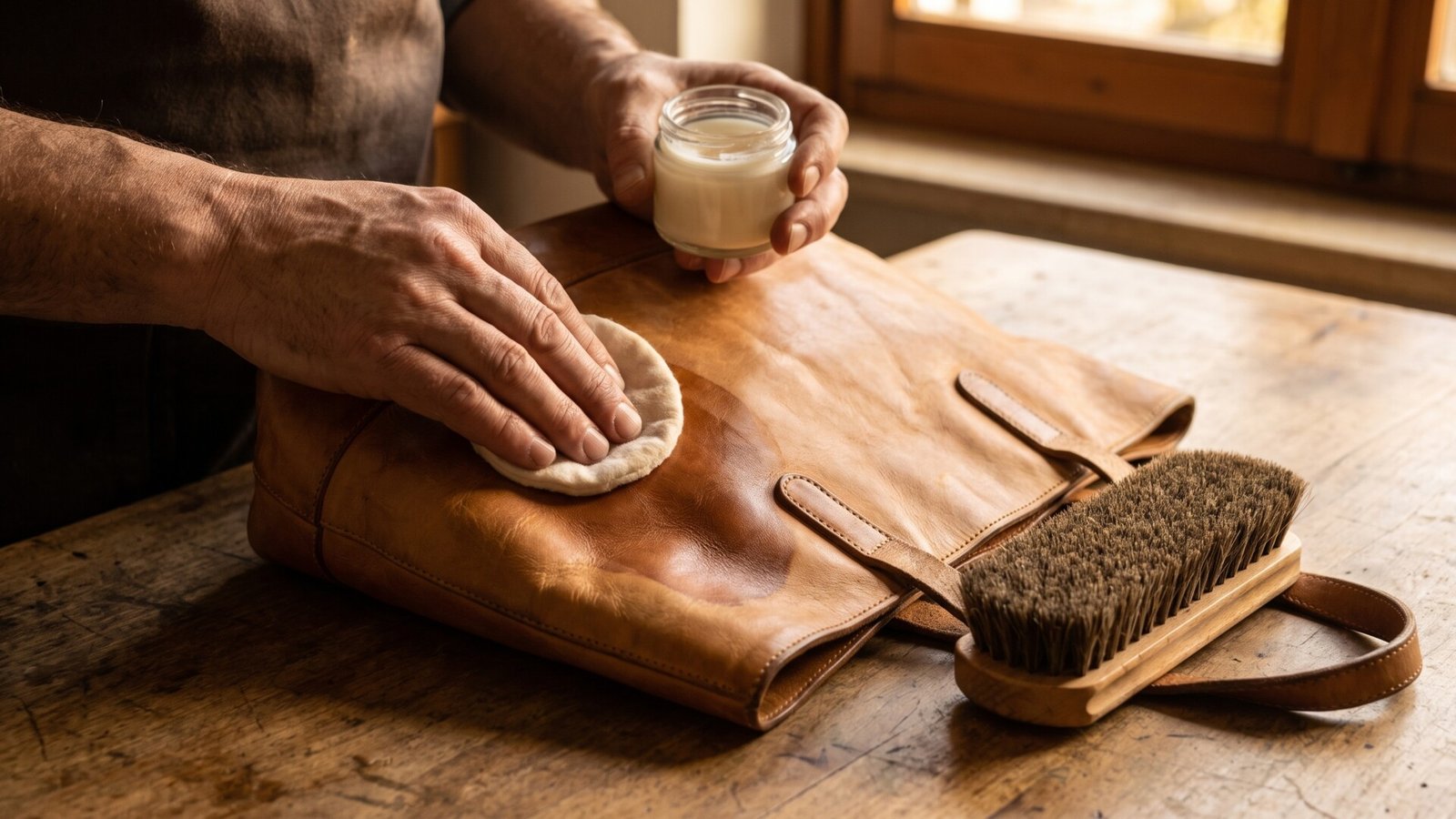
Apply the conditioner with a soft, lint-free cloth. Work it into the leather in gentle, circular motions. Do not saturate the leather. You want to apply a thin, even layer. Then let the conditioner absorb for at least 30 minutes. If the leather still feels dry, apply a second thin layer.
Here is the key: do not over-condition. I learned this the hard way with a vintage bag that I loved too aggressively. I applied three layers of conditioner in a single afternoon, and the leather became greasy and dark. It looked like I had spilled oil on it. It took weeks for the excess conditioner to fully absorb, and even then, the bag was darker than it had been before.
The rule of thumb is simple: condition your bag when it feels dry, not on a schedule. If the leather feels supple and looks healthy, leave it alone.
Applying Color or Polish if Necessary
This is the step that separates a simple maintenance routine from a true restoration.
If your bag has scratches, scuffs, or areas where the color has faded, you may need to apply a color restorer or a polish. This is where you need to be careful. Matching the color of natural leather is an art, not a science. The patina on your bag is unique. It has been created by years of sun, oil, and use. No dye will match it perfectly.
For minor scratches and scuffs, I use [Affiliate: Saphir Renovateur]. This is a combination cleaner, conditioner, and polish that is specifically designed for fine leathers. It contains a small amount of pigment that helps to mask minor imperfections and even out the color. It will not dramatically change the color of your bag, but it will help to blend scratches and give the leather a beautiful, subtle sheen.
For more significant color loss, you may need to use a leather dye. [Affiliate: Fiebing’s Leather Dye] is the industry standard. It is a professional-grade dye that is available in a wide range of colors. However, I want to be very clear: dyeing leather is risky. It is very difficult to get an even result, and if you make a mistake, it is nearly impossible to undo.
If you have a bag with significant color loss, I would strongly recommend taking it to a professional. The cost of a professional color restoration is usually between $100 and $300, depending on the size of the bag and the complexity of the job. That is a small price to pay compared to the cost of ruining a $2,000 bag with a botched DIY dye job.
If you do decide to dye the leather yourself, test the dye on a small, inconspicuous area first. Apply it with a small brush or a sponge, and work in thin, even layers. Let each layer dry completely before applying the next. And remember: it is much easier to add color than to remove it. Start light and build up.
Protecting the Leather Post-Restoration
You have cleaned, conditioned, and polished your bag. It looks beautiful. Now you need to protect that work.
The final step is to apply a leather protector. This creates a barrier on the surface of the leather that repels water and stains. I use [Affiliate: Apple Brand Garde Rain & Stain Repellent]. It is a spray-on protector that is safe for all types of leather, and it does not alter the color or feel of the leather.
Spray the protector evenly over the entire surface of the bag, holding the can about six inches away. Let it dry completely before using the bag. You should reapply the protector every few months, or after any time the bag gets significantly wet.
Here is a word of caution: a protector is not a force field. It will repel light rain and minor spills, but it will not protect your bag from being submerged in water. It will not prevent scratches. It will not stop the patina from developing. And that is a good thing. You want the patina to develop. You just want to protect the leather from the kind of damage that will shorten its life.
Maintenance Tips for Natural Italian Leather Bags
Restoration is not a one-time event. It is part of an ongoing relationship with your bag. And the better you maintain your bag between restorations, the less often you will need to restore it.
Here are the practices that have kept my bags looking beautiful for years.
Establish a regular cleaning and conditioning routine. I clean and condition my natural leather bags every three to four months, depending on how often I use them. If I have been carrying a bag daily, I might condition it every six weeks. If I only use it occasionally, I might go six months. The key is to pay attention to how the leather feels. When it starts to feel dry or look dull, it is time to condition.
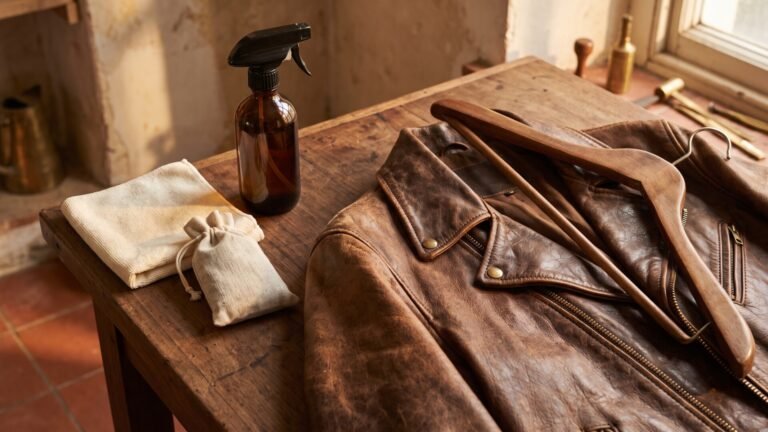
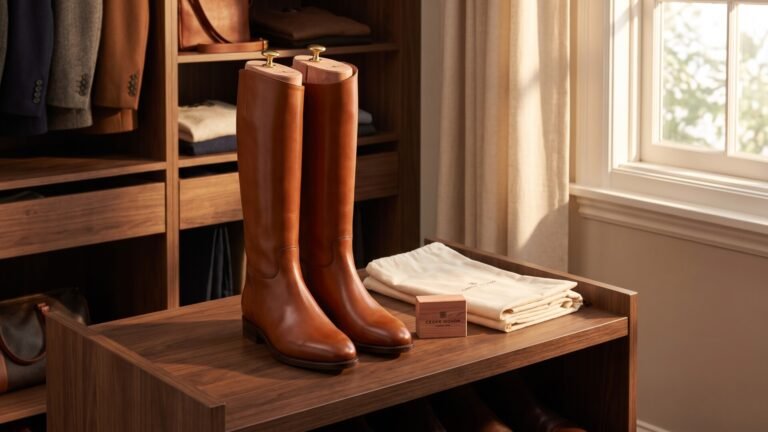
Store your bags properly. This is one of the most overlooked aspects of leather care. When you are not using your bag, store it in its dust bag, stuffed with tissue paper to help it hold its shape. Do not store it in a plastic bag, which can trap moisture and cause mold. Do not hang it by its handles, which can stretch the leather. And do not store it in direct sunlight, which will dry out the leather and cause the color to fade unevenly.
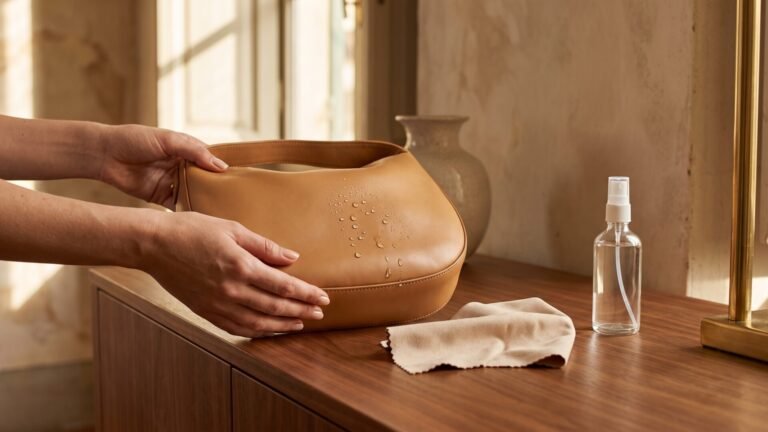
Avoid environmental damage. Water is the enemy of natural leather. It causes water spots that are very difficult to remove, and it can stain the leather permanently. If your bag does get wet, blot it dry immediately with a soft cloth. Do not rub, which will spread the water and damage the fibers. Let it air dry naturally, away from heat sources.
Direct sunlight is also a problem. It will dry out the leather and cause the color to fade. I learned this the hard way with a beautiful cognac bag that I left on a windowsill for a weekend. The side facing the sun faded noticeably, and the color never fully evened out.
Cost of Restoration
Let us talk about money, because that is the heart of this article. How much does it actually cost to restore the patina on a natural Italian leather bag?
The answer depends on whether you do it yourself or hire a professional.
DIY restoration. If you are starting from scratch, you will need to buy the products. Here is a rough breakdown of the costs:
- Leather cleaner: $15 to $30
- Leather conditioner: $20 to $40
- Leather polish or renovateur: $20 to $50
- Leather dye (if needed): $15 to $30
- Leather protector: $15 to $25
So, a full DIY restoration kit will cost you between $85 and $175. And here is the good news: these products last a long time. A bottle of conditioner will last for years, even if you are conditioning multiple bags. The ongoing cost of maintenance is very low.
Professional restoration. If you take your bag to a professional, the cost is significantly higher. A basic cleaning and conditioning will run you between $75 and $150. A full color restoration, including dyeing, will cost between $150 and $400. If your bag needs structural repairs, such as new handles or a new lining, you can easily spend $500 or more.
Here is the math that matters: a professional restoration costs roughly 10 to 20 percent of the value of a high-end Italian leather bag. That is a significant investment. But it is also significantly less than the cost of replacing the bag.
Let me give you a concrete example. I have a Bottega Veneta tote that I bought for $2,800. After five years of heavy use, the leather was dry, the corners were scuffed, and the color had faded unevenly. A professional restoration would have cost me about $400. A new Bottega Veneta tote costs over $3,000. The restoration was clearly the smarter financial choice.
But here is the thing I want you to understand: the real value of DIY restoration is not the money you save. It is the relationship you build with your bag. When you spend an afternoon cleaning, conditioning, and polishing your bag, you learn its quirks. You notice the small scratches and the areas where the leather is starting to dry. You catch problems early, before they become expensive repairs. You become a better owner.
Common Mistakes to Avoid
I have made almost every mistake in the book when it comes to leather care. Let me save you the trouble.
Testing products on a small area first. This is the most important rule, and it is the one I violated the most in my early years. I once applied a dark polish to a light-colored bag without testing it first. The polish stained the leather, and I spent weeks trying to remove it. I eventually had to take the bag to a professional, who charged me $150 to fix my mistake. Test every product on an inconspicuous area — the bottom of the bag, the inside of a flap — before you apply it to the visible surfaces.
Over-conditioning. More is not better. Over-conditioning leads to greasy, sticky leather that attracts dirt. It can also darken the leather unevenly. Apply conditioners in thin layers, and let each layer absorb before applying more.
Using improper products. Do not use shoe polish on a handbag. Do not use furniture polish. Do not use saddle soap unless you know what you are doing. These products are formulated for different materials and different conditions. They can strip the natural oils from your leather or leave a residue that is difficult to remove.
Rubbing at stains. When your bag gets a water spot or a stain, your instinct will be to rub it. Resist that instinct. Rubbing will spread the stain and damage the leather fibers. Blot the stain gently with a clean, dry cloth. If the stain does not lift, take the bag to a professional.
Ignoring the problem. The worst mistake is doing nothing. Dry leather cracks. Cracks become permanent damage. A bag that is maintained can last for decades. A bag that is ignored will be lucky to last five years.
Conclusion
I started this article with a confession about my early fear of patina. I will end it with a different confession. The bag that taught me to love patina — the one that belonged to the woman at the dinner party — is now mine. She sold it to me a few years later, when she decided she wanted a different style. It is a decade old now. The leather is a deep, rich amber. The corners are scuffed. The handles have a warm, honeyed glow that comes only from years of being held.
I have restored that bag twice in the years I have owned it. Not because it needed it, but because I wanted to honor it. I clean it, I condition it, I polish it. And every time I do, I think about the woman who carried it before me, and the life it lived before it came into mine.
That is the secret at the heart of patina. It is not just a chemical reaction. It is a record. It is the memory of every coffee you carried, every trip you took, every rainy day you walked through. It is the proof that your bag has lived a life. And when you restore it, you are not erasing that history. You are preserving it.
The bag you carry in your heart — that is the one that matters. The one on your arm should be treated just as well.
If you are ready to give your bag the care it deserves, [Affiliate: shop our full line of leather care products here]. And if you want to learn more about choosing, caring for, and investing in luxury Italian leather, [Internal: explore our complete guide to Italian leather bags].
Frequently Asked Questions About Restoring The Patina On Italian Leather Bags
What is patina, and why is it important?
Patina is the sheen and color change that develops on the surface of natural leather over time. It is caused by exposure to light, the natural oils in your hands, and the slow oxidation of the tanning agents. Patina is valued because it gives each bag a unique character and depth that cannot be replicated by any factory finish. A beautiful patina is a sign of a well-loved, well-maintained bag.
How often should I restore the patina on my leather bag?
It depends on how often you use the bag and the conditions it is exposed to. As a general rule, you should clean and condition your bag every three to six months. If you use the bag daily, you may need to condition it more often. The key is to pay attention to the leather. When it starts to feel dry or look dull, it is time for a conditioning treatment.
Can I restore patina myself, or should I hire a professional?
DIY restoration is absolutely possible for basic cleaning, conditioning, and polishing. These are routine maintenance tasks that any careful owner can perform. However, if your bag has significant color loss, deep scratches, or structural damage, you should hire a professional. Dyeing leather is an art, and a botched DIY dye job can ruin a bag.
What products should I avoid when restoring leather?
Avoid harsh chemicals, including bleach, ammonia, and alcohol-based cleaners. Avoid products that are not specifically formulated for leather, such as shoe polish, furniture polish, and saddle soap. These products can strip the natural oils from the leather or leave a damaging residue.
How do I know if my leather bag needs restoration?
Look for signs of dryness, dullness, and discoloration. If the leather feels rough or brittle to the touch, it needs conditioning. If the color looks uneven or faded, it may need polishing or dyeing. If you see visible scratches or scuffs, they can often be minimized with a renovateur.
Will restoring my bag increase its resale value?
Yes. A well-maintained bag with a healthy patina will retain significantly more of its value than a neglected bag. In the luxury resale market, the condition of the leather is the single most important factor in determining price. A bag with supple, healthy leather and an even patina can sell for 60 to 80 percent of its original retail price. A dry, cracked, splotchy bag will sell for a fraction of that.