Zegna vs. Tod’s: Which Luxury Casual Shoes Should You Buy?
Most of what gets written about these two brands is wrong, and it is wrong in the same direction. Zegna and Tod’s get filed under the same vague heading – Italian luxury casual shoes – and then compared as if one were simply a better version of the other. They are not competing for the same slot in your wardrobe. Zegna builds a refined sneaker for people who spend their week between offices, airports and dinners where the dress code is "smart but do not make me think about it." Tod’s builds a driving shoe, and a very good one, for people whose weekends involve a car, a linen shirt and nowhere urgent to be. Buy the wrong one and you will spend real money on a shoe that sits in the box. Buy the right one and you will wear it three days a week for years.
What Separates Zegna and Tod’s in Practice
Walk into a Zegna store and the shoes are displayed the way the tailoring is displayed: low, quiet, spaced out, nothing shouting. Walk into a Tod’s store and the leather is doing the talking – soft, matte, slightly rumpled in a way that is deliberate.
That difference in presentation is the whole story.
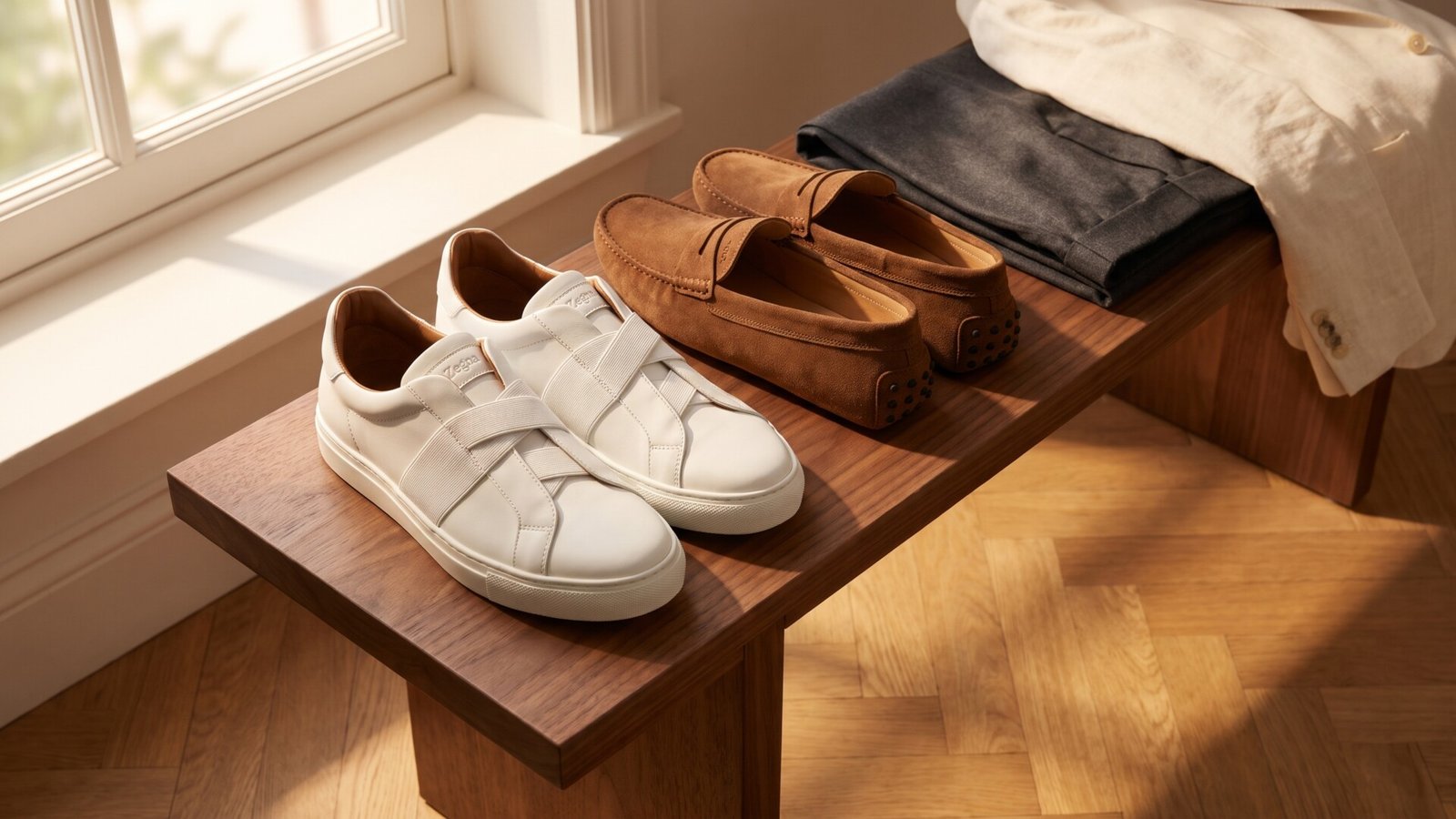
Zegna is a menswear house first. Its shoe line exists to serve the clothes: unstructured blazers, wool trousers, knit polos, the kind of wardrobe that costs a fortune and looks like it cost nothing. The shoes follow that brief. Low-profile silhouettes, tonal finishes, logos reduced to a small tab or a stitched detail. The Triple Stitch is the clearest expression of it – three elastic bands crossing the upper, no visible branding at all from two metres away.
Tod’s comes at it from the opposite end. The house built its reputation on the Gommino, the driving shoe with the pebble sole – a rubber outsole studded with 133 small raised bumps, originally there to grip a pedal. That sole is still the signature. Tod’s leather is chosen and finished to feel soft from the first wear, and the shoes are built to be slipped on and off, worn with the heel folded down if you are that sort of person, and generally treated as a piece of clothing rather than a piece of equipment.
So the comparison framework is this. Zegna wins on polished versatility and contemporary styling. Tod’s wins on relaxed character and heritage. Neither is a quality verdict. They are answers to different questions.
One thing to get straight before we go further: putting a Zegna Triple Stitch next to a Tod’s Gommino is useful for deciding what your wardrobe needs. It is not a like-for-like technical comparison. One is a sneaker with a closed, structured upper and a rubber cup sole. The other is a soft slip-on with a pebble outsole and almost no structure at all. Judging them against each other on durability or support is like judging a blazer against a cardigan.
Zegna vs. Tod’s Shoes: Design, Materials, and Construction
Zegna’s design and construction priorities
Pick up a Triple Stitch and the first thing you notice is how little there is to notice. The upper is usually a single clean expanse of leather or suede, the toe is rounded but not bulbous, and the sole is a slim rubber unit that sits close to the ground. The proportions are deliberately restrained – this is a shoe designed to disappear under a trouser hem.
The construction is sneaker construction, done well. The upper is stitched to the sole unit rather than cemented and left, the lining is usually a soft leather or textile, and the insole is cushioned in a way that a dress shoe never is. That is what makes the shoe work with tailoring: it has the visual language of a low sneaker but the finish of something made by a house that also sells $4,000 suits.
Materials vary by model and season. Smooth calfskin, suede, and technical fabrics all appear. The buyer implication is straightforward. Smooth leather in a light colour will crease at the vamp and show every mark. That is not a defect; it is what smooth leather does. If you want a shoe that looks new for three years with minimal attention, choose a darker tone or a suede with some nap, which hides scuffs far better than a polished finish.
The other thing to understand about Zegna sneakers is that the flexible rubber sole is a genuine advantage for city wear. It absorbs pavement, it does not need a cobbler to add a protective sole, and it does not care about rain the way a leather sole does. The trade-off is that a rubber cup sole bonded to a leather upper will eventually separate at the flex point if the shoe is worn hard and never rested. Rotate it and it will not.
For a full breakdown of the model itself, [Internal: See our Zegna Triple Stitch Sneaker Review: Why Every CEO Owns a Pair]. And if you are weighing it against the other minimalist sneaker that everyone mentions in the same breath, that comparison is coming – [Internal: Zegna Triple Stitch vs. Common Projects Achilles Low].
Tod’s design and construction priorities
The Gommino is a leather-first object. The upper is cut from soft calfskin, often unlined or lightly lined, and the whole shoe is built to bend. Hold one and you can fold the toe section almost in half with two fingers. That flexibility is the point.
The pebble outsole – the gommini (little rubber nubs) that give the shoe its name – is a design decision with real handling consequences. The raised bumps grip a pedal well and give a distinctive feel underfoot. On wet marble, polished concrete or a gravel path, they are considerably less impressive. The pebbles are also the part that wears first: the ones under the ball of the foot and the heel flatten and abrade with regular walking on hard surfaces. That is normal, and it is why a driving shoe should not be your walking shoe.
Tod’s also makes proper loafers – the Gommino loafer, the City Gommino, and a range of softer slip-ons – and these are a different proposition from the pure driving shoe. The City Gommino adds a slightly more substantial sole and a bit more structure, which makes it more usable on pavement. If you are drawn to Tod’s but your days involve city streets rather than a steering wheel, that is the model to look at.
The distinction matters more than most buyers realise. For the background, [Internal: Why is Tod’s Gommino So Popular?] covers how the shoe became a staple, and [Internal: Tod’s Gommino vs Driving Shoe difference explained] lays out exactly where the line falls between the two categories. If you are trying to work out which Tod’s model suits you, [Internal: Tod’s Gommino vs. City Gommino: What’s the Difference?] is the one to read next.
The construction trade-off buyers often miss
Here is the thing that gets lost in the marketing. Softness and flexibility improve immediate comfort and reduce support. A Tod’s Gommino feels wonderful the moment you put it on because there is almost nothing between your foot and the ground and the leather gives instantly. That same quality means less stability over a long day, less protection from stones and uneven ground, and faster wear at the points where the soft leather flexes.
Zegna’s sneaker construction goes the other way. More structure, more cushioning, a sole that distributes pressure. Less of that immediate "oh, that is lovely" sensation, more of a shoe that still feels fine at hour nine.
Neither is better. But price does not tell you which will last longer, and it is worth saying plainly: a $700 driving shoe worn daily on pavement will wear out faster than a $500 sneaker worn in rotation. Leather quality, care, sole exposure and how often you actually wear the thing matter more than the label on the insole.
Comfort and Fit: Which Brand Works for Your Feet?
Neither brand should be bought by label. Fit varies by model, by last – the wooden or plastic form the shoe is built around, which determines its internal shape – by upper material, by toe shape, and by whether the style is lined or unlined.
What you can generalise is the comfort profile. Zegna sneakers feel familiar. If you have worn any well-made low sneaker, you know roughly what you are getting: a slightly roomier toe box than a dress shoe, a cushioned footbed, a heel that holds. Tod’s feels close and soft, almost like a slipper with a sole, and the slip-on models demand a genuinely good fit because there is no lacing to adjust.
The hand test, then. When you try either on:
- Heel security. Walk five steps. If your heel lifts more than a few millimetres, the shoe is too long or too wide at the back, and no amount of breaking in will fix it.
- Toe room. You want roughly a thumb’s width between your longest toe and the end of the shoe. Less and you will lose a toenail on a warm day.
- Instep pressure. Press down across the top of your foot. If you feel pressure from the upper, the last is wrong for your foot shape. Soft Tod’s leather will stretch a little; it will not stretch enough.
- Forefoot flex. Bend the shoe where your foot bends. It should flex there and nowhere else. A shoe that flexes in the middle of the arch will tire your foot.
- The four-hour question. Try them late in the day, when your feet are at their largest, and keep them on for at least twenty minutes in the shop. A shoe that is comfortable for ninety seconds tells you nothing.
A buyer decision framework, then:
- Choose Zegna if the priority is a sneaker-like feel, modern proportions, and regular city wear.
- Choose Tod’s if the priority is soft leather, easy slip-on wear, driving, and relaxed outfits.
- Choose neither as your first pick for extensive walking unless the specific model offers enough support and you have verified the fit properly.
For the wider question of sizing across Italian makers, [Internal: How Should Italian Designer Shoes Fit?] goes into it properly, and [Internal: Top 7 Italian Luxury Sneakers That Are Actually Comfortable] is worth reading if comfort is your deciding factor.
Everyday Versatility and Styling
Where Zegna fits best
The Triple Stitch earns its reputation because it works with almost everything a modern wardrobe contains. Wool trousers and an unstructured blazer. Dark denim and a knit polo. Chinos and a cashmere crewneck. It is the shoe you pack for a trip when you can only take one pair and you do not know what the evenings will require.
Colour is where buyers get this wrong. Tonal white, grey, black, brown and neutral colourways have far better long-term wardrobe value than seasonal colours or high-contrast details. A white sneaker with a contrasting heel tab looks great for one season and then dates. A plain off-white or a dark brown suede works for a decade. If you are spending this much on a sneaker, buy the boring colour.
The other Zegna advantage is the bridge it builds between tailoring and casual clothing. A Triple Stitch under a soft-shouldered jacket reads as deliberate. The same shoe under a hard-structured business suit reads as a mistake. Know which side of that line your wardrobe sits on.
Where Tod’s fits best
Tod’s looks most convincing when the outfit is intentionally relaxed. Linen trousers, chinos, denim, summer tailoring, knitwear, resort clothing. A Gommino with a crisp business suit is a mismatch; a Gommino with a rumpled linen shirt and no socks is exactly right.
The distinction between a Tod’s driving shoe, a Tod’s loafer and a structured dress shoe is one buyers blur at their cost. A driving shoe is casual construction – soft, flexible, minimal support. It is not a substitute for a formal loafer, and it will look underdressed in any setting that expects a leather sole and a bit of structure. The Gommino loafer sits a step up from the pure driving shoe; the City Gommino a step up again.
If your priority is loafers rather than sneakers, [Internal: Italian Loafers: The Complete Guide to Timeless Luxury Footwear] is the place to start, and [Internal: How to Style Italian Shoes for Every Occasion] covers the styling question across both categories.
Styling verdict
Zegna is usually the more versatile choice for a contemporary capsule wardrobe. Tod’s is more distinctive for a soft, leisurely Italian wardrobe. If you own one pair of luxury casual shoes and need it to cover the most ground, Zegna. If you own a wardrobe of linen and chinos and want the shoe that completes it, Tod’s. For readers building a business-casual rotation, [Internal: Best Italian Designer Shoes for Business Casual Outfits] takes this further.
What Most Buyers Get Wrong About Luxury Casual Shoes
The most recognisable model is not automatically the best all-purpose purchase. This is the single most expensive mistake in the category.
A Gommino is iconic. It is also not the right shoe for a long urban walk, a rainy commute or a formal meeting. A Triple Stitch is versatile. It is also not the right shoe for black-tie, and it is not the right shoe for a job site. Buyers who choose the famous model first and work out their actual needs second end up buying a second pair to cover the gap – which quietly doubles the cost and halves the value of the first purchase.
The second mistake is treating "made in Italy" as a complete quality assurance. It is not. Italy has extraordinary workshops and ordinary ones, and the label tells you where a shoe was assembled, not how well. What you actually assess is finishing, construction, sole design, material behaviour and fit. Run your thumb along the inside edge of the upper where it meets the lining – if it catches, it was finished in a hurry. Turn the shoe over and look at how the sole is attached. Look at whether the stitching is even and whether the thread sits flush or floats.
The third mistake is judging quality from softness alone. Very soft leather feels luxurious immediately. It also creases, stretches and scuffs sooner if worn heavily without rotation. A slightly firmer calfskin that breaks in over a month will often look better at year three than a buttery-soft one that was comfortable from day one.
And the fourth, the one that costs the most: buying the wrong category and then needing a second shoe for long walking, wet weather, formal meetings or structured outfits. That is not a quality failure. It is a planning failure. The best purchase is often the less iconic model that fills a genuine gap in your wardrobe, not the model most associated with the brand.
Comparison Table: Zegna vs. Tod’s Shoes
| Factor | Zegna | Tod’s | Best for |
|---|---|---|---|
| Core identity | Modern luxury sneakers and refined casual footwear | Driving shoes, Gommino styles, relaxed loafers | Depends on category |
| Signature option | Triple Stitch | Gommino or City Gommino | Zegna for sneaker wardrobes; Tod’s for heritage casual |
| Overall aesthetic | Minimal, streamlined, contemporary | Soft, relaxed, visibly Italian | Personal style |
| Comfort profile | Familiar sneaker-like feel in most casual models | Flexible, close-fitting, soft leather | Zegna for city wear; Tod’s for driving |
| Styling range | Strong with tailoring, trousers, denim, travel clothing | Strong with chinos, linen, denim, resort wear | Zegna for broader versatility |
| Formality | Refined casual; some models bridge business casual | Casual to smart casual; not for formal settings | Zegna |
| Durability focus | Upper finish, sole wear, sneaker construction | Pebble sole abrasion, leather stretch, wet weather | Model-specific |
| Long-term value | Strong if it fills a regular sneaker role | Strong if you regularly wear driving shoes or soft loafers | Usage-dependent |
| Best buyer | Wants one discreet luxury casual shoe for varied outfits | Values heritage, soft leather, relaxed styling | Different buyers |
| Main limitation | Can feel expensive for a sneaker used only occasionally | Gommino styles unsuitable for heavy walking or formal use | Depends on lifestyle |
Ownership Value: Cost per Wear, Durability, and Resale
Sticker price is the least useful number in this decision. Cost per wear is the one that matters, and it is simple arithmetic: divide what you paid by the number of times you will realistically wear the shoe.
A Zegna sneaker at the upper end of the range, worn twice a week for four years, works out to a few dollars a wear. The same shoe bought and worn six times a year is an expensive ornament. A Tod’s Gommino worn every weekend through spring and summer, and stored through the wet months, does the same arithmetic in its favour. The question is never "which is worth more" in the abstract. It is "which will I actually wear."
What goes first, in practice:
- Zegna: creasing at the vamp, dirt and scuffing on light smooth leather, wear at the heel and outsole edge, and eventual separation at the flex point if the shoe is worn daily without rest.
- Tod’s: abrasion on the pebble sole, stretching and heel slippage in the soft leather, scuffing on the toe, and a general loss of sharpness if worn in rain or on rough ground.
Care is not optional at this price. Cedar shoe trees – the wooden forms that hold the shoe’s shape and draw out moisture – matter for both. Keep the leather clean and conditioned, let shoes rest a full day between wears, and do not treat a driving shoe as an all-weather walking shoe. [Internal: How to Care for Italian Leather Shoes] covers the routine properly, and a decent conditioner and a pair of trees cost very little against the price of the shoes.
Resale deserves an honest word. Iconic models in neutral colourways with the box and dust bags do better than seasonal colours or heavily worn pairs. But resale depends on condition, size, timing and demand, and neither brand should be bought as a financial instrument. Buy them to wear. If you want the broader argument on value, [Internal: Are Luxury Italian Shoes Worth the Money?] and [Internal: The Art of Italian Shoe Making] both go deeper into what you are actually paying for.
Which Brand Still Makes Sense in Three Years?
Style longevity is where these two brands diverge most.
Zegna’s minimalist sneakers are built to stay useful. A plain leather or suede low-top in a restrained colour has looked reasonable for a decade and will look reasonable in another. The silhouette does not depend on a trend; it depends on proportion, and proportion is the slowest thing in fashion to change.
Tod’s Gommino and classic loafers have heritage recognition on their side, which is a real asset. But they are tied more closely to a relaxed, preppy, resort-oriented wardrobe. If that is your life, they will never look wrong. If your wardrobe is sharper and more urban, they may sit unworn for months at a time.
Choosing for longevity comes down to four things: neutral shades, serviceable components where available, restrained branding, and a silhouette that already resembles what you own. If you have to build an outfit around the shoe, it is the wrong shoe.
Three buyer scenarios, then:
- The frequent traveller who wants one polished casual shoe that covers airports, meetings and dinners: lean Zegna.
- The driver or resort dresser who lives in loafers and soft leather: lean Tod’s.
- The buyer building a broad Italian shoe wardrobe: buy Zegna for sneakers and Tod’s for driving shoes or loafers, rather than forcing one brand to cover every role.
The long-term verdict is clear enough. Zegna is the safer single-purchase choice for most buyers seeking a versatile luxury casual shoe. Tod’s is the more rewarding specialist purchase for the right lifestyle.
Buying Verdict: Which Luxury Casual Shoes Should You Buy?
Buy Zegna if:
- You want a refined sneaker that works with trousers, tailoring, denim and travel clothing.
- You prefer discreet branding and contemporary proportions.
- You need more urban versatility than a traditional driving shoe provides.
- You are willing to maintain light-coloured or smooth leather uppers carefully.
Buy Tod’s if:
- You specifically want a Gommino, City Gommino or relaxed luxury loafer.
- You value soft leather, flexibility and Italian heritage over sneaker-style support.
- Your wardrobe includes linen, chinos, resort wear and relaxed tailoring.
- You drive frequently or want a casual slip-on for short-distance wear.
Skip both, or reconsider the category, if:
- You need a formal dress shoe, an extensive walking shoe, a wet-weather shoe or a technical travel sneaker.
- You are buying primarily for resale rather than regular use.
- The fit is imperfect and the brand name is doing the persuading.
The final framework:
- Best overall for most luxury casual wardrobes: Zegna, especially a restrained Triple Stitch colourway.
- Best for driving and relaxed Italian style: Tod’s Gommino or City Gommino.
- Best for a dedicated loafer buyer: Tod’s.
- Best for a modern business-casual wardrobe: Zegna.
The Caveat
The recommendation is Zegna for most readers, in a neutral Triple Stitch colourway, and it holds – provided you actually live the life that shoe is built for. If your week is mostly pavement, offices, travel and dinners, it will earn its price several times over. If your week is mostly a steering wheel, a garden and a linen shirt, the Gommino is the better shoe for you and no amount of versatility argument changes that.
The honest condition attached to all of it is this: neither brand is the right answer if you are buying the label rather than the shoe. Fit first, role second, brand third. Get those in the right order and you will end up with a pair you wear until the sole needs replacing – which, for the record, is the best possible outcome.
If you are still mapping the category, start with [Internal: Italian Designer Shoes: The Complete Guide to Luxury Footwear Craftsmanship] and [Internal: Italian Designer Sneakers: The Complete Guide to Luxury Casual Footwear]. If loafers are where your interest actually lies, [Internal: Italian Loafers: The Complete Guide to Timeless Luxury Footwear] is the better door to walk through.
Frequently Asked Questions About Zegna Vs. Tod\'s Shoes
Is Zegna better than Tod's?
Neither brand wins every category. Zegna is generally stronger for versatile luxury sneakers and contemporary business-casual dressing. Tod’s is stronger for driving shoes, Gommino styles and relaxed loafers. The answer depends entirely on which role you need filled.
Are Zegna Triple Stitch shoes comfortable for walking?
They can suit ordinary city and travel use when properly fitted. Comfort depends on the specific model, your foot shape and how far you are walking. Do not treat them as performance walking shoes – they are not built for that, and no luxury sneaker really is.
Are Tod's Gommino shoes good for everyday wear?
They work well for light everyday wear, driving and relaxed outfits. Heavy urban walking, wet weather and rough surfaces accelerate wear and expose the limitations of the pebble sole. Treat them as a shoe for the right day, not every day.
Which has better quality, Zegna or Tod's?
Compare by category rather than brand reputation. Tod’s has a stronger heritage in soft leather driving shoes and loafers. Zegna is compelling in modern sneakers and refined casual footwear. Both make good shoes; they make different shoes.
Do Zegna and Tod's shoes hold their value?
Neutral, recognisable models in excellent condition may retain value better than seasonal or heavily worn versions. Resale is not guaranteed and should never be the primary reason to buy a pair of shoes.
Which brand is better for business casual outfits?
Zegna, for most modern business-casual wardrobes. Its cleaner sneaker silhouettes bridge trousers and tailored clothing more easily. Tod’s can work when the office dress code is genuinely relaxed and the outfit leans toward loafers or soft tailoring.
Should I buy a Zegna Triple Stitch or Tod's Gommino?
Buy the Triple Stitch for sneaker-like versatility, city wear and modern tailoring. Buy the Gommino for driving, soft leather comfort, resort dressing and a more traditional Italian casual aesthetic. If you can only own one, the Triple Stitch covers more ground.