Golden Goose Ball Star Review: Fit, Comfort and Styling
Most Ball Star owners I hear from are not talking about the scuffs. They are talking about the heel. Six months in, the leather has softened across the vamp, the sole edge has picked up a grey ring from wet pavements, and the shoe has started to feel like it belongs to them – which is the whole point of buying it pre-aged. But a fair number also mention the same thing: a slight lift at the heel when they walk, more noticeable on stairs than on flat ground. That is the Ball Star in one sentence. It is a roomy, retro basketball silhouette with a deliberately worn-in finish, comfortable enough for a normal day and not built for a long one. Whether that trade is worth the money depends on your foot and your week, and both are things you can check before you pay.
What the Golden Goose Ball Star Is Designed to Do
Start with what it is not. The Ball Star is not a basketball shoe. It borrows the shape – the low collar, the flat rubber cupsole, the side panel that runs from the eyestay down toward the midsole – and then removes everything that made that shape functional. No cushioning unit. No torsional shank you would notice. No lateral support worth the name.
What remains is a fashion sneaker with a genuinely good silhouette.
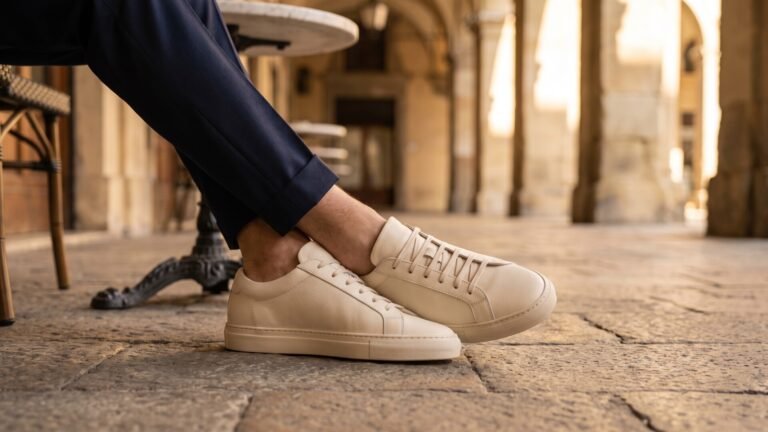
The proportions are the reason it works. The Ball Star sits slightly wider and slightly taller through the midfoot than a minimalist leather sneaker, which gives it visual weight without looking clumsy. That bulk is doing real work in an outfit. It balances a wide-leg trouser, it stops a straight-leg jean from looking tidy in a way that reads as trying too hard, and it holds its own under a chore jacket in a way that a slim white sneaker does not. You can feel the difference when you put it next to a Common Projects Achilles Low – the Achilles disappears into an outfit, the Ball Star sits in it.
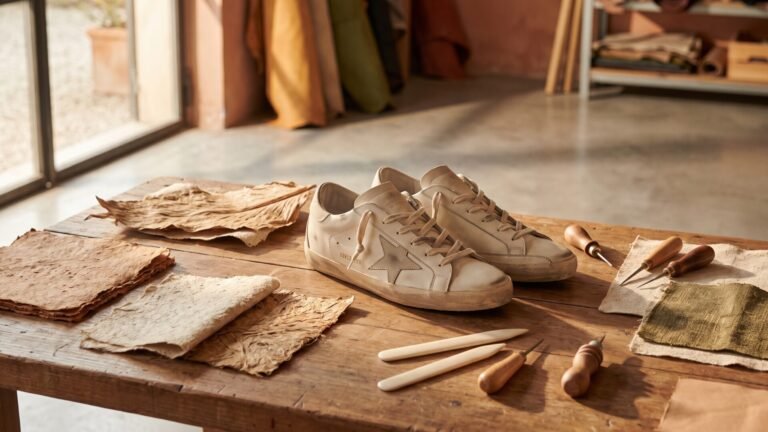
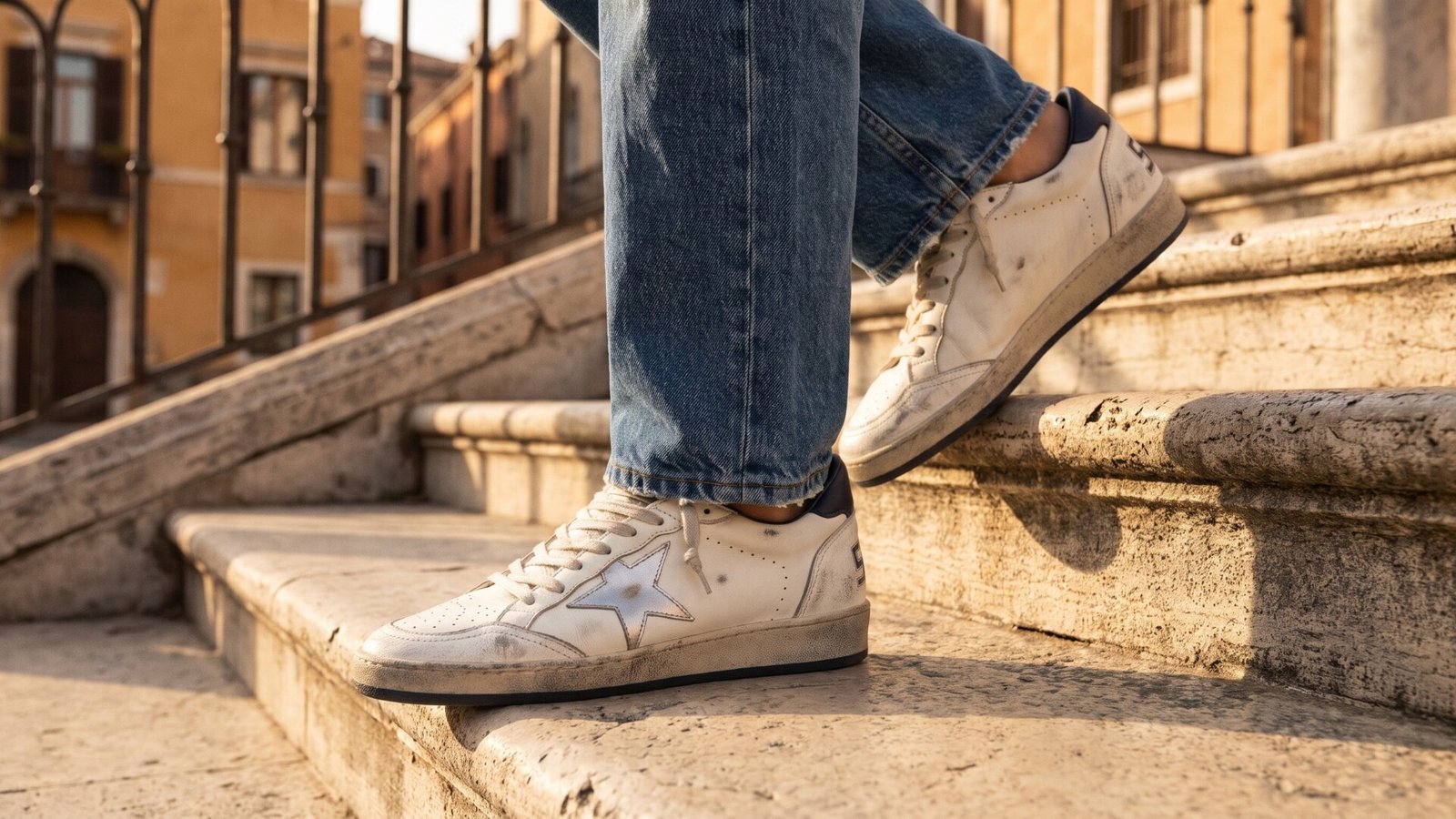
The distressed finish is the other half of the design language. Golden Goose calls it vissuto, which just means lived-in, and it is applied deliberately: abrasion at the toe and heel, a slightly dulled finish on the leather, laces that look like they have been through a washing machine. This is not sloppy finishing. It is a manufactured patina, and it is the single most divisive thing about the shoe. Either you find it liberating – you cannot ruin a shoe that arrived ruined – or you find it absurd to pay a premium for artificial wear.
Be careful about treating all Ball Stars as the same shoe. The model turns up in smooth leather, suede, canvas and textile panels, with everything from plain white to metallic panels and crystal embellishment. A suede Ball Star and a smooth leather one fit slightly differently, age differently and need different care. When you read a review that says "the Ball Star runs big," check which version that person owned.
Fit and Sizing: What Buyers Should Know
General fit profile
The Ball Star fits roomy. Not sloppy, but there is more internal volume here than in a sleek leather sneaker, and the toe box is generous. If you have spent years in Common Projects, Axel Arigato or a slim Italian derby, the first try-on will feel like a half size too much shoe.
For average and slightly wide feet, that is a gift. The Ball Star is one of the more forgiving luxury sneakers for a wider forefoot, because the shape does not taper aggressively toward the toe. For narrow feet, it is the opposite. You may get heel slip, and you may feel the shoe moving around the forefoot rather than holding it.
Two practical notes before you order. First, check the specific retailer’s size chart rather than assuming Golden Goose’s own conversion is what you are buying against – and confirm the return policy covers worn-on-carpet try-ons, because you will need one. Second, if you are buying a suede or textile-panelled version, expect a slightly different fit from the smooth leather model. Suede has less give initially and then softens more.
Sizing decision framework
Start with your usual European sneaker size. That is the honest default, and most people who complain about Ball Star sizing went a size up for the wrong reason.
Here is how to think about the three options:
- Stay true to size if your feet are average width and you wear medium-weight socks. This is the correct answer for most buyers.
- Size down only if you are genuinely between sizes and the shoe feels long – toe room you could measure in centimetres, not just a roomy toe box. Do not size down to fix width.
- Size up if you have a wide forefoot or plan to wear thick socks through winter. Do not size up to solve a width problem, because extra length gives you heel slip on top of a tight forefoot, which is worse than where you started.
That last point is the one people get wrong. A shoe that is too narrow will not be fixed by length. If the vamp presses across the top of your foot, a bigger size just moves the pressure point and adds a gap at the heel.
The hand test at home
Try them on late in the day, when your feet are at their largest, and walk on a hard floor rather than carpet.
- Heel security. Walk ten steps. If your heel lifts more than a finger’s width, the shoe is too long or too wide for you. Break-in will not fix this.
- Toe clearance. You want roughly a thumb’s width past your longest toe when standing. More than that and you will slide forward.
- Vamp pressure. Press down across the top of the foot where the laces sit. If you feel pressure through the leather rather than a gentle hold, the shoe is too shallow for your instep.
- Stairs. Walk up a flight. If your foot slides forward and your toes jam, the shoe is too long regardless of how it felt standing still.
What happens after break-in
The upper will soften. Smooth leather creases across the vamp and relaxes slightly at the collar; suede gives a little more. What will not change is the underlying shape and the sole. The flat cupsole stays flat.
So: mild stiffness across the top of the foot usually improves within a couple of weeks of regular wear. A loose heel does not. And do not buy a size up because the collar feels firm on day one – that firmness is the heel counter doing its job, and it will soften into shape rather than away from it.
One more mistake worth naming. The distressed finish makes people assume the shoe needs no protection from new. It does. More on that below.
Comfort for Everyday Wear
Here is where the marketing and the reality separate. The Ball Star is comfortable. It is not a walking shoe, and no amount of brand storytelling changes the construction.
For a commute that involves a train and a few blocks, a day of shopping, an office-casual shift, or a weekend in a city where you are mostly sitting and occasionally strolling, the Ball Star is easy. The leather upper is soft against the foot, the collar is padded enough not to bite, and the flat sole gives you a stable, grounded feel. Plenty of owners wear theirs four or five days a week without complaint.
Where it runs out of road is sustained standing and long distances. The sole is flat and fashion-oriented. There is no meaningful arch support built in, and the cushioning underfoot is modest – closer to a canvas plimsoll than to a running-derived walking shoe. If your day involves 15,000 steps on hard pavement, you will feel it by late afternoon, mostly through the ball of the foot and the heel.
The variables that decide whether it works for you:
- Heel grip. The single biggest comfort factor. A secure heel makes a flat shoe feel far more supportive than it is. A slipping heel makes every step a small correction.
- Sole flexibility. New Ball Stars are fairly stiff through the forefoot. They flex with wear, but they never become soft.
- Sock choice. Medium-weight cotton socks improve both fit and underfoot comfort noticeably. Very thin socks in a roomy shoe make the whole thing feel loose.
- Foot width. Narrow feet get movement; wide feet get a pleasant lack of pressure. Average feet get the best of it.
- Standing versus walking. The shoe handles intermittent walking better than prolonged standing. If your job is on your feet on a hard floor all day, this is not the shoe for that job.
If all-day support is your priority, be honest with yourself and look elsewhere in the category. [Internal: Top 7 Italian Luxury Sneakers That Are Actually Comfortable] covers the models that hold up to a long day, and [Internal: Are Golden Goose Sneakers Comfortable for All-Day Wear] goes deeper into the brand’s comfort question across models. The Ball Star is a lifestyle sneaker with usable comfort. Judge it on that basis and it will not disappoint you.
What Most Buyers Get Wrong About the Ball Star
Three misconceptions do most of the damage.
The first is that pre-distressed means maintenance-free. It does not. The abrasion is cosmetic; the materials underneath are ordinary leather, suede and textile and they degrade exactly as those materials always do. Dirt still works into suede. Smooth leather still dries and cracks if it gets soaked and left wet. Laces still fray. The sole edge still picks up a grey ring that no amount of "it’s meant to look worn" makes attractive. The finish buys you forgiveness for new scuffs. It does not buy you out of care.
The second is that a higher price means better technical comfort. It does not, and this is the most expensive misunderstanding in luxury sneakers. What you are paying for here is design, finishing, brand identity and the specific visual language of the shoe. The comfort engineering is basic. A $150 sneaker from a comfort brand will out-walk a Ball Star without breaking a sweat. That is not a scandal – it is just what the product is – but buyers who expect the price to buy performance end up resentful.
The third is that the basketball reference makes it a sporty shoe that only works with casual clothes. In practice the opposite is true. The worn-in treatment is what makes the Ball Star more versatile than a pristine white sneaker. A clean white leather sneaker under relaxed wool trousers can look like you are trying to be modern. The Ball Star under the same trousers looks like you stopped caring in a way that was deliberate. The distressed finish lowers the formality of everything it is paired with, which is precisely why it slides into smart-casual outfits that a shiny sneaker would fight.
There is a psychology point underneath all this. A large part of the appeal is that the shoe arrives already lived-in, which removes the anxiety of the first scuff. For buyers who find pristine luxury stressful – who baby a white sneaker and then stop wearing it – the Ball Star is genuinely liberating. You cannot ruin it. That is worth something real, even if it is hard to put a number on.
Materials, Construction and Durability in Practice
The Ball Star is put together well for what it is. It is not a hand-welted dress shoe and should not be judged as one, but the materials are decent and the assembly is sound.
What you are most likely buying:
- Smooth leather uppers on the core colourways – the most versatile and the easiest to care for.
- Suede on many seasonal versions – softer hand, more prone to marking, needs a brush rather than a cloth.
- Canvas and textile panels – lighter, more casual, and the first thing to show genuine wear.
- Rubber cupsole – flat, stitched and bonded to the upper, replaceable in principle but rarely replaced in practice.
- Decorative treatments – the distressing, the metallic finishes, the embellishment. Cosmetic, and the first thing to look tired.
What actually determines how long they last has little to do with the finish:
- Seam quality. Run your thumb along the inside edge of the lining where it meets the upper. If it catches, the edge was finished in a hurry. On a good pair it should feel smooth and continuous.
- Sole bonding. Look at the join between upper and midsole all the way around. Any lifting, any visible gap, any glue line that looks uneven is a warning.
- Heel-counter wear. The inside back of the shoe is where sneakers die first. If the lining there is thin or already collapsing, the shoe will lose its grip on your heel long before the sole wears through.
- Creasing. Smooth leather creases across the vamp. That is normal and, on this shoe, blends into the aesthetic.
- Moisture. The real enemy. Leather that stays damp loses structure and cracks. Rotate your shoes and let them dry properly.
- Rotation. The single biggest factor in lifespan. A Ball Star worn every day will look tired in a year. The same shoe worn three days a week and rested between wears will last several.
Distinguish cosmetic aging from structural failure. More scuffs, more creasing, a duller finish – all of that suits the design. A collapsing heel counter, a sole separating from the upper, leather that has stretched out of shape – those are genuine failures and are not covered by the "it’s meant to look worn" story.
A care routine that respects the materials:
- Brush suede and textile gently with a soft suede brush, dry, in one direction. Do not scrub.
- Wipe smooth leather with a soft damp cloth and let it air dry away from direct heat. Never saturate it.
- Air between wears. Stuff with paper or use shoe trees to hold shape and draw out moisture.
- Use material-specific products. A suede protector on suede, a neutral cream on smooth leather. [Affiliate: Browse suede and leather sneaker care kits]
- Never machine wash them. Not the laces, not the uppers, not "on a gentle cycle." Water and agitation will destroy the structure and the finish together.
Treat the distressing as styling, not as a licence to be rough. The shoe will age. You still want it to age in the direction you chose.
Styling the Golden Goose Ball Star
Everyday casual dressing
This is where the Ball Star earns its keep. Straight-leg denim, relaxed jeans, cargo trousers, cotton shorts, a plain knit or a heavyweight tee – the shoe slots in without effort.
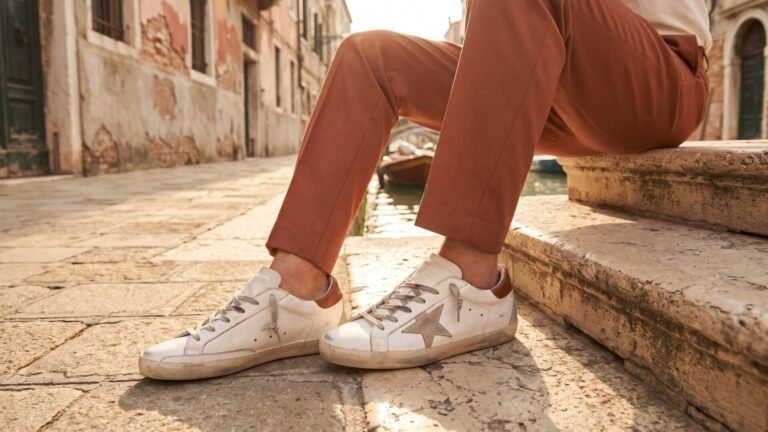
The one rule that matters is proportion. Pair the Ball Star with a trouser leg that has some width to it. A slightly relaxed straight leg or a gentle taper breaks over the shoe and balances its visual volume. Very slim trousers make the sneaker look heavy and slightly cartoonish, like a large shoe on a small leg. If your wardrobe is all skinny jeans, this is not the sneaker for it.
On colour: clean white and cream versions are the most versatile and the easiest to wear with everything. Darker colourways – black, charcoal, deep navy – read slightly dressier and hide marks better. Visibly distressed and multi-panel versions are more of a statement and narrow what they work with. None of these is wrong; they just do different jobs.
Smart-casual and travel outfits
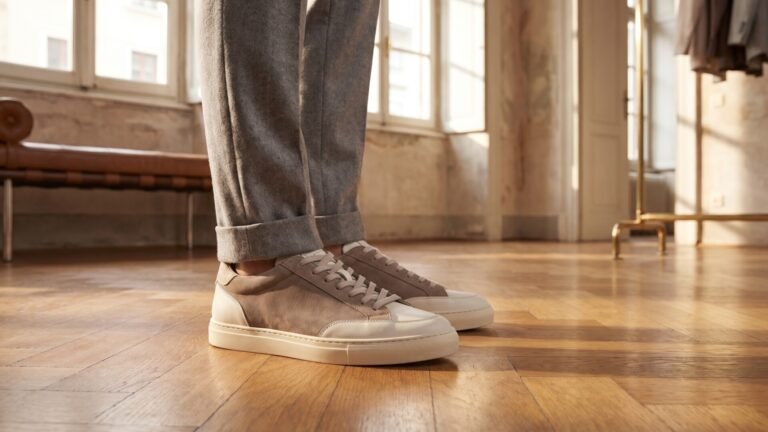
The Ball Star’s real talent is informal tailoring. Unstructured blazers, wool trousers with a relaxed cut, overshirts, chore jackets, a soft-shouldered suit worn without a tie – the distressed finish takes the polish off all of it in a way that looks intentional.
It is not a formal shoe and should not pretend to be. For a business meeting with a client, a dark leather derby or a clean loafer does the job better. For an informal office, a weekend in the city, or a travel wardrobe where you want one shoe that covers dinner and the airport, the Ball Star is genuinely useful. [Internal: How to Style Italian Shoes for Every Occasion] has the broader framework if you are building around it.
On travel specifically: the Ball Star can replace a separate casual shoe, which is real luggage value. But do not make it your only shoe for a walking-heavy itinerary without testing the fit at home first. A roomy shoe that slips on stairs is a bad travel companion.
Choosing the right colorway
Colourway choice matters more to long-term value than small construction differences between versions. A restrained, neutral Ball Star will work with almost everything you own for years. A bright-panelled, heavily embellished one is tied to a season and a mood.
For maximum cost per wear, look at white, cream, grey, black and muted metallic combinations. For personality, the louder versions are fun – just buy them knowing they are statement pieces, not wardrobe workhorses. [Affiliate: See the current Golden Goose Ball Star colourways]
Ball Star vs. Super-Star and Other Luxury Sneakers
The comparison most buyers actually face is internal to Golden Goose. The Super-Star is the brand’s signature low-profile sneaker – slimmer, lower, more established, and the one most people picture when they hear the name. The Ball Star is the roomier, chunkier, basketball-derived sibling.
The practical difference is visual profile and outfit range. The Super-Star is neater and slides more easily under a slim trouser or a sharper outfit. The Ball Star has more presence and works better with relaxed proportions. Neither is more comfortable in any meaningful, universal way – fit decides that, and fit differs between the two silhouettes. If you are torn, [Internal: Golden Goose Super-Star Review: Are They Worth the Price?] covers the other side properly.
Beyond the brand, three alternatives come up again and again:
- Common Projects Achilles Low for minimalist polish. Cleaner, quieter, and easier to wear in a polished outfit. Less visually distinctive, and the slim shape is unforgiving on wide feet.
- Zegna Triple Stitch for refined slip-on convenience and business-casual use. The premium is easier to justify when you actually want the slip-on practicality. [Internal: Zegna Triple Stitch Sneaker Review: Why Every CEO Owns a Pair] goes into it.
- Comfort-focused Italian luxury sneakers for buyers whose priority is a long walking day. Better functional value, less fashion identity.
| Sneaker | Design character | Comfort profile | Best for | Value consideration |
|---|---|---|---|---|
| Golden Goose Ball Star | Retro basketball-inspired, deliberately worn-in | Comfortable for casual use, not performance-led | Buyers wanting a relaxed statement sneaker | Strong wardrobe value if worn frequently and kept in rotation |
| Golden Goose Super-Star | Lower-profile signature sneaker with recognizable star detail | Generally easy for everyday casual wear, subject to individual fit | Buyers wanting a more established Golden Goose silhouette | Better choice for those who prefer a slimmer visual profile |
| Common Projects Achilles Low | Minimalist and clean | Simple, low-tech comfort with a neater shape | Buyers prioritizing understated styling | Less visually distinctive but easier to wear in polished outfits |
| Zegna Triple Stitch | Refined, slip-on luxury sneaker | Convenient and comfortable for smart-casual use | Travel and business-casual wardrobes | Premium is easier to justify when slip-on practicality matters |
| Comfort-focused Italian luxury sneaker | Usually more cushioning or ergonomic support | Better suited to longer walking days, depending on model | Buyers prioritizing all-day wear | May offer better functional value than a fashion-led distressed sneaker |
Is the Golden Goose Ball Star Worth the Price?
Do the arithmetic on your own feet rather than on the brand’s reputation.
A Ball Star typically lands somewhere in the $500 to $600 range depending on version and retailer. Take the middle of that and run three scenarios:
- Occasional wear. Twice a month, for outfits that need it. That is roughly 24 wears a year. Over three years, you are paying around $7 per wear. Hard to defend on value grounds alone.
- Weekly wear. Once or twice a week across casual, travel and smart-casual outfits. Around 75 wears a year. Over three years, that is closer to $2.30 per wear – defensible for a shoe you actually enjoy wearing.
- Frequent rotation. Three or four days a week, cared for and rested between wears. Around 175 wears a year. Spread over three to four years of decent condition, the cost per wear drops under a dollar and the purchase starts to look sensible.
The point is not the exact numbers – your price and your habits will differ. The point is that the Ball Star only makes financial sense as a shoe you wear often. Bought as an occasional statement piece, it is an expensive way to own a scuff.
What you are actually paying for: Italian design identity, decent finishing, brand recognition, styling flexibility, and the deliberately aged look. Not advanced sports technology, and not hand-welted construction. Judge the price against those things and it is coherent. Judge it against material value and it is not.
Resale deserves a cautious word. Neutral, recognizable, lightly worn colourways in common sizes tend to hold more secondhand appeal than highly seasonal or heavily embellished versions. But resale depends on condition, demand, size, packaging and authenticity, and it is not a reason to buy. Buy it to wear.
Here is the contrarian verdict, stated plainly: if maximum material value is your goal, a clean leather sneaker at a third of the price is the smarter purchase. The Ball Star makes sense for the buyer who specifically wants its visual language and will wear it hard. For everyone else, it is a beautiful object with an irrational price tag, and that is fine as long as you know which one you are buying.
Who Should Buy the Ball Star – and Who Should Skip It
Buy it if you want a distinctive casual sneaker that already looks lived-in, you prefer relaxed proportions, you do not need athletic cushioning, and you can wear one shoe across denim, travel clothes and informal tailoring. It rewards buyers who value wardrobe personality over minimalist restraint.
Skip it, or try before you commit, if you have narrow feet and dislike heel movement, if you need dependable support for long daily walks, if you expect pristine leather or formal-shoe longevity from the price, or if you want a clean unbranded sneaker that disappears into an outfit.
By buyer type, the recommendations are clear:
- Best for retro-fashion buyers: Golden Goose Ball Star.
- Best for a slimmer Golden Goose profile: Golden Goose Super-Star.
- Best for minimalist styling: Common Projects Achilles Low.
- Best for refined travel and business casual: Zegna Triple Stitch.
- Best for comfort-first walking: a dedicated comfort-focused Italian luxury sneaker, chosen by fit and support rather than branding.
[Internal: Explore the Italian Designer Sneakers hub] for the full category, and [Internal: the Italian Luxury Footwear hub] if you are building a wider shoe wardrobe.
The verdict, in one line
If you want a roomy, retro, deliberately scuffed luxury sneaker that will look better the more you wear it, the Ball Star is a good buy and an easy one to live with. If you want a shoe that will carry you through a long walking day or convince you that the price bought performance, it will not, and no amount of break-in will change that. Buy it for the look, wear it often, and it earns its keep.
Frequently Asked Questions About Golden Goose Ball Star
Is the Golden Goose Ball Star true to size?
For most people, yes. Start with your usual European sneaker size. The shoe is roomy rather than small, so sizing up out of habit is the most common mistake. If you are genuinely between sizes and the shoe feels long rather than wide, consider going down half a size.
Do Golden Goose Ball Stars run wide?
They run roomy through the forefoot and toe box compared with slim leather sneakers like Common Projects. Average and slightly wide feet usually find them comfortable. Narrow feet may get heel slip and should try before buying or confirm a generous return policy.
Are Golden Goose Ball Stars comfortable for walking all day?
For a normal day of commuting, shopping and casual walking, yes. For sustained standing or long distances on hard pavement, no – the flat sole offers limited support and cushioning. If all-day walking is the priority, choose a comfort-focused sneaker instead.
How long does it take to break in Golden Goose Ball Stars?
Mild stiffness across the upper usually eases within a couple of weeks of regular wear. The sole stays fairly firm and the overall shape does not change dramatically. A loose heel will not tighten up with break-in, so get the fit right from the start.
Can Golden Goose Ball Stars be worn with smart-casual clothing?
Yes – this is where they are strongest. Unstructured blazers, wool trousers, overshirts and relaxed tailoring all work. They are not appropriate for formal business dress, where a leather derby or clean loafer is the better choice.
Are Golden Goose Ball Stars worth the price?
They are worth it if you want the specific retro, distressed look and will wear them several times a week. They are hard to justify as an occasional purchase, and they do not offer performance-led comfort or formal-shoe construction for the money. The value comes from wear frequency, not from the materials alone.
How should Golden Goose Ball Stars be cleaned and maintained?
Brush suede and textile gently with a soft brush. Wipe smooth leather with a soft damp cloth and air dry away from heat. Use shoe trees or paper to hold shape, rest them between wears, and use material-specific products. Never machine wash them.