Guidi — The Complete Guide to Italy’s Cult Leather Artisan Brand
For years, I believed that the best leather came from fashion houses. I assumed that Gucci, Prada, and their ilk had access to the finest hides, and that any independent tannery was a step down. Then I held a pair of Guidi boots in my hands for the first time. The leather was unlike anything I had ever touched—soft, almost rumpled, with a depth of colour that seemed to shift in the light. It was not perfect. It was better than perfect. It was alive.
I turned the boots over, looking for a logo. There was none. The only marking was a small stamp on the insole. I asked the shopkeeper why a brand with such extraordinary leather would hide its name.
Because Guidi is not a fashion brand, he said. It is a leather company that happens to make fashion.
That was the moment I understood that Guidi operates on a different plane from most luxury houses. Its products are not designed first and then made from leather. They are made from leather first, and the design exists to showcase the material. This guide will tell you everything you need to know about one of Italy’s most revered artisanal leather houses.
The History of Guidi
Origins in Tuscany‘s Leather Industry
Guidi’s story begins in 1896, when Guido Guidi, Giovanni Rosellini, and Gino Ulivo established the Conceria Guidi e Rosellini tannery in Pescia, Tuscany. This was not a fashion workshop. It was a tannery—a facility dedicated to transforming raw hides into finished leather, using techniques that had been refined in Tuscany since the Middle Ages.
For decades, the Guidi tannery operated quietly, supplying leather to other manufacturers. The family developed a reputation for exceptional quality, particularly in the vegetable-tanning methods that had been passed down through generations. The tannery became known for its ability to produce leather that was both supple and durable—a rare combination that made it a preferred supplier for discerning designers.
From Tannery to Luxury Brand
The transition from tannery to finished goods producer came later. In 2005, Guidi launched its own brand, beginning with a small series of shoe models. The brand was an extension of the tannery‘s philosophy: if you control the leather from start to finish, you can create products that showcase the material’s full potential.
Unlike most fashion brands, which buy leather from tanneries and then design products, Guidi already owned the leather. The design was secondary to the material. This fundamental difference would define the brand‘s identity.
The Influence of Ruggero Guidi
Today, the Conceria Guidi Rosellini is operated by Ruggero Guidi, a direct descendant of the founder. Ruggero rejects mass production logic and focuses on his own research, always seeking a balance between advanced technologies and respect for tradition and skill. He has become the leather tanner that designers around the world look to for high-quality results.
Ruggero safeguards the company’s techniques and works hand-in-hand with clients to fulfill bespoke orders for partners like nonnative, a Japanese brand known for its discerning material choices. His commitment to vegetable tanning has been refined for over a century, with each generation developing the techniques.
Guidi Today
Today, Guidi is revered as one of the most respected artisanal leather houses in the world. The brand produces a range of footwear, bags, and accessories, all crafted in Italy using leather from its own tannery. The products are characterised by their unique tanning and dyeing processes, which create a lived-in appearance that is crucial to the brand’s appeal.
Guidi resists logos and branding, exclusively stamping its label on insoles and shoeboxes, allowing the leather to speak for itself. The brand has achieved cult status among fashion insiders who chase rarity and substance.
What Makes Guidi Different?
A Tannery That Became a Fashion Brand
Most luxury brands start with a design and then find leather to match. Guidi starts with the leather. The brand’s tannery heritage is its competitive advantage—it controls the material from raw hide to finished product, ensuring that the leather is never compromised for the sake of a silhouette.
Leather as the Product
At Guidi, the leather is the product. The design exists to showcase the material’s character, not to obscure it. This leather-first philosophy is evident in every pair of boots and every bag. The leather is not corrected or coated to hide imperfections; it is celebrated for its natural grain, its subtle scars, and its unique texture.
Controlled Imperfection
Guidi embraces imperfection. The leather is full-grain, meaning it retains the natural surface of the hide, including any marks or variations that occurred during the animal‘s life. The object-dyeing process creates tonal variations that are unique to each piece. No two Guidi products are exactly alike. This is not a flaw; it is a feature.
Anti-Luxury Luxury
You will find no loud logos on a Guidi product. The brand does not advertise. It does not chase trends. It relies on the quality of its leather and the skill of its artisans to build its reputation. This is luxury that communicates through the fingertips, not the eyes.
Guidi‘s Leather: Some of the Finest in the World
Understanding Guidi’s Tannery Heritage
Guidi‘s leather expertise is the foundation of everything the brand does. The tannery uses traditional vegetable-tanning methods handed down in Tuscany, which slowly nourish the leather over time. While ordinary vegetable tannin produces a high degree of solidity with a hard texture, Guidi’s leather has a unique atmosphere with excellent texture and suppleness.
The brand uses full-grain leather, which has only had the outermost body hair removed. This retains the intact nature of the hide, without hiding any natural scars. Full-grain leather is rare, and the number of products that can be produced is very limited, as it is highly dependent on the condition of the raw leather.
Horse Leather
Horse leather is the typical leather used in many of Guidi‘s most famous and representative pieces. It has a smooth silver surface with few grains and wrinkles, and its tight expression gives it a neat and powerful look. The solid look and subdued dull sheen give it a luxurious impression.
Guidi’s full-grain horse leather is lauded for its smooth surface sheen and rich patina developed with wear. The leather is refined using century-old techniques, and each pair of boots is handcrafted in Tuscany.
Cordovan
Cordovan is a rare and highly prized leather from a specific part of the horsehide. Guidi’s cordovan features a bouncy, taut texture and a very smooth, moist and comfortable feel, as well as exceptional fittability. Its lustrous expression is dignified and strong. Cordovan is originally a rare commodity, but only Guidi‘s high technology with vegetable tannin tanage can achieve such a smooth and supple texture.
Calf Leather
Calf leather is also widely used at Guidi. It features a matte look with modest elasticity and luster, and a grain side engraved with finer grain than horse leather. It has a soft and embracing texture, with a modest and gentle impression compared to horse leather.
Baby Calf Leather
Baby calf is produced from calves within three months of age, which is especially rare. It has a finer grain feeling and finer texture than calf leather and is as soft, but rare since it is difficult to produce.
Reverse Leather
Guidi also uses reverse leather, where the flesh side of the hide is used as the exterior. This creates a soft, suede-like texture that is both luxurious and durable. The soft horse reverse leather is unlined and piece-dyed, allowing the dye to penetrate deeply into the fibers.
The Craftsmanship Behind Every Guidi Product
Leather Selection Process
Each hide is inspected by hand before a single piece is cut. The artisans study the grain, the texture, and the natural marks of the leather, positioning the pattern to take advantage of the hide‘s unique characteristics. No two pieces of leather are ever identical, and Guidi celebrates this individuality.
Hand-Dyeing Techniques
Guidi’s signature technique is object-dyeing, where the finished product is dyed after construction. This allows the dye to penetrate deeply into the seams, metal fittings, and every detail, creating a unique texture and worldview. The process involves tumbling the finished footwear in a tanning drum, which creates a richly layered color and a distinctive patina.
The piece-dyeing process results in a homogeneous color tone, softened leather uppers, and gently textured surfaces. Each pair has a unique finish because the nature of the dyeing technique means every pair is different.
Garment Dyeing and Object Dyeing
Guidi’s object-dyeing process is applied not just to footwear but to bags and accessories as well. The finished product is dyed, rather than the raw leather, which ensures that every component—the leather, the stitching, the hardware—absorbs the colour uniformly. This creates a depth and richness that cannot be achieved with surface dyeing alone.
Construction Standards
Guidi uses Goodyear welt construction on many of its boots, which allows the sole to be replaced and extends the life of the shoe. The boots feature heavy-duty YKK Excella zippers, which are known for their durability. The construction is robust, designed to withstand years of wear.
Why Every Guidi Product Is Unique
Because of the hand-dyeing and finishing processes, every Guidi product is unique. The colour shifts, the texture varies, and the leather develops its own character. This is not a bug; it is the entire point. Guidi celebrates the individuality of each piece, just as it celebrates the individuality of its wearer.
Core Product Categories
788 Boots
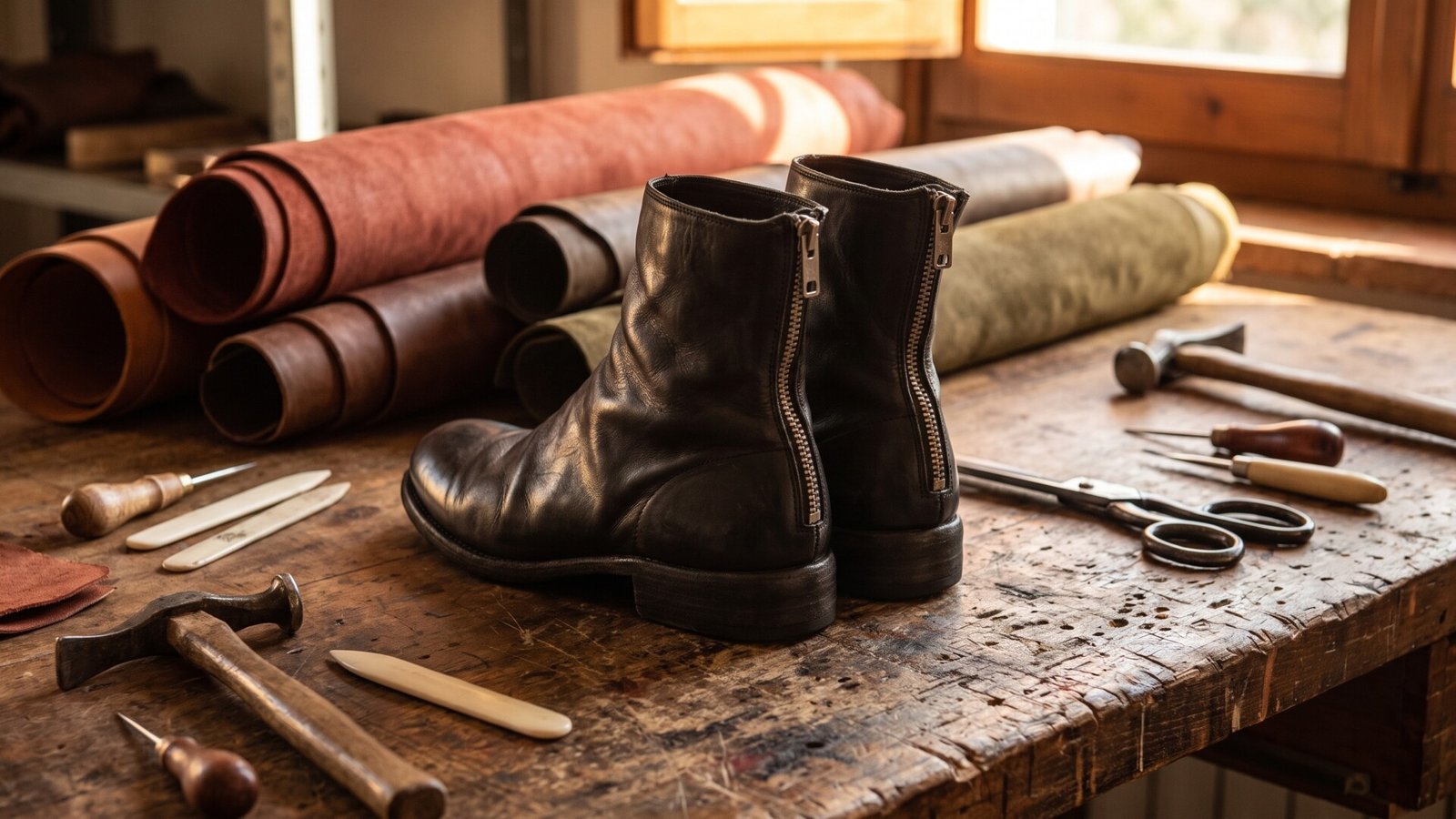
The 788 is one of Guidi‘s most iconic models. These ankle-high boots are crafted from full-grain horse leather and feature a rear zip fastening, a chunky low heel, and a round toe. The boots are object-dyed, resulting in a rich interplay of dark hues that dances with the light. The boots are Goodyear welted and feature a stacked leather heel and a leather sole.
986 Boots
The 986 is another classic back-zip boot. These ankle-high boots are cut from buffed horse leather that has been piece-dyed, giving the surface a distinctive depth that is grainy, tactile, and quietly opulent. The deep black horse leather projects a moody, avant-garde elegance. The boots feature a Goodyear welt and a stacked leather heel.
988 Boots
The 988 is Guidi‘s iconic back-zip boot, crafted with the tannery’s full-grain vegetable-tanned horse leather. The upper is cut from a single piece of leather and finished with a heavy-duty YKK Excella zipper. Each pair is fully object-dyed post-construction, resulting in a homogeneous color tone and softened leather uppers. The boots feature a fully resoleable Goodyear welt.
Front-Zip Boots
Guidi also produces front-zip boots, such as the VS01. These boots have become cult among fashion insiders who chase both rarity and substance. They quietly signal an affinity for heritage Italian craftsmanship filtered through a streetwise, modern lens.
Back-Zip Boots
The back-zip boot is a Guidi signature. The zip closure at the heel is both functional and distinctive, allowing for easy entry while maintaining a clean silhouette. These boots are available in a range of leathers, including horse, calf, and reverse leathers.
Derbies
Guidi’s derbies, such as the 792V, are crafted from full-grain horse leather and feature a lace-up closure, Goodyear welt, and a treaded Vibram rubber sole. The boots are piece-dyed, resulting in beautiful tonal variations. The design is timeless, with a modern twist that aligns with current trends.
Bags
Guidi produces a range of leather bags, including crossbody bags, travel bags, and totes. The bags are made from soft horse leather and are designed for daily use. They feature the same vegetable-tanned full-grain leather and object-dyeing techniques as the footwear, and they develop a deeper luster and wrinkles with use.
Leather Jackets
Guidi also produces leather jackets, though this is a smaller category. The jackets are made from full-grain horse leather and feature the same artisanal craftsmanship as the footwear. They are designed to be worn and to develop character over time.
Accessories
Guidi produces a range of accessories, including wallets, belts, and small leather goods. These are excellent entry points to the brand, allowing customers to experience the quality of Guidi‘s leather at a lower price point.
Comparison Table: Guidi vs Other Italian Leather Specialists
| Brand | Specialty | Style | Leather Expertise | Best For |
|---|---|---|---|---|
| Guidi | Avant-garde leather goods | Experimental artisan | Exceptional | Collectors, leather purists |
| Officine Creative | Artistic footwear | Contemporary artisan | Excellent | Everyday individuality |
| Stefano Bemer | Bespoke shoes | Traditional luxury | Excellent | Classic footwear |
| Santoni | Luxury footwear | Refined elegance | Excellent | Mainstream luxury |
| Giorgio Brato | Hand-treated leather garments | Contemporary luxury | Excellent | Leather fashion |
Original Perspective: Why Guidi Is Really a Leather Company That Happens to Make Fashion
Most Luxury Brands Start With Design
Walk into any luxury boutique, and you will see products designed by fashion designers. The design brief comes first: a silhouette, a colour, a mood. The leather is then sourced to match the design. If the leather is not perfect, it is corrected, coated, or embossed to hide its flaws.
Guidi Starts With Materials
Guidi reverses this process. The brand starts with the leather—full-grain, vegetable-tanned hides from its own tannery. The design exists to showcase the material‘s character, not to obscure it. This leather-first philosophy changes everything. The products are not designed to be perfect; they are designed to be authentic.
Why This Changes Everything
When you design around the material, you celebrate its imperfections. The grain, the scars, the subtle colour variations—these are not flaws; they are features. A Guidi product is not a fashion item; it is a leather object. It is meant to be touched, worn, and lived in.
The Difference Between Leather Products and Leather Objects
Most luxury brands sell leather products. They are accessories designed to complement an outfit. Guidi sells leather objects. They are pieces that stand on their own, that develop character with age, that become more beautiful with use. This distinction is the essence of Guidi‘s philosophy.
Guidi vs Officine Creative: Two Different Approaches to Artisanal Luxury
Officine Creative is Guidi‘s most direct competitor. Both are Italian, both use high-quality leather, and both have devoted followings. But they serve different buyers.
Design philosophy: Officine Creative focuses on artistic experimentation and hand-finished individuality. Guidi focuses on the material itself—the leather is the star, and the design is secondary.
Leather treatments: Officine Creative uses washed, wrinkled, and hand-dyed leathers that feel soft and lived-in. Guidi uses full-grain vegetable-tanned horse and calf leathers that are object-dyed after construction, creating a depth of colour that is unique to each piece.
Comfort and wearability: Both brands are comfortable from day one, but Guidi’s leather is often softer and more pliable, thanks to its vegetable-tanning process.
Styling differences: Officine Creative leans contemporary and artistic. Guidi leans avant-garde and experimental. A pair of Officine Creative boots looks distinctive; a pair of Guidi boots looks like they belong in a museum.
Which buyer fits each brand? Choose Officine Creative if you want distinctive, artisanal shoes with character. Choose Guidi if you want exceptional leather that will develop a beautiful patina over time.
Are Guidi Boots Worth the Price?
Craftsmanship Assessment
Guidi‘s craftsmanship is exceptional. The leather is full-grain, vegetable-tanned, and object-dyed. The construction is Goodyear welted, and the hardware is from quality suppliers like YKK Excella. Each pair is handcrafted in Tuscany by skilled artisans.
Material Quality
Guidi uses some of the finest leather available. The full-grain horse leather is vegetable-tanned using century-old techniques, and the object-dyeing process creates a depth of colour that cannot be achieved with surface dyeing alone.
Collector Appeal
Guidi has a dedicated collector base. The brand‘s boots are highly sought after by fashion insiders and leather enthusiasts. The limited production and unique finishing ensure that each pair is rare.
Durability Expectations
With proper care, Guidi boots should last 15 to 20 years. The Goodyear welt construction allows the sole to be replaced, and the vegetable-tanned leather will develop a beautiful patina over time.
Cost-Per-Wear Analysis
A $1,700 pair of Guidi boots worn 100 days a year for 15 years costs $1.13 per wear. A $300 mass-market boot worn 50 days a year for two years costs $3 per wear—and the Guidi boots will still be in excellent condition. Over a lifetime, Guidi is the better investment.
How Guidi Became a Cult Fashion Brand
Early Adoption by Avant-Garde Fashion
Guidi‘s leathers were initially supplied to avant-garde fashion houses such as Maison Margiela and Rick Owens, as well as the defunct cult brand Carpe Diem, which was widely commended for starting the wave of avant-garde and artisanal brands in the 2000s. This early association with the avant-garde established Guidi‘s credibility among fashion insiders.
Influence on Designers
Designers known for their insatiable pursuit of materials, such as Carpe Diem and Carol Christian Poell, have relied on Guidi‘s outstanding tanning techniques. The brand‘s leather has become a reference point for those who demand the finest materials.
Celebrity and Creative Industry Appeal
Guidi‘s boots have become cult among fashion insiders who chase both rarity and substance. The brand‘s legacy runs deep in underground fashion circles—part covetable status symbol, part secret handshake.
Why Guidi Remains Niche
Guidi does not advertise. It does not chase trends. It relies on word of mouth and the quality of its products to build its reputation. This has kept the brand niche, but it has also preserved its authenticity.
The Benefits of Staying Small
By remaining small, Guidi can maintain quality control, work with the finest leathers, and ensure that each product is made to the highest standard. The brand‘s commitment to small-batch production is not a limitation; it is a philosophy.
How to Style Guidi Products
Minimalist Wardrobes
Guidi boots work best with minimalist wardrobes. Pair a pair of back-zip boots with black jeans, a white t-shirt, and a black leather jacket. The boots’ distinctive silhouette and rich leather will stand out without being flashy.
Avant-Garde Fashion
Guidi‘s boots are a natural fit for avant-garde fashion. Pair them with oversized silhouettes, asymmetrical cuts, and dark, moody colours. The boots‘ architectural shape and hand-finished leathers complement the aesthetic.
Contemporary Luxury
For a more contemporary look, pair Guidi derbies with tailored trousers, a merino sweater, and a relaxed blazer. The derbies‘ clean lines and rich leather add a touch of luxury without being ostentatious.
Casual Luxury
Guidi boots can also be dressed down. Pair a pair of front-zip boots with cargo trousers, a hoodie, and a puffer jacket. The boots‘ rugged construction and distinctive leather add texture and depth to a casual outfit.
Building Outfits Around Statement Footwear
Let the boots lead. Keep the rest of the outfit simple—neutral colours, minimal accessories. The boots‘ unique leather and distinctive silhouette will be the focal point.
Care and Maintenance Guide
Caring for Vegetable-Tanned Leather
Vegetable-tanned leather requires care, but it rewards attention. Wipe with a soft, dry cloth after each wear. For deeper cleaning, use a mild leather cleaner designed for delicate finishes. Avoid harsh chemicals and silicone-based products, which can alter the hand-dyed colour.
Preserving Hand-Dyed Finishes
Guidi‘s object-dyed finishes are delicate. Avoid exposure to direct sunlight, which can fade the colour. If the leather gets wet, blot it dry with a soft cloth and let it air dry away from heat.
Boot Care Best Practices
- Condition sparingly: The vegetable-tanned leather already has a soft, pliable feel. Excessive conditioning can flatten the texture.
- Use a shoe tree: Insert a cedar shoe tree after each wear to maintain shape and absorb moisture.
- Store in a dust bag: Keep boots in a breathable cotton dust bag, away from direct sunlight and heat.
Storage Guidelines
Store Guidi products in a cool, dry closet. Avoid plastic bags, which trap moisture. Use a wide, padded hanger for jackets and bags.
Repair and Restoration
Guidi boots can be resoled by a skilled cobbler. For major repairs, consult a specialist in high-end leather goods.
The Future of Guidi
Growth of Artisanal Luxury
The quiet luxury movement has accelerated demand for products with visible craftsmanship. Guidi‘s hand-finished, imperfect aesthetic is perfectly aligned with this shift.
Consumer Demand for Authenticity
Consumers are increasingly seeking out brands that offer authenticity. Guidi‘s tannery heritage, its commitment to vegetable-tanning, and its small-batch production provide that authenticity.
Sustainability Through Longevity
A pair of boots that you love and wear for a decade is more sustainable than cheap boots you replace every year. Guidi‘s focus on durability and repairability is inherently sustainable.
Why Guidi‘s Philosophy Feels Increasingly Relevant
In a world of mass production, Guidi offers something rare: products that are made by hand, from exceptional materials, and designed to last. This philosophy feels increasingly relevant as consumers grow tired of disposable fashion.
Frequently Asked Questions About Guidi
Is Guidi a luxury brand?
Yes. Guidi is an Italian luxury brand known for artisanal leather goods, exceptional craftsmanship, and a distinctive, avant-garde aesthetic.
Why are Guidi boots so expensive?
The price reflects the exceptional quality of the leather, the traditional vegetable-tanning process, the hand-dyeing and finishing, and the small-batch production. Each pair takes time and skill to produce.
What leather does Guidi use?
Guidi uses full-grain vegetable-tanned horse leather, calf leather, cordovan, and other premium hides from its own tannery. The leather is object-dyed after construction to achieve a deep, layered colour.
Are Guidi boots comfortable?
Yes. The vegetable-tanned leather is soft and supple, and the boots are designed to be comfortable from the first wear.
How long do Guidi boots last?
With proper care, 15 to 20 years. The Goodyear welt construction allows the sole to be replaced, and the leather will develop a beautiful patina over time.
Is Guidi better than Officine Creative?
They serve different purposes. Guidi focuses on exceptional leather and avant-garde design. Officine Creative focuses on artistic footwear with hand-finished individuality. Choose based on your aesthetic.
What is Guidi best known for?
Guidi is best known for its exceptional vegetable-tanned horse leather, its object-dyeing technique, and its distinctive back-zip boots.
Which Guidi boot should I buy first?
The 788 or 986 back-zip boot in black horse leather. These are the most iconic styles and the best introduction to the brand‘s quality.
Conclusion
Guidi is not a fashion brand. It is a leather company that happens to make fashion. The difference is profound. Most luxury brands start with a design and then find leather to match. Guidi starts with the leather—full-grain, vegetable-tanned, object-dyed—and lets the material dictate the form.
When you buy a pair of Guidi boots, you are not buying a fashion item. You are buying a piece of leather art. The boots will soften, darken, and develop a rich patina that is entirely your own. They will become more beautiful with age, not less. They will outlast trends, outlast fashion cycles, and perhaps outlast you.
In a world of disposable fashion, Guidi is a quiet act of resistance. It reminds us that the best things are made slowly, by hand, with care. And that is the truest luxury of all.
[Explore more Italian luxury: Italian Designer Boots | Italian Designer Shoes | Officine Creative | Giorgio Brato | Italian Leather Brands Known for Durability]