Sunnei: the cheeky Milanese label that turned off-beat charm into a global mood
Alright, sit back — we’re going to talk about Sunnei like we’re on a long walk through the menswear section of a vintage market, pointing out the pieces worth keeping. If you’ve seen a kid-like pop of color on an oversized tee, a strangely satisfying rounded shoulder, or a puffer that looks like it’s smiling at you, there’s a good chance Sunnei had a hand in convincing you that those things are cool again.
Sunnei isn’t one of those dusty heritage houses with grandpa’s ledger books and a century of logos. It came out of nowhere (well, not nowhere — Milan, but still), with two young guys, a handful of tees and stripes, and an instinct for putting a friendly face on contemporary wardrobe staples. Over the last decade-plus the label has become one of those rare European brands that feels both playful and serious — like it can throw a design gag and then, two seasons later, build a genuinely covetable bag. Let’s break down how they did it, what defines the Sunnei look, and why everyone from cool kids to editors still stare when the brand drops something new.
The origin story — short, messy, and very modern
Sunnei was launched in the mid-2010s by Simone Rizzo and Loris Messina. They weren’t running around with couture diplomas or centuries of family tailors — they were just two guys with a bunch of ideas, some digital savvy, and a taste for stuff that didn’t feel precious. The label officially rolled into life around 2014–2015, starting with a modest menswear offering that leaned on bold stripes and clean — but slightly off — proportions. The name? A playful twist on “sunny” — you know, a little Italian spin on an English word, which captures the whole mood: bright, approachable, and not taking itself too seriously.
That low-key start is part of what made Sunnei feel fresh. They launched in an era when the fashion calendar and the retail model were still trying to catch up with the internet neighborhood. Social media helped them build a following but they didn’t lean into hype in the usual way — instead they kept a tone that was casual but clever, and gradually the product began to speak for itself.
The aesthetic — “kindergarten for adults” (and we mean that lovingly)
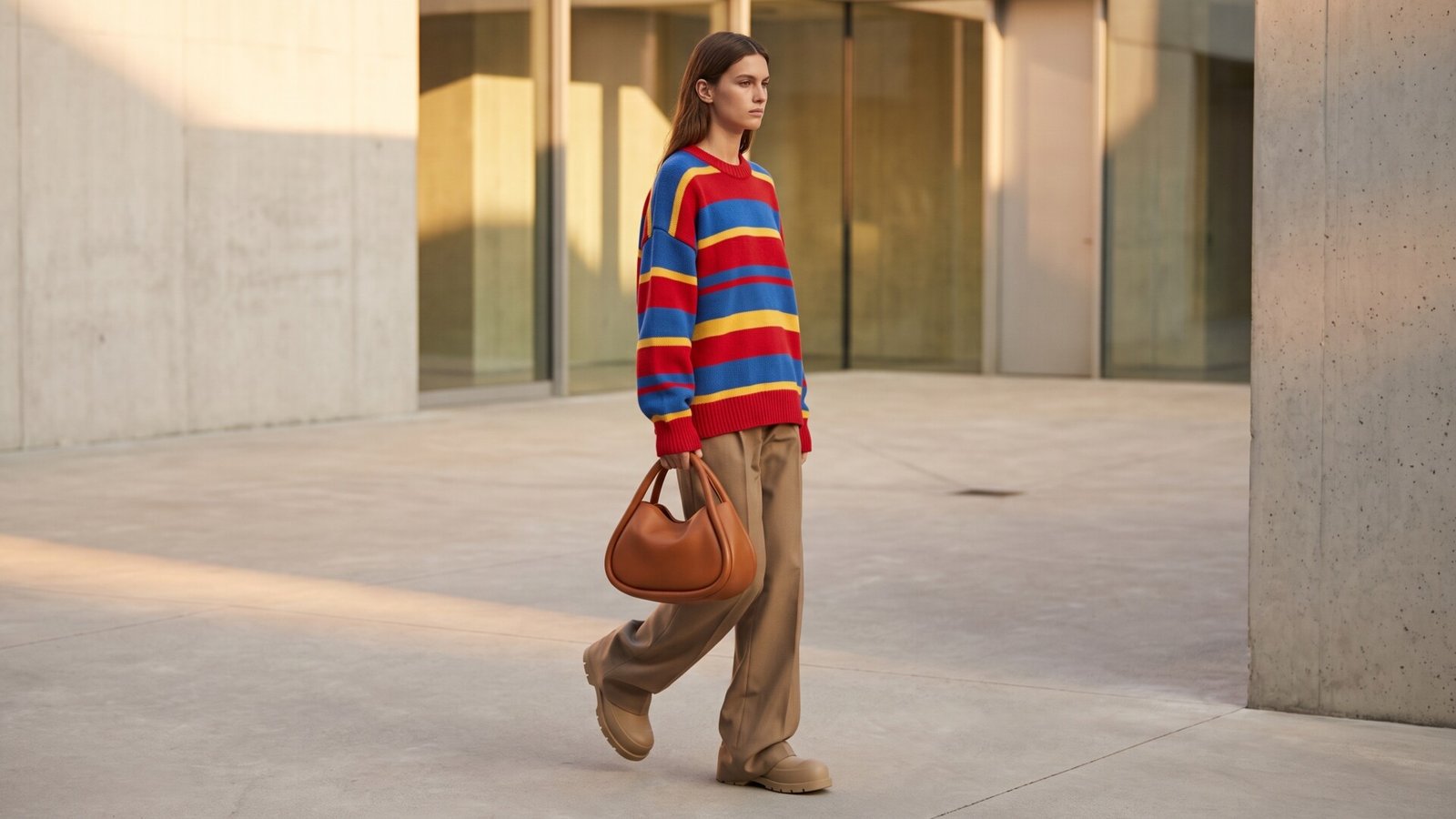
If there’s one shorthand people use to describe Sunnei, it’s “kindergarten for adults.” That line shows up a lot, and it’s accurate: you get rounded shapes, saturated primary colors, and a curious mix of utility and whimsy. But it’s not childish. The pieces are matured by Italian manufacturing, refined cuts, and details that wink without shouting.
Key signatures include:
- Relaxed, boxy silhouettes that still feel tailored enough to be wearable.
- Pure, unapologetic color — electric blues, saturated yellows, acid greens — used in blocks or as shocking inner linings.
- Playful pattern and texture combinations: think stripes reimagined as graphic blocks, or a soft knit with a construction detail that looks like a patch but is actually a clever seam.
- Accessories that are minimalist but with a twist — a bag that reads as sculptural or a shoe that simplifies classic runners into something oddly elegant.
This aesthetic allows Sunnei to sit comfortably in streetwear conversations while also appealing to people who like a quiet luxury moment. It’s a tone that says: “I’m having fun with clothes, but I know what I’m doing.”
From Instagram buzz to real business moves
Sunnei’s early growth rode the wave of fashion’s digital moment. Founders who understood content, mood and community made it easy for the brand to be discovered. But whereas many Instagram-native labels stall at that stage, Sunnei built an infrastructure: better manufacturing, wider distribution, and a move from boutique drops to wholesale partners and e-commerce platforms. By the early 2020s they were no longer a small side project — they were scaling.
A strategic inflection came when external investment and partnerships started changing how the business operated. With backing and a clearer growth plan, Sunnei moved from the frenetic release schedule of an indie label to a more measured cadence and an expanded product range that now includes womenswear, accessories, and even design objects. That shift allowed them to stabilize revenue streams and expand their audience beyond the fashion-forward alone.
The Milan base — store, café, gallery, community hub
One of the things that distinguishes Sunnei is how they turned retail into a social experience. Their Milan space evolved from a tidy storefront into a sort of cultural outpost: a store-café-gallery hybrid where product mingled with events, talks, and community meetups. These spaces aren’t sterile flagships with mannequins under spotlights — they’re designed to be used, to host projects, and to feel like a neighborhood hangout. The team calls it a “Store-Café-Gallery” and it’s part retail, part gallery, part living room. If you pop in, expect to see carefully curated objects, limited collabs, and a sense that fashion is being treated as part of a broader cultural conversation.
Beyond the shop, the brand also set up what they call Palazzina Sunnei — a more expansive HQ that houses offices, studios, and more experimental space where design and community projects can happen. That move from being an online buzz brand to having real, flexible physical infrastructure is huge — it’s how you turn a moment into a steady operation.
Collabs and product hits — the playground gets serious
Sunnei never did collabs like a corporation chasing headlines. Their partnerships tend to feel like natural extensions of what the brand is interested in: material experiments, surprising product reworks, and a shared aesthetic sense. Camper is one of the notable names they’ve worked with; you’ll also see Sunnei linked with design-oriented collaborators on rugs, home objects and the occasional footwear capsule. These collabs let the brand flex its design muscles in different contexts and reach customers who might not cross over from the ready-to-wear racks.
On the product side, the sneakers and footwear have been quietly influential — Sunnei isn’t a hype sneaker brand, but their approach to proportion and color has ended up informing how smaller labels approach casual shoes. Their bags and accessories, often minimalist with a sculptural twist, have become wardrobe staples for buyers who want something unobtrusive but distinct.
The cultural playbook — events, mentorship, and community
Sunnei isn’t just about clothes. They’ve invested in community programming: mentorship with Milanese design schools, gallery shows, and “momento” events that bring artists, designers, and customers under one roof. Those moves might seem small, but they matter. They make the brand more resilient, give it deeper cultural capital, and help Sunnei operate as a platform as much as a label. These programs position Sunnei as an active participant in the Milan creative scene, not just a seller of clothes. (Think boutique + mini cultural institute.)
The business side — growth, strategy and evolving rhythms
A common story for independent brands is the tension between creativity and growth. Sunnei’s route was to slow certain levers while professionalizing others. Rather than chasing four heavy collections plus constant micro-drops, they cut down the output and focused on two core collections a year, plus smaller “amplifications” and regional pushes. That’s a smart play: fewer heavy drops reduces design fatigue and improves inventory health, while planned amplifications keep the brand present in key markets.
Their distribution strategy was also pragmatic. Wholesale remained important (Farfetch and others carry the line), but Sunnei pushed to make their owned retail experiences and their website cultural destinations, not just transaction pages. It’s a balance: the brand keeps the aesthetic control of its own spaces while leveraging partners for scale.
The defining moments — shows, moves, and a very Sunnei goodbye
The founders have always had a taste for theatricality — Sunnei shows and presentations often blurred performance art and runway. Some of those moments landed as viral highlights; others took critics’ breath away because they were so unapologetically silly or sincere.
One of the more recent, headline-grabbing moves was the founders’ symbolic “mock auction” farewell — an event staged with Christie’s that read like a Sunnei take on fashion ritual and capitalism. It doubled as both a send-off and a critique, the kind of wry, boundary-pushing gesture that’s become their signature. The auction was covered widely and signaled a real change — the founders announced they were stepping down from the label after the event. The exit is the sort of theatrical, thoughtful thing you’d expect from Sunnei: dry, playful, and resonant.
Why Sunnei matters — beyond the clothes
So why does a brand that started with striped tees and a funny name matter? Because Sunnei is a case study in doing a couple things exceptionally well:
- Mood over logos — Sunnei sells a vibe. The clothes are vehicles for an attitude: a bright, slightly ironic optimism. That mood has weight in contemporary fashion; people don’t just buy garments, they buy the way they want to feel in them.
- Culture-first retail — Sunnei’s stores aren’t just storefronts; they’re cultural touchpoints. That shift from “shop” to “space” is one of the most important retail developments in the last decade and Sunnei did it with taste and restraint.
- A flexible product approach — they can swing from a smart wool coat to a cheeky accessory with ease. That adaptability keeps the customer base broad without diluting the brand.
- Intelligent scaling — Sunnei didn’t try to be everything overnight. They sought partnerships, investments, and operational changes that allowed growth without losing identity.
- Playful critique — their gestures are often satirical, but they’re also earnest. That mix keeps them relevant in conversations about how fashion should talk to culture.
Picking your Sunnei piece — what to grab first
If you’re new to the brand and want to try it without overcommitting, here’s your cheat sheet:
- Start with an accessory. A simple Sunnei cap or a small bag gives you the brand’s DNA without owning a whole wardrobe. Accessories are cheap entry points and often show the best of a label’s design ideas in miniature.
- Try the tee or knit. Their tees are usually straightforward, but with proportion or color that makes them feel new. Knits often reflect the more conceptual side of the brand.
- If you like color, commit to it. Sunnei does color in a way that’s wearable — bright but not garish. Their outerwear tends to be where they push color hardest.
- Watch the drops. Sunnei’s limited editions and collabs are where you’ll find the most unexpected pieces. If something talks to you, don’t wait too long.
Critics and bumps — not everything’s sunshine
Sunnei hasn’t been without critique. Some observers wonder if the playful aesthetic risks becoming a costume if not refreshed thoughtfully. Scaling also always brings tension: as a brand grows its community can feel less intimate. And the founders’ exit raises questions about continuity — can a brand that was so identified with twin founders maintain the same spark when they step away?
Those are fair concerns. The good sign is Sunnei built an ecosystem — a headquarters, a team, collaborators — that suggests the brand culture is distributed, not singular. Whether the brand’s DNA survives leadership changes depends on how the new stewards balance heritage and reinvention.
The future — conservative bets and creative experiments
Sunnei’s next chapter looks like a mix of consolidation and creative experiments. Expect more curated physical experiences, a continued focus on fewer, stronger collections, and smart collaborations that play to the brand’s playful side without cheapening it. Their strategy to open spaces that double as creative hubs suggests they want to be as much a cultural producer as a clothing brand.
If the brand keeps its emphasis on craftsmanship, playful design, and community programming, it’ll probably keep its place as a distinct voice in contemporary fashion. If they can preserve that “kindergarten for adults” charm without becoming a caricature of it, Sunnei will stay interesting. And given how they announced their own exit — with a wink and a wobble — you get the feeling they’ll be the kind of brand that reinvents its own rules, again and again.
Final thoughts — why you should care
Sunnei is proof that fashion doesn’t have to be solemn to be serious. A brand can be delightful and thoughtful at once, playful and well made. For anyone who likes their wardrobe to be smart but readable, Sunnei has been a great example of how to balance design instincts with real business sense.
They came from a small, scrappy origin, built a community, invested in real spaces and programs, and turned an approachable visual language into something that matters. Whether you love them for their colors, their shop, or their audacious presentations, Sunnei is one of the most interesting contemporary labels to watch for anyone who cares about how fashion talks to the rest of culture.
Explore the full Emerging / Niche Italian Designers hub for more profiles on Marco Rambaldi, GCDS, The Attico, and Giuseppe di Morabito.