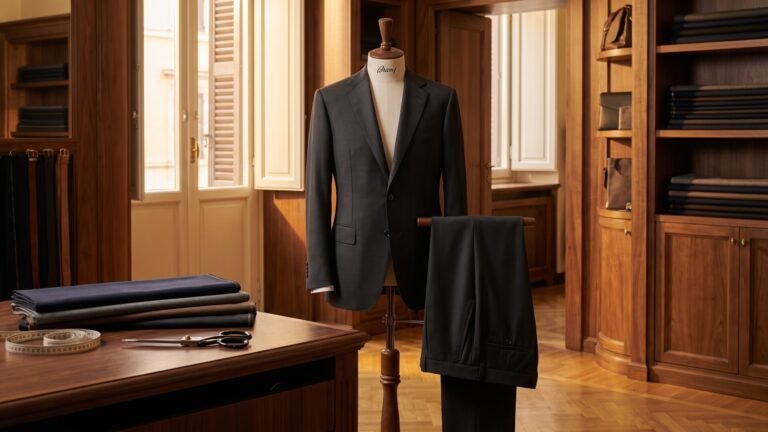
Stylish Brioni Suits for a Modern CEO
Brioni is one of the best-known names in Italian tailoring, and it is a frequent first stop for executives who want a suit that looks composed rather than loud. This guide is written for the buyer who has to wear a suit across a full working week: boardrooms, investor meetings, flights and dinners. It covers where Brioni comes from, what its suits cost in the US, how its ready-to-wear, made-to-measure and bespoke tiers differ, which fabrics and fits suit which situations, how Brioni compares with Kiton, Canali and Zegna, and how to care for the suit once you own it.
For the full brand story, see our complete guide to Brioni. For the wider category, our Italian suits guide and the Italian designer brands overview put Brioni in context.
Why Brioni Appeals to Executives
Brioni was founded in Rome in 1945 by the tailor Nazareno Fonticoli and the businessman Gaetano Savini, with a first boutique on Via Barberini. The house is widely credited with staging an early menswear runway show at the Sala Bianca of Palazzo Pitti in Florence in 1952. Its production is based in Penne, in Abruzzo, where it opened a plant in 1959 and a tailoring school, the Scuola di Alta Sartoria, in 1985. Today it is part of the luxury group Kering, which agreed to buy it in November 2011 and completed the purchase in January 2012 (the group was still called PPR at the time).
The house is in a transition period. Norbert Stumpfl, who had led its design since 2018, left in December 2025, and at the time Brioni did not name a successor; Federico Arrigoni, formerly deputy CEO of Saint Laurent, was appointed CEO by Kering in 2025. For a suit buyer this matters less than it would for a fashion label, because Brioni’s tailoring models and Penne workshops carry the house style, but expect seasonal details to shift.
For a working executive, the house’s history translates into a few practical advantages:
- Structured but not stiff: Brioni’s Roman cut has a defined shoulder and a canvassed chest that hold their shape through long days and flights, with softer interlinings than many heavily built English or German jackets.
- A full service ladder: you can start with ready-to-wear and move up to made-to-measure (Su Misura) or bespoke within the same house.
- Restrained styling: the cut and colors are conservative, so a Brioni suit rarely looks dated or showy in a conservative office.
- Cultural recognition: the label is known in film and business circles. Brioni dressed Pierce Brosnan in his James Bond films from GoldenEye (1995) and later Daniel Craig in Casino Royale (2006).
Brioni at a Glance: Ready-to-Wear, Made-to-Measure and Bespoke
| Tier | What it is | Lead time and fit | Best for |
|---|---|---|---|
| Ready-to-wear | Standard sizes made in the house’s models and fabrics | Available quickly; a tailor usually adjusts sleeves, trouser length and waist | Executives who need a suit now or buy while traveling |
| Made-to-measure (Su Misura) | A pattern adapted to your measurements, with a choice of fabric and details | Takes weeks; fitted after a trial garment | Buyers whose bodies sit between standard sizes |
| Bespoke | A pattern cut from scratch for you, with more fittings | The longest process; the highest level of personalization | Buyers who want a fully personal silhouette and have the time |
What a Brioni Suit Costs in the US
Ready-to-wear is the only tier with published prices. In November 2026, the US retailer Mitchell Stores listed full-price Brioni ready-to-wear suits from $6,500 to $12,995:
| Suit (as listed) | Cloth | US price, Nov 2026 |
|---|---|---|
| Plain navy, black or charcoal wool suits | Wool | $6,500 |
| Brunico suits (windowpane, tic weave, glen plaid) | Patterned wool | $6,500–$7,495 |
| 150’s wool suits (check, tonal, houndstooth) | Super 150’s wool | $7,500–$8,500 |
| Navy plaid suit | Wool and silk | $8,500 |
| Anthracite tonal pinstripe | Super 170’s wool | $8,900 |
| Escorial charcoal suit | Escorial wool | $12,995 |
The pattern is clear: the cut stays the same and the cloth drives the price, from a plain wool at the entry point to rarer fibres at the top. Made-to-measure and bespoke are quoted in the boutique, depend on the cloth you choose and cost more than ready-to-wear; ask what the quote includes (fittings, alterations, lead time). For comparison, Kiton’s own US site listed a herringbone virgin wool suit at $9,140 in November 2026.
Cost per Wear: A Decision Rule for Executives
Most guides stop at “it is an investment”. A clearer test is how often the suit will actually be worn. Taking the $6,500 entry price and assuming the suit stays in regular rotation for five years (46 working weeks a year), the arithmetic looks like this:
| How often you wear it | Wears over five years | Cost per wear |
|---|---|---|
| Twice a week | About 460 | About $14 |
| Once a week | About 230 | About $28 |
| Once a month | About 60 | About $108 |
- Choose Brioni ready-to-wear if you wear a suit most working days, fit a standard size with minor alterations, and want navy or charcoal in a plain wool: this is where the cost per wear is lowest.
- Choose made-to-measure if off-the-rack jackets need more than sleeve, hem and waist changes; heavy alterations on a ready-to-wear suit rarely fix the shoulders.
- Look at Canali or Zegna first if you wear a suit once a month or less: the Brioni premium buys softness and finish that you will rarely feel at that frequency.
- Skip the top cloths for daily wear: Super 170’s or Escorial cost more and are softer, but finer cloth generally wears faster, so they suit an occasional or evening suit rather than a Monday-to-Friday one.
Understanding Brioni Fits
Fit matters more than the label. Brioni offers several silhouettes, and their names and cuts change by season, so confirm the current naming in a boutique. In general terms, the choices break down as follows.
1. Classic, fuller cut
- Description: A more generous chest and leg that keeps clean lines while leaving room to move.
- Ideal for: Executives with athletic builds or those who prefer a traditional boardroom look.
- Styling tip: A silk tie in a muted tone and a white or pale blue shirt keep it formal.
2. Slimmer, contemporary cut
- Description: A tapered waist and leg for a sharper line.
- Ideal for: Leaner builds and creative or technology-sector offices.
- Styling tip: Keep accessories minimal so the lines stay clean.
3. Bespoke / Made-to-Measure
- Description: A suit built around your measurements and posture.
- Ideal for: Buyers who struggle with off-the-rack proportions.
- Customization options typically include:
- Shoulder construction and sleeve length
- Button stance and lapel width
- Trouser rise, taper and hem length
- Lining, buttons and monogramming
Fabrics and Materials
Brioni suits are made in fine Italian wools, with silk, linen and cashmere used in blends and lighter weights. Cloth choice shapes comfort and wear as much as the cut does.
1. Wool
- What the “Super” number means: Super 100s, 120s, 150s and so on describe the fineness of the wool fibre. Higher numbers feel softer but are generally more delicate, so a very high number is not automatically better for a suit you wear weekly.
- Seasonality: Medium-weight wool is the most versatile; heavier cloth suits winter, lighter weaves suit hot offices and travel.
2. Cashmere Blends
- Add softness and a slightly richer hand to jackets and soft tailoring. See how it is made in our guide to Italian cashmere.
- Softer cloths wear faster at the elbows and seat than firm worsted, so rotate them.
3. Silk and Wool-Silk Mixes
- Give a subtle sheen that suits evening dressing, such as dinners and receptions.
4. Summer Tropicals and Linen Blends
- Open-weave wool or wool-linen blends breathe better in warm climates while holding their shape.
- Linen creases easily; expect a more relaxed look than a worsted wool.
How a Brioni Suit Is Made
Published profiles of the house state that a Brioni jacket involves roughly 12,000 stitches and is pressed and steamed many times (about 80 by one account) during production. Not all of that is hand work, and Brioni, like most large tailoring houses, combines machine and hand stages, with hand finishing on elements such as lapels and buttonholes. If hand construction is the reason you are buying, ask the boutique exactly which operations are done by hand on the specific model, because it differs between lines.
For context on what “handmade” can and cannot mean at this level, see our explainer on handmade vs mass-produced Italian fashion.
The Made-to-Measure and Bespoke Process
Although details vary by boutique and market, the made-to-measure (Su Misura) and bespoke routes usually follow the same sequence:
- Consultation: you discuss how and where you will wear the suit: office, travel, events.
- Measurement: a tailor records detailed measurements and notes posture and shoulder slope.
- Fabric and details: you choose cloth, lining, buttons and monogram.
- Fitting: a trial garment is adjusted before final cutting and finishing.
- Delivery and final adjustment: small changes after the first wear are normal.
Ask in advance how many fittings are included, how long the process takes, and whether re-ordering your pattern later is simpler. Ready-to-wear remains the faster option if you fit standard sizes or need a suit for an upcoming event.
Brioni vs Kiton, Canali, Zegna and Armani
Executives rarely buy in a vacuum, so here is how Brioni sits against the other suit names readers ask about. These comparisons are general and based on each house’s positioning; try suits on before buying.
| Brand | Known for | Consider it if |
|---|---|---|
| Brioni | Roman tailoring, soft shoulder, full ready-to-wear, Su Misura and bespoke range | You want refined, restrained tailoring with several service levels |
| Kiton | Neapolitan tailoring and a strong emphasis on handwork | Hand construction is your priority |
| Canali | Accessible entry to Italian tailoring | You want Italian suits at a more moderate level |
| Zegna | Own-mill fabrics and a broad menswear range | You want fabric depth and wardrobe breadth from one brand |
| Armani | Soft, minimal tailoring; see our guides on Armani suits through the decades and Armani Collezioni | You prefer a modern, minimalist silhouette |
What You Are Paying For
At this price level the money goes into four things: cloth quality, the amount and quality of handwork, the fit process, and the brand. Cloth and construction affect how the suit wears for years, so judge these first. The brand and boutique experience are real parts of the price but do not change how the suit performs, so a buyer focused on value should compare fabric, canvas construction and fitting service across houses rather than relying on reputation. Resale value is uncertain, and we do not assume a suit will hold it.
Dressing Guide: Which Brioni Suit for Which Occasion
- Board and investor meetings: Navy or charcoal in a medium-weight wool, single-breasted, with a white or pale blue shirt.
- Travel: A wrinkle-resistant wool and an unstructured jacket that survives a flight; pack a garment bag.
- Evening events: A dark suit in a fine wool or wool-silk blend, or a formal dinner jacket where the dress code calls for it.
- Warm climates and summer: Open-weave wool or a wool-linen blend in a lighter color.
Accessories for the Modern Executive
1. Ties
- Silk ties: Solid, striped or subtly patterned.
- Width: Around 2.5-3 inches, matching the width of the lapel.
2. Pocket Squares
- A folded white linen square is the safest choice; add color only if it complements the tie.
3. Shoes
- Oxford or Derby shoes: Polished leather in black or deep brown. See our best Italian dress shoes and the Italian dress shoes guide.
- Loafers: Suitable for summer or less formal offices.
- Makers to look at: Santoni and Tod’s are both covered on this site.
4. Watches and Small Accessories
- A slim, understated watch suits a suit best; see our guide to Italian designer watches.
- Keep cufflinks and tie bars plain.
If you favor quiet, logo-free dressing, the thinking behind quiet luxury pairs naturally with a Brioni suit.
Why Fit Matters More Than Labels
A well-fitted mid-priced suit usually looks better than an ill-fitting expensive one. Check shoulder seams that end at your shoulder bone, a collar that sits flat against the shirt, sleeves that show roughly half an inch of shirt cuff, and trousers with a clean break. Even a ready-to-wear Brioni will usually benefit from alterations to the sleeves, hem and waist.
Building a Brioni Wardrobe
If you wear suits several days a week, a small rotation protects each one and, as the cost-per-wear table shows, spreads the price over more wears. A practical starting set is a navy and a charcoal suit in medium-weight wool, then a lighter-weight option for summer, and an evening-appropriate dark suit if events are part of your calendar. Rotating suits gives the fabric time to recover between wears.
Around the suits, the same restrained approach works for the rest of an executive wardrobe: a fine cashmere knit from Loro Piana or Brunello Cucinelli for dress-down Fridays and flights, and a dark wool overcoat or a slim down coat from Herno that sits cleanly over a tailored jacket. Our Italian designer clothing guide covers the full wardrobe.
Buying Safely
Buy from Brioni boutiques or established authorized retailers where you can. Heavily discounted “new” Brioni suits on marketplaces deserve caution when the full price starts at $6,500. If you consider secondhand, ask for the label, care tag and any purchase documentation, and read our guide on how to spot authentic Italian designer pieces. No checklist can prove authenticity on its own, so use a seller that offers returns and verification.
Brioni Suit Care for Longevity
- Dry clean sparingly: Frequent dry cleaning wears the cloth. Brush after wearing, steam to release creases, and clean only when needed, using a specialist experienced with fine fabrics.
- Store properly: Use a wide, shaped hanger and a breathable garment bag, away from damp.
- Rotate: Avoid wearing the same suit on consecutive days.
- Repair early: Re-sew loose buttons and small seam failures promptly; a good tailor can also re-line or let out a suit as your fit changes.
Frequently Asked Questions About Brioni Suits
How much does a Brioni suit cost?
In November 2026, full-price Brioni ready-to-wear suits at the US retailer Mitchell Stores ranged from $6,500 for plain wool to $12,995 for an Escorial wool suit, with most Super 150’s styles at $7,500 to $8,500. Made-to-measure and bespoke are quoted in the boutique and cost more, depending on the cloth.
Where are Brioni suits made?
Brioni’s tailoring production is based in Penne in Abruzzo, Italy, where it opened a plant in 1959 and its tailoring school in 1985. Check the label of the specific item for its country of manufacture, since accessories and other categories may be made elsewhere.
Who designs Brioni now?
Norbert Stumpfl, Brioni’s design director since 2018, left the house in December 2025, and no successor had been announced at the time. Federico Arrigoni became CEO in 2025. The core tailoring models and the Penne workshops carry the house style, so the suits themselves change less than seasonal collections do.
Is Brioni better than Kiton?
Neither is better in general. Kiton is Neapolitan and emphasizes handwork, with a softer, more sculpted shoulder; Brioni is Roman, slightly more restrained, and offers a wider ready-to-wear range. Prices overlap: a Kiton herringbone wool suit was $9,140 on Kiton’s US site in November 2026. Try both cuts on your build before deciding.
Can a Brioni suit be altered?
Yes. Sleeve length, trouser hem and waist are routine alterations, and suits usually have some seam allowance for letting out. The shoulders and jacket length are hard to change, so get those right when you buy. Use the boutique’s tailor or an experienced alterations tailor, and ask whether alterations are included in the price.
Which Brioni suit color is the most versatile?
Navy and charcoal in a medium-weight wool work across most business settings and seasons, and they are also the entry-priced plain wool styles, which keeps the cost per wear lowest if you wear the suit every week.
Conclusion
A Brioni suit is a good fit for an executive who wears tailoring most working days and wants quiet, well-cut suits with a clear route from ready-to-wear to bespoke. Decide the tier first, then fabric weight, then fit, and let wear frequency decide whether the price makes sense. Comparing it with Kiton, Canali and Zegna will show where your priorities lie.
Keep exploring: Brioni: The Definitive Guide | Italian Suits | Italian Designer Brands