Top Italian Handbag Brands for 2026
For years, I approached the annual ritual of “which bags to buy” with a kind of cynical exhaustion. The same names. The same logos. The same heavily photographed arm candy, circulating from season to season like a game of musical chairs where the music never actually stopped.
Then I sat in a Milanese café in September 2025, two days into Fashion Week, and watched a man walk past with a bag I did not recognize.
It was not Gucci. It was not Prada. It was not any of the names I had memorized over two decades of writing about this industry. The leather had a depth that suggested hours of hand-work. The silhouette was simultaneously classic and entirely unfamiliar. The man carrying it was not performing. He was simply walking, and the bag walked with him.
I asked someone later what it was.
Serapian, they said. The new collaboration with an artist you haven’t heard of yet. You haven’t written about it?
I had not. I had been looking at the same lists, the same houses, the same twenty names that dominate every “top brands” article written since 2010. And in doing so, I had missed something essential: Italian handbag design in 2026 is not about which brand is biggest. It is about which brands are becoming.
This is the guide I wish someone had given me before I spent years walking past the future without recognizing it. The top Italian handbag brands for 2026 are not a ranking. They are a landscape—and it has shifted.
What Changed While We Weren’t Looking
Let me start with the context, because the brands do not exist in a vacuum.
2026 has brought something unexpected to Italian luxury: a collective exhale. After years of logo mania, of status signaling so aggressive it bordered on cartoon, the tide has turned. The man who knows what he wants no longer needs to announce it from across the room.
The shift is generational. Younger buyers—men in their twenties and thirties with disposable income and digital-era skepticism—have rejected the idea that a bag should function primarily as a billboard. They want leather they can feel. They want construction they can trust. They want names that require explanation, not recognition.
This has created space for brands that were never famous, and for famous brands to remember what made them famous in the first place. The result is a market more interesting than any I have seen in twenty years of watching this industry.
The Old Guard That Still Leads
Let me begin with the names you know, because they are not going anywhere. But the reason to buy them in 2026 is different than it was in 2016.
Gucci under Sabato De Sarno has entered what I can only describe as a quiet period—and I mean that as a compliment. After years of Alessandro Michele’s maximalist exuberance, the brand has dialed back. The horsebit loafer remains. The Jackie bag remains. But the leathers are richer, the silhouettes more restrained, the logos smaller.
For a man, the 2026 Gucci offering is about one thing: the bag that does not scream. The leather Ophidia in dark brown, the Horsebit 1955 in unadorned calf—these are bags for the man who wants the world to know he has arrived without announcing the flight number.
Prada continues its unlikely reign as both intellectual and accessible. The brand that your grandfather may have dismissed as “that nylon company” has spent two decades proving him wrong. For 2026, the focus is on the Saffiano leather that Miuccia Prada herself patented in 1913—a leather so distinctive that you can identify it from across a room by its cross-hatched texture alone.
The Prada bag for a man in 2026 is the triangular logo pouch worn cross-body, or the soft briefcase that looks like it has accompanied you to a thousand meetings. The trick with Prada is not to try too hard. Their bags are designed for men who have things to carry, not statements to make.
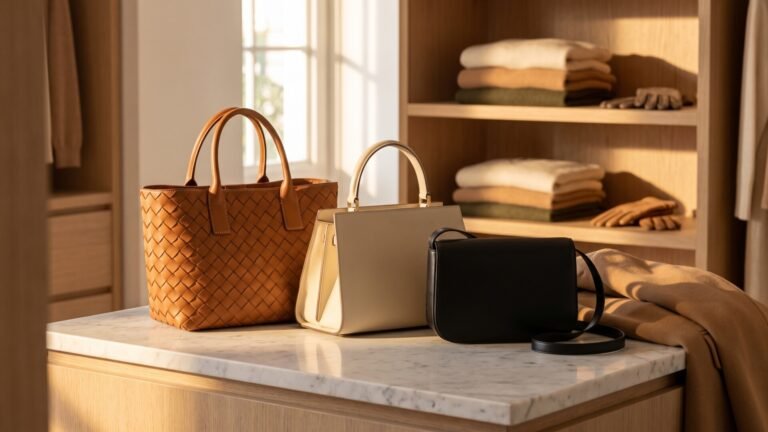
Bottega Veneta remains the intellectual’s choice, largely because Matthieu Blazy has understood something fundamental: when you remove the logo entirely, the bag must earn its keep through texture, construction, and form alone.
The Intrecciato weave—that distinctive leather lattice—is not a pattern printed on material. It is the material itself, created by weaving thin strips of leather by hand. A Bottega bag in 2026 is for the man who knows that the absence of a logo is itself a kind of signal, and who is comfortable sending signals that only some will receive.
I bought my first Bottega bag five years ago. I carry it more than any other. Not because it is the most practical—it is not—but because no one has ever asked me if it is real.
The Florentine House That Refuses to Rush
Serapian is the oldest name on this list that you may not know, and that is exactly how they want it.
Founded in Milan in 1928 by Stefano Serapian, the house has operated for nearly a century in what can only be described as deliberate obscurity. They have never chased trends. They have never expanded beyond what their ateliers can sustain. They have simply made bags, quietly, for people who know.
In 2024, Serapian collaborated with the artist and designer Bethan Laura Wood on a collection called Secret Garden . The bags were not bags in the conventional sense. They were objects—sculptural, colorful, unmistakably the work of a mind trained in something other than accessory design.
For 2026, Serapian has returned to its roots while retaining the creative confidence that collaboration unlocked. The Meneghino bag, named for the traditional Milanese mask, is the brand’s signature: a soft, unstructured silhouette that requires hours of hand-stitching to achieve its apparently effortless drape.
The Serapian man is not young, necessarily. But he is curious. He is the man who, when asked what he is carrying, enjoys the brief pause before he answers.
The Neapolitan That Thinks Like a Shoemaker
E. Marinella is famous for ties. For a hundred years, that is what they did: neckwear, made by hand in Naples, worn by men who understood that a tie is not a decoration but a conclusion.
In 2025, they did something unexpected. They applied the same logic—the same leathers, the same construction techniques, the same Neapolitan refusal to compromise—to bags.
The result is a small collection of accessories that feel like they were made by people who have spent their lives thinking about how things fold, drape, and endure. The leather is vegetable-tanned in Tuscany. The stitching is done by hand in Naples. The bags are not available everywhere, and that is the point.
For a man in 2026, an E. Marinella bag is a signal so subtle that most will miss it. The ones who notice are the ones worth talking to.
The Roman Rebel
Fendi is not a rebel, historically. Fendi is the establishment—Roman, family-founded in 1925, synonymous with the kind of luxury that does not need to explain itself.
But in 2026, Fendi is doing something interesting. They are leaning into men’s bags in a way they never have before.
The Peekaboo, originally designed in 2009, has become the brand’s most recognisable silhouette. For men, the Peekaboo ISeeU Essential offers a soft, compartmented structure that works as both briefcase and weekender. The Selleria line, hand-stitched using a technique derived from saddle-making, represents the absolute peak of Fendi’s craft.
The Fendi man in 2026 is the man who understands that Roman luxury is different from Milanese luxury. It is warmer. It is more tactile. It is less concerned with what people think and more concerned with how things feel.
I spent an hour in Fendi’s Rome store last year, holding bags I had no intention of buying. The saleswoman—a woman in her sixties who had worked there for forty years—did not try to sell me anything. She just talked about leather. About the difference between cuoio and vacchetta. About how a bag changes over twenty years.
I left without a bag. I also left understanding something I had not understood before.
The Younger Generation
Valextra is not young—founded in Milan in 1937—but they have spent the last decade positioning themselves as the thinking man’s alternative to the usual suspects.
Their bags are instantly recognizable to those who know: clean lines, no external branding except the small black Costa edging that frames each piece, and a distinctive “marca” black triangle at the clasp. The leather is often untreated, designed to develop a patina over decades rather than remain pristine.
For 2026, Valextra’s focus is on the Serie S, a line of bags and backpacks designed for the man who moves through cities. They are light. They are structured. They are the opposite of performative.
Gianni Chiarini offers something different entirely: accessible luxury without apology. Founded in Florence in 1970, the brand has spent five decades making bags that are beautiful without being precious, well-made without being unaffordable.
For a man buying his first serious Italian bag, or for the man who needs a bag for travel that he will not worry about losing, Chiarini is the answer. The leather is good. The construction is solid. The prices will not make you wince.
The Bridge is the oldest of this younger group, founded in Florence in 1969, and they have never changed what they do. Vegetable-tanned leather, brass hardware, a distinctive honey-brown colour that deepens with age. Their bags look like they have been in your family for generations on the day you buy them.
The Bridge man is the man who does not care about fashion. He cares about things that last.
The Ones to Watch for 2026
A few names that are not yet household, and may never be, but deserve your attention.
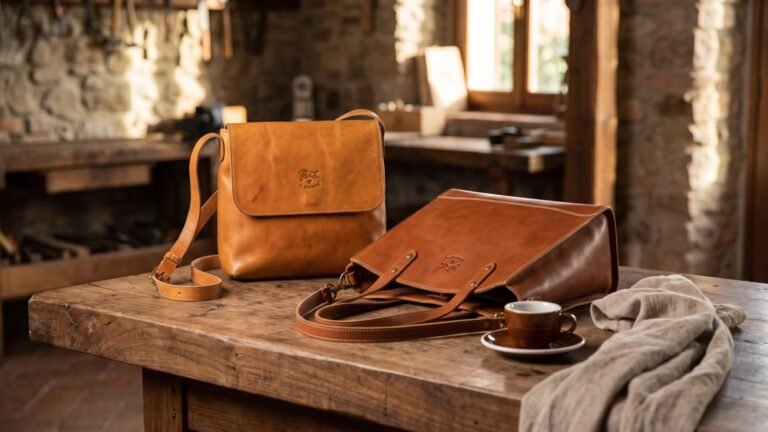
Il Bisonte was founded in Florence in 1970 and has spent fifty-five years making leather goods that feel like they were dug up from a beautiful past. The name means “the bison,” a reference to the thickness and texture of their leather. Their bags are not polished. They are not refined. They are simply themselves.
For 2026, Il Bisonte has introduced a line of men’s backpacks and messenger bags that feel like they have already accompanied you on a dozen trips. If you want a bag that looks new, look elsewhere. If you want a bag that looks like it has stories to tell, start here.
Ghiaia is newer, founded in 2015, and named for the pebbles of the River Po. Their bags are designed to be carried, not displayed—soft leathers, minimal hardware, silhouettes that conform to the body rather than imposing on it.
The Ghiaia man is young, urban, and uninterested in status. He wants a bag that holds his things and does not demand attention. That is surprisingly hard to find, and Ghiaia has found it.
Cuoiofficina operates out of a small workshop in Tuscany, producing bags in limited quantities for people who write to them directly. Their website is minimal. Their Instagram is sparse. Their bags are extraordinary.
For 2026, they are producing a small run of document bags in walnut-dyed vacchetta leather. I have not seen them in person. I have seen photographs. That is enough.
What to Look For, Regardless of Name
I have spent this article talking about brands, but I need to end with something else.
A brand is a promise. A bag is a thing. And after you have owned enough bags, you stop caring about promises and start caring about things.
Here is what I look for now, regardless of whose name is on the leather.
The leather itself. Vegetable-tanned leather ages. Chrome-tanned leather does not. Vegetable-tanned leather develops a patina—a darkening, a softening, a record of every day it has accompanied you. Chrome-tanned leather looks the same on year five as it did on day one, which sounds like a benefit until you realize that sameness is the opposite of relationship.
The stitching. Machine stitching is uniform. Hand stitching is irregular, slightly, in ways that you can feel before you can see. A hand-stitched bag will last longer because the thread is waxed and the stitches are individually tensioned. A machine-stitched bag will fail at the seams eventually.
The hardware. Solid brass, not plated. Solid brass will develop its own patina. Plated metal will reveal its base eventually, and the reveal is never attractive.
The weight. A bag should not be heavy when empty. If it is, the materials are either too thick or the construction is compensating for something. The best Italian bags are light in the hand and heavy in the presence.
The smell. This sounds absurd until you have smelled it. Good leather has a smell that cannot be faked. It is warm, slightly sweet, unmistakable. If a bag smells like chemicals, it is not the bag for you.
I keep thinking about the man in Milan, the one with the Serapian I did not recognize.
I did not speak to him. I did not ask about the bag. I just watched him walk past, and I realized that for the first time in years, I had seen a bag I could not identify and wanted to know more about.
That is the moment this list became possible. Not the moment I finished researching. The moment I understood that the brands worth knowing are the ones you do not already know.
The bag you carry today will outlive you. Someone who has not been born yet will hold it in their hands and wonder about the life it lived. The question is not whether the name on the leather will impress them.
The question is whether the leather itself will have something to say.
[Shop Gucci Bags]
[Shop Prada Bags]
[Shop Bottega Veneta]
[Discover Serapian]
[Browse E. Marinella Accessories]
[Shop Fendi Mens Bags]
[Explore Artisanal Collections]