The history of the Missoni Ziz Zag pattern
The Missoni zig zag looks like a print, but it is not one. The stripes, peaks and colour shifts are built into the knitted fabric itself, which is why the pattern has survived seven decades of changing fashion and why Missoni pieces tend to hold their shape and colour. This guide explains where the zig zag came from, how it is made, how it changed from decade to decade, and what to check if you want to buy a piece, new or vintage.
In short: Ottavio and Rosita Missoni opened a small knitwear business in Gallarate, Lombardy, in 1953. Using Raschel knitting machines, the type Rosita’s family used for shawls, they developed colourful striped and zig zag knits that became the house signature. The pattern is knitted in, not printed on.
The House of Missoni: A Legacy Woven in Colour
To understand the zig zag, start with the family behind it. Ottavio Missoni, known as Tai, was an athlete who competed in the 1948 London Olympics, where he met Rosita Jelmini. Rosita was born in Golasecca, Lombardy, into a family of textile artisans who made shawls. In 1953 the couple started a small knitwear business in Gallarate, and the company later moved production to Sumirago, near Varese, where the factory still stands.
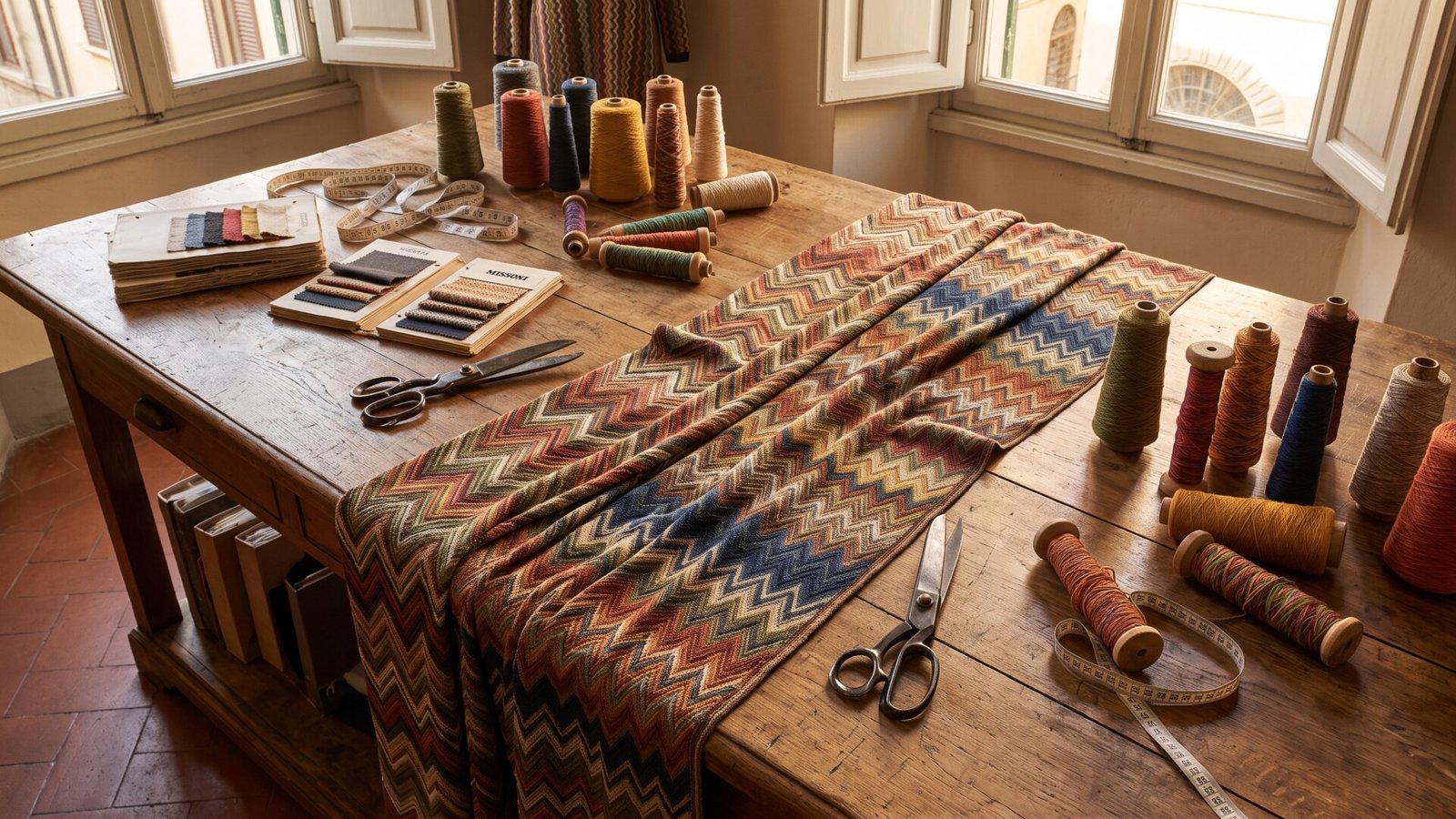
The technical starting point was the machinery. Rosita’s family used Raschel machines, and the Missonis adapted that technology to produce patterned, lightweight knitwear in colours that Paris-led fashion of the time rarely used for knits. Rosita has also named the painter Sonia Delaunay among her inspirations. The result is a textile in which the pattern is part of the structure rather than a surface decoration, which gives the fabric its characteristic drape.
This is the first thing to understand when you shop: a Missoni garment is a piece of engineered textile that happens to read as a pattern. It also explains why the brand is closely tied to Italian knitwear traditions, covered more broadly in our guide to Italian designer brands.
The Birth of the Zig Zag: More Than a Pattern
The angular zig zag, often described as chevron or flame-stitch (fiammato) striping, became the brand’s defining motif from the 1960s onward. It grew out of the Missonis’ interest in placing adjacent colours against each other so that they seem to vibrate, an effect that the sharp angles of a zig zag exaggerate.
The timing matters. In the 1960s, op art and geometric abstraction were influencing posters, textiles and dresses. Missoni’s knits were abstract and graphic, yet soft and wearable, which separated them from both printed fashion and conventional sweaters. Treat precise claims about the exact year the first zig zag was knitted with caution: the house tells its own origin story, and published histories differ on dates. What is well documented is that striped and zig zag knits on Raschel machines were the foundation of the brand’s identity from its early decades.
How the Zig Zag Is Made: Knitted In, Not Printed
Printed fabric is dyed or printed after it is made; a Missoni zig zag is created by the yarns themselves. Coloured yarns are loaded onto the machine in a planned sequence, and the knitting structure shifts the stitches so the colour bands rise and fall. A few practical consequences follow:
- Colour is in the yarn. Because the fibre is dyed before knitting, the colour does not sit on the surface and cannot rub off the way a print can. Older pieces often keep their colour well, although sun and washing still age them.
- The back looks like the front. A knitted-in pattern shows on both sides of the fabric, whereas a print usually looks paler or blank on the reverse.
- Stretch and drape. Knitted structures move with the body, which is why zig zag dresses are cut close and simple.
- Pattern placement is a construction decision. Panels have to be cut so that the zig zag lines up at seams, which takes more fabric and more skill than cutting a plain knit.
Yarn blends vary by garment and season, and the house uses fibres including cotton, wool, silk, viscose and, in some pieces, cashmere or metallic thread. Always read the composition label on the exact item, because the blend determines both warmth and care.
Design Evolution: From Radical to Recognisable
The zig zag has never been static, and dating a piece by its palette and scale is one of the more useful skills for vintage buyers.
| Period | Typical look | What to know when buying |
|---|---|---|
| 1960s-1970s | Larger-scale stripes and zig zags, often in earthy tones with bright accents | Most collectible; check yarn for moth damage and stretched knit |
| 1980s | More saturated palettes and wider commercial range | Widely available vintage; condition varies a lot |
| 1990s-2000s | New scales and categories; the Missoni children manage the business from 1997 | Good value entry point for vintage |
| 2010s-today | Heritage motifs reinterpreted, tonal and neon versions, expanded accessories and home | Check which line the piece belongs to (see below) |
From 1997 the three children, Angela, Luca and Vittorio, took over management, sharing creative and financial responsibilities, and Angela Missoni led creative direction for many years. Creative leadership has changed since: Filippo Grazioli was appointed creative director in 2022, and press reports in late 2024 announced Alberto Caliri, a longtime Missoni designer, as his successor. Because appointments change, check the brand’s own website for the current line-up before quoting it.
Cultural Significance: The Zig Zag in the Zeitgeist
The zig zag became shorthand for a relaxed, artistic kind of Italian luxury: colourful but not logo-driven. That is why it sits comfortably next to the quieter side of Italian fashion yet is unmistakable from across a room. The approach to colour and line has influenced many knitwear designers and colour-blocking trends since. It has also been a subject for museums and design exhibitions, which is one reason vintage pieces are collected as textiles as well as clothes.
Contemporary Applications: The Zig Zag Everywhere
The pattern now appears across apparel, accessories and home, each offering a different entry point.
Apparel
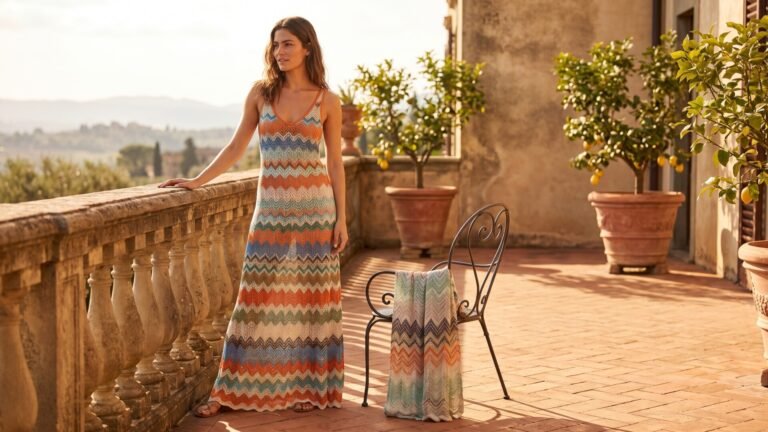
The dress is the signature piece: a close-cut knit where the zig zag lines run horizontally or at an angle across the body. Beyond dresses, the pattern appears on sweaters, cardigans, beachwear and scarves. Scarves and small accessories are the lowest-cost way to try the pattern, while knitwear and dresses carry the full construction story.
Home Textiles
Missoni Home is a separate line of throws, cushions, towels and rugs. Luxury retailers list wool-and-cashmere throws in the zig zag family at roughly 130 x 190 cm. Prices vary by model and retailer, so check current listings.
Accessories
Bags and shoes use the pattern in fabric or knit panels. These are easier to integrate into a wardrobe than a full dress, and the pattern is often the only design feature, so judge them by construction, lining and hardware rather than by the print alone.
Buying Considerations: What to Check
Buy from reliable sources. Missoni is widely imitated. Buy new pieces from the brand or established retailers, and for pre-owned pieces use sellers who provide clear photos of labels, composition tags and care labels. No checklist can prove authenticity on its own, so if the price is high, use a professional authentication service.
Inspect the fabric. The knit should feel even and substantial for its fibre, with the pattern visible on both sides. Thin, scratchy or printed-looking fabric is a reason to ask questions.
Check pattern alignment at the seams. On well-made pieces the zig zag lines are matched across side seams and sleeves. Misaligned patterns are a quality warning, though not proof by themselves.
Judge condition on vintage. Look for pilling, snagged yarns, stretched hems, moth holes and underarm staining. Light wear can be acceptable if reflected in the price; structural damage usually is not.
Know which line you are buying. The house has sold under several labels and lines over the years, including more accessible ones, and Missoni Home is a separate product range. Check the label and the retailer’s description so you know whether you are buying the main collection.
Think about how you will wear it. A zig zag dress is a statement piece. Consider whether it works with the rest of your wardrobe before buying.
Cost Per Wear and Resale: A Realistic View
Cost per wear. Divide the price by the number of times you realistically expect to wear the piece. A garment costing $1,000 to $2,000 that is worn 50 times costs $20 to $40 per wear; worn five times, it costs $200 to $400. The calculation only favours a piece you will actually reach for, which is why a versatile cardigan often beats a showpiece dress.
Resale. There is an active secondhand and vintage market for Missoni, and rare, well-kept older pieces can be sought after. Resale prices vary widely by era, condition and style, and no piece should be bought on the assumption that it will gain in value. Treat any resale benefit as a bonus, and check recent sold listings on resale platforms before deciding.
Durability. Knitted-in colour and solid construction help, but knitwear still needs careful handling: follow the care label, wash cool or dry-clean as directed, dry flat and store folded rather than hung so the knit does not stretch.
What Most Buyers Get Wrong
The most common misconception is that Missoni is only a summer brand. The beachwear and light dresses are well known, but the house also produces heavier knits, cardigans and coats in deeper palettes.
The second is assuming everything with the zig zag is equivalent. Main-line fashion, accessories, licensed or accessible lines and the home collection differ in materials and price, so compare like with like.
Where to Start: Recommended Pieces
If you want to bring the zig zag into your wardrobe or home, these are sensible starting points, from the signature garment to the easiest entry.
The Signature Dress
The [Affiliate: Missoni Zig Zag Knit Dress] is the garment most closely associated with the pattern. It works as a summer piece and can be layered in cooler weather.
The Home Statement
For living with the pattern every day, the [Affiliate: Missoni Home Zig Zag Throw Blanket] is the usual choice, and it makes an easy gift for someone who likes Italian design.
The Everyday Accessory
For a smaller dose of the pattern, consider the [Affiliate: Missoni Zig Zag Tote Bag], which carries the look into daily use.
The Beach Essential
For holidays, the [Affiliate: Missoni Zig Zag Swimwear] is the most recognisable summer option.
Why the Pattern Endures
Three things explain the zig zag’s longevity. It rewards close looking, because the colour interplay and the knit texture are both visible up close. It is tied to a specific moment in postwar Italian textile industry, when Lombardy’s knitting expertise met a new appetite for colour. And because scale and palette vary so much from season to season, each piece has its own character even within one recognisable signature.
The Future of the Zig Zag
Missoni continues to rework the motif through changing creative direction while keeping the zig zag as its most recognisable asset. As the brand changes, the practical advice stays the same: buy pieces whose construction and colours you will keep using, and read the label to know exactly what you are getting. For more on the house, browse our Missoni guide and the wider Italian designer brands overview.
Frequently Asked Questions About The Missoni Zig Zag Pattern
Is the Missoni zig zag printed or knitted?
It is knitted. The coloured yarns form the pattern during knitting, so the design is part of the fabric structure and is visible on both sides.
When did Missoni start?
Ottavio and Rosita Missoni started the business in 1953 with a small knitwear shop in Gallarate, Lombardy. Production later moved to Sumirago.
What machines make Missoni knitwear?
The house became known for Raschel machines, the type Rosita’s family used for shawls, to produce its patterned knits.
Is Missoni only for summer?
No. Beachwear and light dresses are well known, but the brand also makes heavier knits, cardigans and coats for colder months.
How can I tell if a vintage Missoni piece is authentic?
Check labels, composition tags, seam finishing and pattern alignment, and compare with documented examples. No checklist proves authenticity, so use a professional authentication service for expensive pieces.
Will a Missoni piece keep its value?
Some older pieces in good condition sell well on the secondhand market, but values vary widely and there is no guarantee. Buy for use first and check recent sold listings.