Missoni: The Italian House That Made Knitwear Legendary
If you talk Italian fashion, names like Gucci, Versace and Prada get a lot of the shine. But one Italian house is known above all for colorful knitwear: Missoni, the label that turned knitted zig-zag stripes into a signature recognizable from across a room.
Founded in post-war Italy, Missoni began as a family business and spent most of its history under family control. That changed in 2026, when the founding family sold its remaining shares (more on that below). This guide covers where Missoni comes from, its signature patterns, who runs the house today, what the pieces cost and why, and how to tell whether it suits you.
Missoni at a Glance
| Question | Answer |
|---|---|
| Country of origin | Italy. Founded in 1953 by Ottavio and Rosita Missoni in Gallarate (Varese province); the company is headquartered in Sumirago, in the same province. |
| Known for | Multicolored knitwear: zig-zags, stripes, waves, flame-effect fiammato and patchwork-like patterns |
| Is it luxury? | Yes. Main-line knit sweaters were listed at about $900 to $1,400 full price at US retailers in 2026, with crochet and special pieces higher, and a more accessible M Missoni line below it. |
| Creative director | Alberto Caliri (interim creative director from May 2021; reappointed in October 2024 after Filippo Grazioli’s 2022–2024 tenure) |
| Ownership (2026) | Italian fund FSI holds the majority (reported at about 73%) and Germany’s Katjes International holds about 27%, with a call option that could make it the controlling shareholder |
The Origins — From a Basement Workshop to Italian Fashion Pioneer
Missoni’s story begins in northern Italy after World War II. Ottavio Missoni was a champion athlete who competed in the 400-metre hurdles at the 1948 London Olympics, where he met Rosita Jelmini, whose family ran a textile business. They married in 1953 and founded Missoni the same year, starting a small knitwear workshop in the basement of their home in Gallarate. Ottavio had begun making knitted tracksuits for athletic teams, and the couple turned that sportswear know-how into knitwear that was modern and wearable.
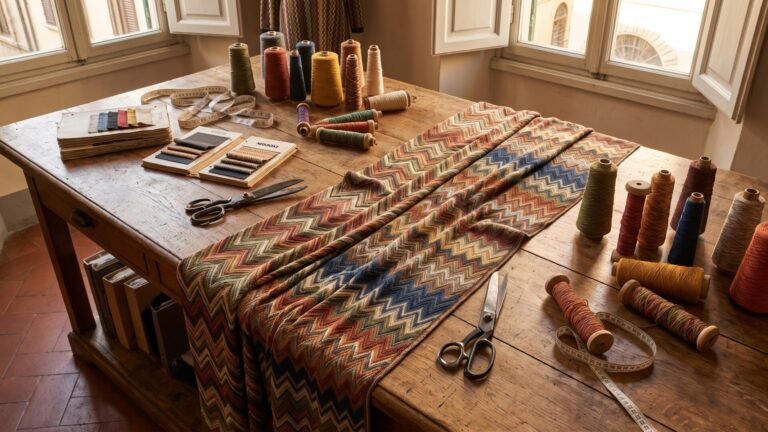
The first collection under the Missoni label was presented in Milan in 1958. At the time, knitwear was often seen as utilitarian. Combining hand-finishing with machine knitting, the couple experimented with textures, patterns and colors, and their multicolored knitted stripes became known as “Missoni stripes”. The turning point was the Raschel knitting machine, which the family nicknamed “Macchina-Mago” (the magic machine) and which retailers still credit for the zig-zag.
Key Dates in Missoni’s History
| Year | Milestone |
|---|---|
| 1953 | Ottavio Missoni and Rosita Jelmini marry and found the company |
| 1958 | First collection under the Missoni label, shown in Milan |
| 1967 | Missoni shows at the Pitti Palace in Florence |
| 1969 | Factory built in Sumirago |
| 1973 | Neiman Marcus Fashion Award |
| 1981 | Home furnishing fabrics, the roots of Missoni Home, are well established |
| 1996–97 | Control passes to the three children; Angela Missoni takes over creative direction |
| 2011 | Missoni for Target sells out within about a day |
| 2013 | Ottavio Missoni dies on 9 May |
| 2018 | FSI buys a 41.2% stake for €70 million (announced in June 2018) |
| 2021 | Angela Missoni steps back from design in May; Alberto Caliri becomes interim creative director |
| 2022 | Filippo Grazioli named creative director; Caliri moves to Missoni Home |
| 2024 | Grazioli leaves; Caliri reappointed creative director (October) |
| 2025 | Rosita Missoni dies on 2 January |
| 2026 | Family sells its remaining shares; FSI ends up with about 73% and Katjes with about 27% (announced in March, completed in May) |
Signature Missoni Patterns and How to Recognize Them
If you think of Missoni, you probably imagine zig-zags, stripes and waves in many colors. The colors are not printed on; they are knitted into the fabric, which gives each piece depth and a slightly irregular, hand-finished look. These are the patterns you will see most often, new and vintage:
| Pattern | What it looks like | Where you see it |
|---|---|---|
| Zig-zag (chevron) | Multicolor V-shaped stripes, knitted as a jacquard on Raschel machines | Sweaters, cardigans, dresses, home textiles |
| Fiammato | Blurred, flame-like color bands from space-dyed yarn | Knits and trousers; often in softer palettes |
| Stripes and waves | Horizontal or undulating bands of many shades | Polos, cardigans, swimwear |
| Patchwork | Blocks of different knits combined in one garment | Archive and runway pieces since the 1970s |
| Crochet and open knits | Lacy, airy knits, sometimes with metallic yarn or sequins | Summer tops, dresses, beachwear |
Retailers date the zig-zag variously to the late 1950s or the 1960s; we trace how it developed in our deep dive on the history of the Missoni zig-zag pattern.
If you are buying vintage, read the label as carefully as the pattern. Resale listings mix main-line Missoni with secondary labels such as Missoni Sport (seen on 1990s pieces) and M Missoni, plus licensed home and beach products. All use the same pattern language, so compare a listing only with pieces from the same label and decade.
The Technical Innovation Behind Missoni
Missoni’s strength is not only artistic but technical. The house developed ways to produce complex multicolor patterns on knitting machines while keeping a crafted look. Documented milestones include:
- Using machine knitting to create multicolored stripes that would be impractical by hand
- Patchwork pieces made from leftover knitwear: at a 1971 show in Cortina, Ottavio built eight outfits from scraps
- Knitted and leather furnishing fabrics for the furniture maker Saporiti in the mid-1970s, an early step toward Missoni Home
Family-Run Fashion — and What Changed in 2026
For decades Missoni was unusual among luxury brands because it stayed family-centered. Ottavio and Rosita worked alongside their children, who took control of the business in 1996. Angela Missoni became creative director in 1997 and led design until 2021; her profile is in our Angela Missoni article.
The “family-owned, never absorbed by a conglomerate” description no longer applies. The Italian fund FSI bought a 41.2% stake for €70 million in 2018, and in 2026 it acquired the rest of the family’s shares while Katjes International, through its Katjes Quiet Luxury unit, bought about 27% (deal completed in May 2026). Katjes holds a call option that could let it become the majority owner. Reporting describes the family as staying involved through the Fondazione Ottavio e Rosita Missoni. Livio Proli remains CEO, and FSI co-founder Barnaba Ravanne became president.
Missoni on the Global Stage
1950s–1970s: Milan, Florence and the United States
After the 1958 Milan debut, the house showed at the Pitti Palace in Florence in 1967, a presentation that drew wide attention, and received the Neiman Marcus Fashion Award in 1973. Its focus on wearable, colorful knitwear carved out a niche between couture and casual dressing.
1980s–2000s: Missoni Home and Lifestyle
The brand expanded beyond clothing into home textiles (bedding, cushions and throws, growing out of the furnishing fabrics of the 1970s and 1980s), fragrances and accessories such as bags, scarves and shoes. Missoni Home later furnished large hospitality and residential projects, including a Manila tower in 2012 and a Dubai waterfront building under a 2021 agreement. Eight new Missoni-branded residential projects have also been reported as planned for cities such as Marbella, Lisbon and Bodrum.
Missoni Menswear
Menswear grew out of the house’s sportswear roots, and Ottavio’s own uniform was a multicolored cardigan worn even where formal dress was expected; a recent runway collection reprised it as its hero piece. Today’s range covers zig-zag and striped sweaters and cardigans, patterned shirts and polos, and accessories such as scarves and knit hats. Recent reporting says the new owners plan to strengthen menswear and expand into small leather goods, bags and footwear.
Iconic Missoni Designs
1. Zig-Zag Knit Dresses, Sweaters and Cardigans
The quintessential Missoni look: colorful, textured and wearable. As a price reference, one zig-zag oversized lamé wrap cardigan (83% viscose, 17% metallic fibres, made in Italy) was listed at about $1,560 full price on Mytheresa in October 2026, discounted to roughly $1,250. The multicolored cardigan in particular is the piece most associated with the founders.
2. Crochet Knits and Summer Pieces
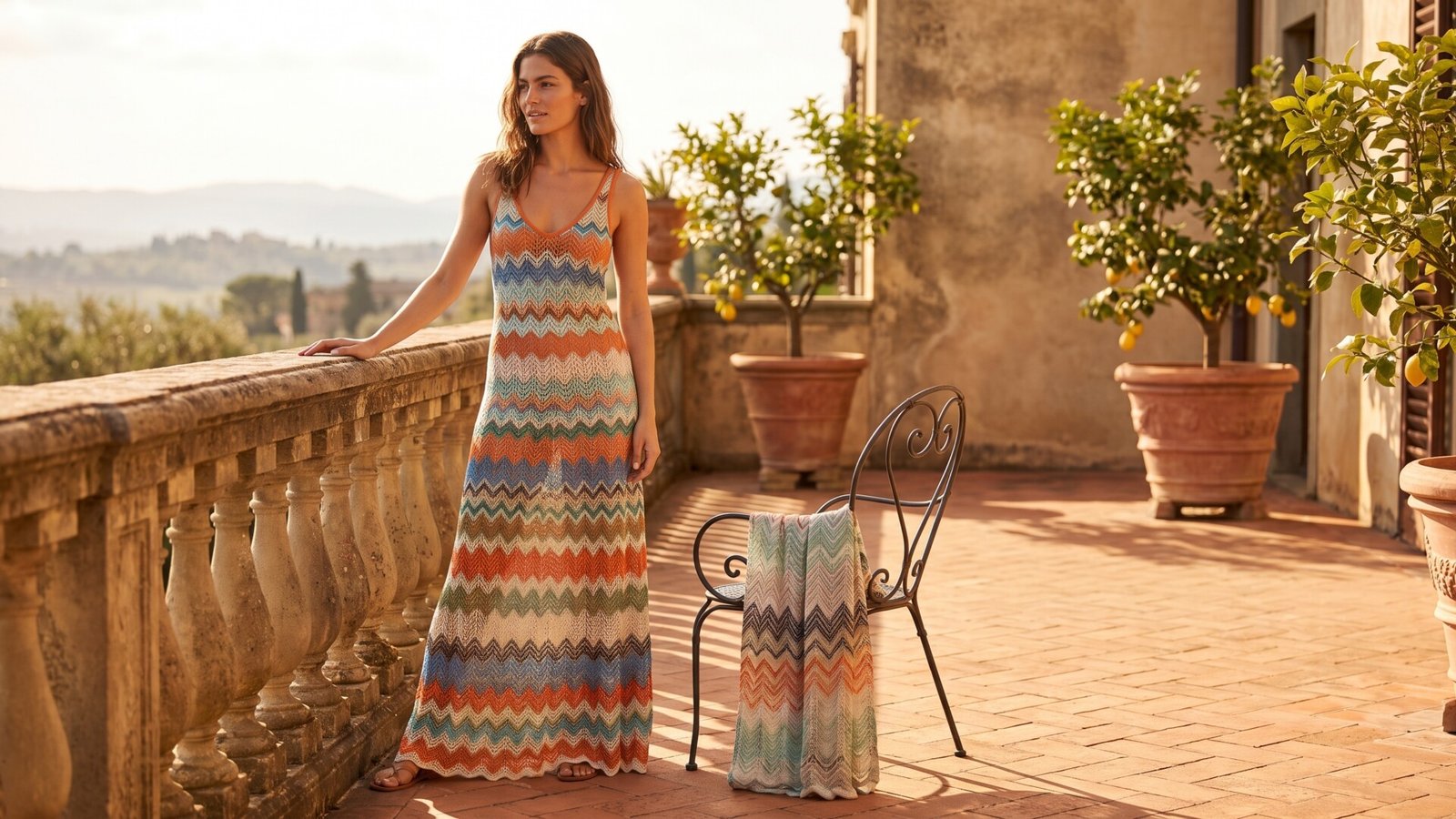
Open crochet tops, dresses and striped crochet sweaters carry the patterns into warm-weather clothing; a striped crochet-knit sweater was listed at about $1,945 on Net-a-Porter in 2026. Missoni swimwear and beach cover-ups use the same pattern language.
3. Missoni Home and Fragrances
Zig-zag cushions, throws and bedding are the easiest way to own the pattern without wearing it, and Missoni fragrances extend the brand into a more accessible category.
Main Line vs M Missoni
Searchers often ask “what is M Missoni?” It is the house’s secondary, more playful diffusion line; Margherita Missoni, Angela’s daughter, presented her first full collection as creative director of M Missoni in 2019. It uses the same pattern vocabulary at a lower price point, and part of its production has been handled by the Italian manufacturer Gilmar. Because “made in Italy” applies per product, check the label of the specific piece rather than assuming both lines are made the same way.
Where Is Missoni Made?
Missoni is an Italian brand with roots in Gallarate and a long-running factory in Sumirago, built in 1969. The main-line sweaters and cardigans we checked at retailers in 2026 were labeled made in Italy, but we have not verified production for every line, and the M Missoni line involves outside manufacturing partners. Always read the label of the exact item.
Angela Missoni and the Designers Who Followed
Angela Missoni, daughter of Ottavio and Rosita, took over creative direction in 1997. She modernized the zig-zags and patterns, expanded the lifestyle division and brought layering and pattern-mixing to the runway. She stepped back in May 2021, when Alberto Caliri, a Missoni designer since 1998, took over as interim creative director. Filippo Grazioli was named creative director in 2022, with Caliri moving to Missoni Home; Grazioli’s departure was announced in October 2024 and Caliri was reappointed. He now leads the main line and the home collections.
Collaborations and Pop Culture Presence
- Missoni for Target (2011): A limited-edition collection that brought Missoni patterns to a mass audience. It sold out within roughly 24 hours and overloaded Target’s website.
- Interior design projects: Hotels, residences and lifestyle products carry Missoni Home textiles.
The Business Side of Missoni
Missoni is now backed by investors rather than owned by the family. According to Italian business press, the house reported revenue of about €130 million in its last fiscal year, up 5%, and aims for around €200 million within five years. Reported plans include:
- Retail: A new boutique on Rue Saint-Honoré in Paris and smaller resort boutiques
- Wholesale: Wider distribution through department stores and specialist retailers
- Menswear and accessories: More menswear, small leather goods, bags and footwear
- Branded residences: Missoni-branded residential projects in several cities
Missoni and Italian Fashion
| House | Signature | Best for |
|---|---|---|
| Gucci | Maximalist, eclectic storytelling | Bold statements |
| Versace | Bold, sexy, theatrical | Glamour |
| Prada | Intellectual minimalism | Understated, modern dressing |
| Fendi | Fur and leather heritage, playful accessories | Accessories and outerwear |
| Missoni | Colorful, pattern-knitted knitwear | Color-forward knit wardrobes |
For the whole landscape, see our guide to Italy’s most influential fashion houses.
Why Is Missoni So Expensive? Pattern, Not Fibre
The most common misunderstanding about Missoni is what the price buys. Many buyers assume a $1,000-plus sweater must be cashmere or fine wool. Read the composition labels and a different picture appears: most main-line Missoni knits are blends in which viscose often outweighs wool.
| Sweater (2026 US full price) | Composition | Price |
|---|---|---|
| Missoni zig-zag rollneck | 66% viscose, 30% wool, 4% metallic | About $675 |
| Missoni zig-zag high-neck | 60% viscose, 34% wool, 6% polyester | About $1,350 |
| Missoni zig-zag V-neck | 49% wool, 44% viscose, small synthetics | About $1,400 |
| Missoni zig-zag cotton sweater (men) | 99% cotton | About $1,400 |
| Brunello Cucinelli crewneck (men) | 100% cashmere | About $1,250 |
So the premium pays for pattern engineering, not rare fibre. Multicolor jacquard and zig-zag knitting is harder to program and run than plain knit, the design is instantly recognizable, and the main-line pieces we checked are made in Italy. That gives a simple decision rule:
- Buy Missoni when the pattern is the point: a statement cardigan or sweater you want people to recognize, worn in mild weather or layered.
- Buy a cashmere specialist when warmth and softness are the point. The same money buys pure cashmere from Brunello Cucinelli, or several sweaters from Falconeri, Gran Sasso or Luca Faloni; Loro Piana sits at the top of that market.
- Wait for a sale if you are flexible on color: Missoni knits regularly appear at 20% to 50% off at major retailers at the end of a season.
How to Buy Missoni: Four Routes Compared
Where you buy decides how much of that pattern premium you pay. The four routes below are the realistic options for a US buyer in 2026.
| Route | Typical price | Best for | Watch out for |
|---|---|---|---|
| Main line, full price | About $675-$1,945 for knits | A specific color or size this season | Composition: many pieces are viscose-rich |
| Main line on sale | Often 20%-50% below full price | Classic zig-zags in last season’s colors | Final-sale terms with no returns |
| M Missoni | Below the main line | Entry-level pieces with the same patterns | Different production; check the label |
| Vintage | Often close to or below new prices | 1970s-1990s archive knits and coats | Moth holes, pulled threads, missing labels |
Who Missoni Suits (and Who It Doesn’t)
Missoni suits buyers who want one recognizable, color-led piece that does the work of an outfit: a cardigan over plain basics, a knit dress for a summer evening, a zig-zag throw in a neutral room. It suits less well if you build a wardrobe around quiet neutrals, need a warm winter sweater, or want garments you can machine wash. If you are drawn to the colors but not the price, start with home textiles or a sale cardigan in a classic zig-zag, which is the pattern that dates least.
Caring for Missoni Knitwear
Follow the care label on each garment, since blends differ; several current zig-zag sweaters are labeled dry clean. As a general rule, patterned knits keep their shape best when folded rather than hung, and metallic or sequin-trimmed pieces usually call for professional cleaning. If in doubt, ask a specialist cleaner and test on a hidden area first. Between seasons, store wool-rich pieces folded in a breathable bag with cedar to deter moths, since a single hole breaks a knitted zig-zag and is hard to repair invisibly.
Frequently Asked Questions About Missoni
Does Missoni knitwear run true to size?
Retailers such as Harrods describe Missoni’s womenswear knits as true to size, but cuts vary from fitted turtlenecks to oversized cardigans. Check the garment measurements on the listing and note the fibre: viscose-rich knits drape and can grow slightly with wear, while cotton and wool-rich pieces hold their shape better.
Are Missoni sweaters warm?
It depends on the composition. Viscose-rich zig-zag knits are lighter and better for mild weather or layering, while wool-rich pieces are warmer. If warmth is the priority, check the label for a high wool content, or choose a cashmere specialist instead.
Can you wash Missoni knitwear at home?
Only if the care label allows it. Several current Missoni sweaters are labeled dry clean, and metallic or sequined pieces need professional care. Never wring or tumble dry a Missoni knit, and dry any hand-washed piece flat so the pattern does not distort.
Is vintage Missoni worth buying?
It can be good value. Vintage dealers list 1970s and 1980s Missoni sweaters, cardigans and long sweater coats, often at prices close to or below new pieces. Check the composition label, ask for measurements and photos of any holes or pulled threads, and buy from sellers with return policies.
How can I tell if a Missoni piece is genuine?
Buy from Missoni or authorized retailers where possible. On resale, compare the label, composition tag and knit with documented pieces: genuine zig-zags are knitted into the fabric rather than printed on. For expensive items, use a platform with an authentication service.
Final Thoughts
Missoni lifted knitwear from functional to luxury and made pattern and color the core of a brand identity. From Ottavio and Rosita’s workshop in Gallarate to a company with new institutional owners, it has kept that idea: knitwear can be technical, colorful and desirable. Buy it for the pattern, read the composition label, and pick a cashmere house when warmth matters more. To explore the rest of Italian fashion, start with our Italian designer brands guide or the Missoni deep dive on the zig-zag pattern.