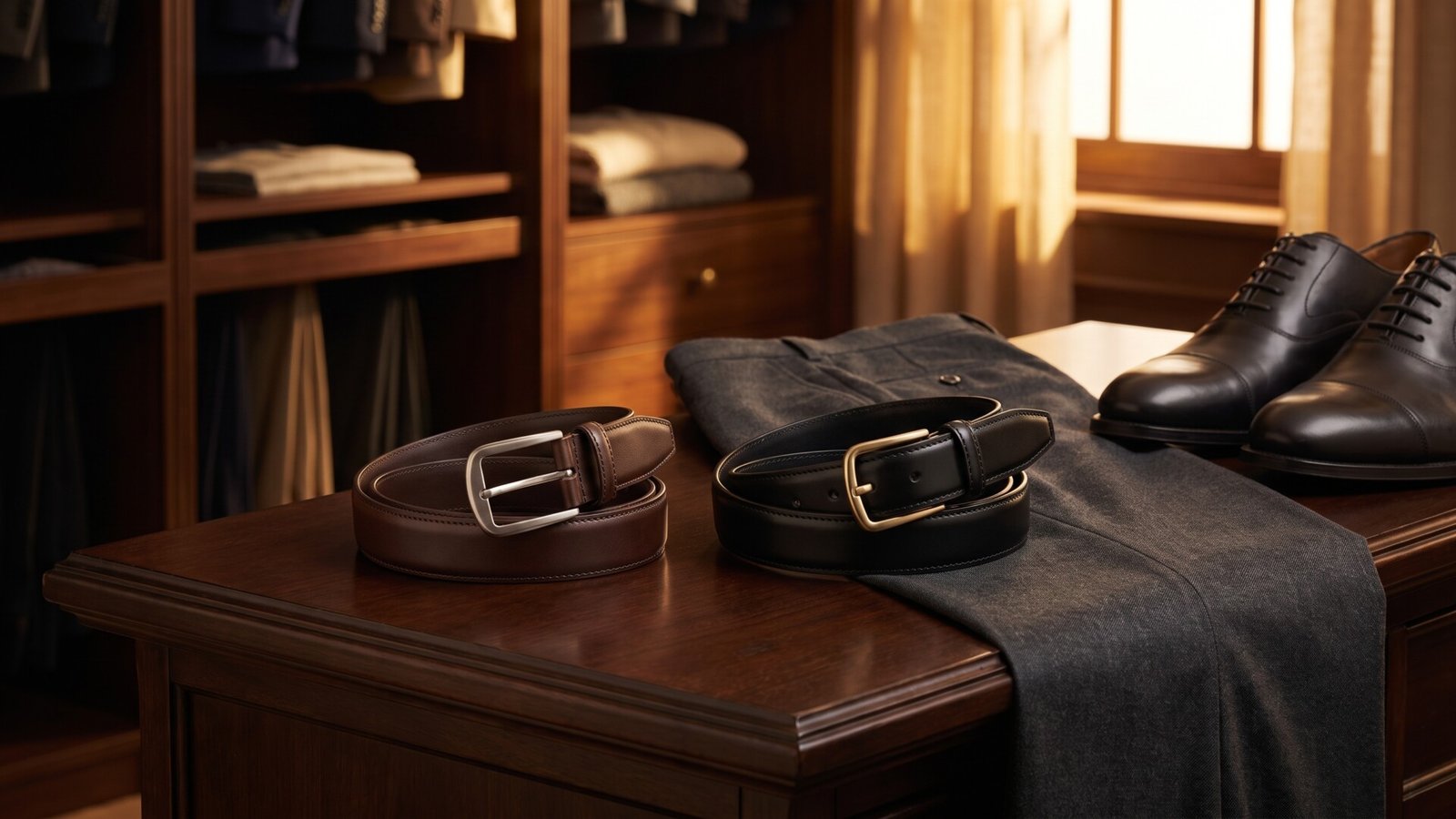
Affordable Italian designer belts for business attire
For the first five years of wearing suits to work, I treated belts as an afterthought. I owned exactly one—a black leather strap with a generic buckle that had come attached to a pair of trousers I bought in college. I wore it with everything. Navy suits. Grey suits. Brown shoes. Black shoes. It did not occur to me that anyone noticed, or that it mattered.
Then a client pulled me aside after a meeting and asked, very quietly, if I owned a brown belt.
I did not. I had never considered that I might need one.
He did not say anything else. He did not need to. I spent the next week noticing every man I passed, looking at their waists, realizing that the belt was not a functional afterthought but a statement I had been making without knowing it. The statement I had been making was: I have not thought about this.
This is the guide I wish someone had given me before I spent years sending the wrong signal. Affordable Italian designer belts for business attire—not the €800 Kitons of the world, but the real, accessible, well-made belts that belong in every professional’s wardrobe.
What “Affordable” Means When We Talk Italian Belts
Let me define my terms before we get to the list.
Under $400 is the ceiling for this conversation. But most of the belts I will discuss sit significantly lower—in the $100-$250 range, where quality Italian manufacturing becomes genuinely accessible.
At this price point, you are not buying hand-stitched, artisanal objects that required three days of labor. What you are buying is Italian design, quality leathers, and factory production that maintains standards while keeping costs reasonable. Several of the brands below manufacture for major luxury houses. They make the belts that carry famous names. They also make belts under their own names, at fractions of the price, using the same leathers and the same工人的 hands.
That is the sweet spot. That is where this list lives.
The Factory Brands That Deserve Your Attention
Anderson’s — The Parma Powerhouse
Founded in 1966, Anderson’s operates a factory in Parma, Italy—a region famous for leather goods. They are not a marketing brand. They are a manufacturing brand, one of those Italian companies that quietly produces belts for the world’s most famous fashion houses while maintaining their own collection.
What sets Anderson’s apart for business attire is their understanding of proportion. Their dress belts sit at the correct width—typically around 30-35mm—and their buckles strike the right balance between presence and restraint. The leather is expressive, often featuring grained textures that catch light subtly, and the buckles carry a quiet shine that reads as quality without shouting.
For the man who needs one belt that works with everything, Anderson’s black leather option with its glossy buckle and grained finish is the answer. It looks like it cost twice what you paid.
Price range: $100-$200
Best for: The everyday workhorse that needs to perform five days a week
Saddler’s — The Matte Alternative
Saddler’s is another Italian factory brand, focused exclusively on belts and committed to made-in-Italy production.
What distinguishes them is texture. Most leather belts have a certain shine—a finish that reflects light and reads as formal. Saddler’s offers something different: a matte texture that is surprisingly rare in the category. This matte finish, combined with a rounded buckle and a softly shaped belt tip, creates a softer image that works beautifully with contemporary suiting.
For the man who wants his business attire to feel approachable rather than armored, Saddler’s delivers. The affordable price point only sweetens the proposition.
Price range: $80-$150
Best for: The man who wants his belt to soften his silhouette rather than sharpen it
Tiberio Ferretti — The Belt Maker’s Belt Maker
Tiberio Ferretti is a name you have never heard. But you have almost certainly seen their work.
This factory specializes in belts and has produced items for Gucci, Burberry, and Berluti. The major luxury houses trust them to execute their designs because Tiberio Ferretti understands construction, leather selection, and finishing at the highest level.
Their own-brand collection includes pieces like a leather belt with a diamond-shaped stamped design on its surface. From a distance, it reads as simple and plain—exactly what business attire requires. Closer inspection reveals the refined stamping, the depth of texture, the attention that separates a good belt from a great one.
This duality—simple from afar, detailed up close—is the hallmark of serious men’s accessories. Tiberio Ferretti delivers it at a price that reflects their factory origins rather than their luxury clients’ markup.
Price range: $150-$250
Best for: The man who appreciates subtle details that reward close attention
D’Amico — The Bologna Original
Andrea D’Amico established his brand in Bologna in 1991, influenced by his grandfather and father who ran a shoemaker’s shop. At 27, he started making original belts with a craftsman, and the brand that bears his name was born.
D’Amico is often called simply “D’amico” by those in the know, and it has become a favorite among regular Pitti Uomo attendees—the famously well-dressed men who flock to Florence’s menswear trade shows. The brand shocked the industry early on by introducing colorful exotic leathers at a time when black and brown calf were the only acceptable options.
For business attire, D’Amico’s more restrained offerings are the focus. Their belts use exquisite materials—only the finest leathers—combined with trend-setting designs and detailed buckle engravings. What makes them particularly attractive is the cost-performance equation: by establishing a factory in 1997, D’Amico increased productivity and developed collections with excellent value.
These are belts built for everyday use by fashionable Italians. That is precisely the recommendation you need.
Price range: $150-$250
Best for: The man who wants Italian design credibility with reasonable pricing
The Dust Company — The Modern Artisan
Luca Ricci spent years in the high-end leather furniture industry before becoming disappointed with the quality of many luxury consumer brands’ leather goods. In 2017, he launched The Dust Company, a brand jointly headquartered in Italy and Wyoming, handcrafted by a team of eight Italian artisans.
The Dust Company’s belts, bags, and wallets are made to improve with age—the hallmark of properly tanned, properly constructed leather goods. They use classic designs and colors that transcend seasons, and they sell direct-to-consumer through their Shopify store, avoiding the markups that come with traditional retail.
For business attire, The Dust Company offers belts in traditional widths and finishes, built by artisans who understand that a belt should last decades, not seasons. The direct-to-consumer model keeps prices reasonable without compromising on the Italian craftsmanship.
Price range: $150-$300
Best for: The man who values modern business ethics alongside traditional craftsmanship
Vicoliventi — The Artisan Curator
Vicoliventi describes itself as an Italian artisan leather goods company, offering belts, bags, accessories, and gift ideas. Their product range includes classic, sporty, studded, braided, and suede belts—but for business attire, the classic options are the focus.
What distinguishes Vicoliventi is their focus on high-quality materials and meticulous attention to detail. They blend traditional techniques with innovative designs, creating pieces that feel both timeless and contemporary. Their customer service—available via WhatsApp and email—reflects the personal approach of a smaller operation.
For the man who wants to buy from a company that feels like a workshop rather than a factory, Vicoliventi delivers.
Price range: $100-$200
Best for: The man who values direct communication with his belt maker
Joseph Abboud — The American Tailoring House, Italian Made
This entry requires a note. Joseph Abboud is an American designer, known for his approach to tailored clothing. But the Joseph Abboud Minimalist Leather Belt, available at Men’s Wearhouse for $59.99, carries a crucial designation: Made in Italy.
This belt—available in black or brown, 33mm wide, genuine leather—represents something important. It proves that Italian manufacturing is accessible at every price point if you know where to look. The belt is minimalist by design, with a silver single-tongue buckle and clean lines that work with any suit.
At $60, this is the entry point for the man who wants to start wearing Italian-made belts without committing to the higher prices of the factory brands. It will not have the same depth of leather or refinement of finish as the others on this list. But it is authentically Italian, authentically well-made, and authentically affordable.
Price range: $60
Best for: The man building his first professional wardrobe
What You Are Actually Paying For
Let me translate what these price points mean.
When you spend $60 on an Italian-made belt, you are getting factory production with quality control, genuine leather (not bonded), and the basic assurance that the belt will not delaminate after six months.
When you spend $150-$250 on a belt from Anderson’s, Tiberio Ferretti, or D’Amico, you are getting better leather—hides selected for consistency, texture, and longevity. You are getting more sophisticated finishing. You are getting design that has been refined over decades. And you are getting the knowledge that this belt was made by people who also make belts for the most famous names in luxury.
The difference between a $60 Italian belt and a $250 Italian belt is not branding. It is the quality of the raw material, the complexity of the construction, and the depth of the design.
Both have their place. The key is knowing which place you are in.
The Business Attire Rules That Never Change
Before you buy, understand the rules that govern belts in professional settings.
Match your shoes. This is non-negotiable. Black belt with black shoes. Brown belt with brown shoes. The shades do not need to match perfectly, but they need to live in the same neighborhood.
Width matters. Dress belts should be approximately 30-35mm wide. Wider belts belong with jeans. Narrower belts look disproportionate with suit trousers.
The buckle should be restrained. Silver or gunmetal for most situations. Gold if your watch and other accessories are gold. Nothing that draws attention to itself.
The belt should fit properly. You should use the middle hole, not the first or last. If you are on the last hole, the belt is too long. If you are on the first, it is too short.
Leather quality reveals itself over time. A good leather belt develops character. It softens without losing structure. It darkens slightly where it bends. It becomes yours.
Where to Buy
The brands above are available through multiple channels.
Direct websites often offer the best selection and the most transparent pricing. The Dust Company’s Shopify store is a model of direct-to-consumer clarity.
Specialty retailers like Men’s Wearhouse carry select Italian-made options at accessible prices.
Online marketplaces like Spartoo (France), The Clothing Lounge (UK), and IVALO (Finland) stock The Dust Company’s products for European buyers. For American buyers, Target+ and Faire.com carry the brand as well.
Italian fashion wholesalers like Italian-fashion.it can connect you with suppliers if you are buying in volume.
For the best value, consider that many of these factory brands produce belts for luxury houses. The belt you buy from Tiberio Ferretti for $200 may be identical—same leather, same construction, same hands—to a belt sold by a luxury house for $600. The only difference is the name stamped on the inside.
That is not speculation. That is how the Italian leather goods industry works.
I keep thinking about that client who asked if I owned a brown belt.
He was not being critical. He was being helpful. He was telling me, in the kindest way possible, that the details matter. That the man who notices belts notices everything. That the difference between adequate and excellent is often the difference between thinking about something and not thinking about it.
I bought my first real belt the next week. An Anderson’s in brown grained leather, glossy buckle, perfect width. I wore it with everything. I still have it.
The belts you buy today will outlive you if you choose well. Someone who has not been born yet will pull them from a drawer, run a finger along the leather, and wonder about the man who wore them. You owe it to them—and to yourself—to choose belts worth inheriting.
Even if you spend less than $400.