Craftsmanship Spotlight: Italian Shoe Making
I have a confession.
The first pair of handmade Italian shoes I ever owned did not fit.
They were beautiful—oxblood cordovan, hand-stitched welts, a last so elegantly elongated they looked like sculpture on the shelf. I had saved for months. I had read the forums. I had convinced myself that discomfort was simply the price of admission to a world I desperately wanted to enter.
I wore them exactly three times. Each time, I bled. Each time, I told myself the leather would break in, the foot would surrender, the pain would transmute into something that felt like pride.
It did not.
Years later, a Bolognese shoemaker named Simone Peron told me I had done everything wrong. Not the saving. Not the wanting. The assumption that beauty and suffering were the same thing.
A shoe that hurts, he said, is not a shoe. It is a mistake someone convinced you to wear.
He was not being unkind. He was stating a fact of his trade, one his father taught him and his grandfather taught his father and the generation before that taught his grandfather. In Bologna, once the capital of finely crafted men’s footwear with 1,850 workshops operating in the 1930s and ’40s, this knowledge was so fundamental it did not need to be spoken.
Now it does. Now the world is full of beautiful shoes that wound their owners. Now artisanal footwear has become a category you can buy without ever meeting the hands that made it.
This is the explanation I wish someone had given me before I spent my savings on a pair of shoes that were never meant for my feet. Not a shopping list. Not a brand guide. A translation of what Italian shoemakers have always known and we, the customers, have forgotten.
The Region That Learned to Wait
There is a stretch of rural Italy, three hours from Rome, that produces some of the finest shoes on earth.
Le Marche does not look like an industrial capital. It looks like agriculture: olive groves, vineyards, the unhurried rhythms of a landscape that has never seen reason to rush. But for more than a century, this region has served as a national epicentre of shoemaking. Tod’s was born here. Santoni was born here. Nerogiardini continues to operate here, designing for men, women, and children from within the same valleys that supply wine and oil to the rest of Italy.
Giuseppe Santoni, whose parents founded the company in 1975, once explained his philosophy to me in terms I have never forgotten.
Making good shoes is like making cheese, he said. The longer the leather rests on the last, the better the shoes. The longer the cheese ages, the better the cheese.
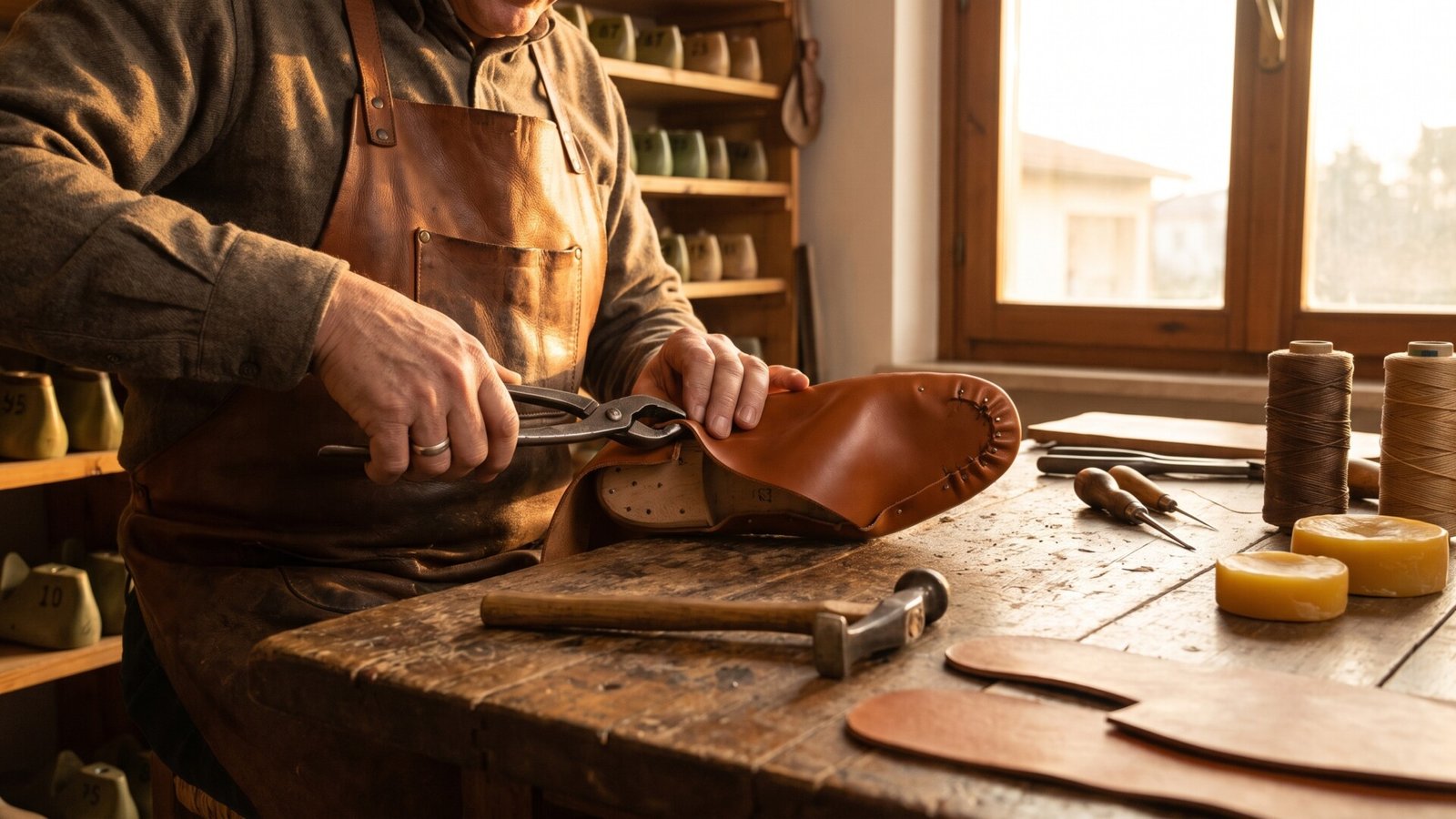
At Santoni’s factory in Corridonia, a Goodyear-welted shoe remains on its last for three weeks. Not because the machinery requires it. Because the leather requires it. Because forcing the pace would produce a shoe that looks correct on the outside and has forgotten something essential within.
This is the difference between manufacturing and craft. Manufacturing compresses time. Craft inhabits it.
The Velatura That Takes Days
I want to tell you about colour.
Most coloured shoes are coloured superficially. A dye is applied, a finish is sealed, the surface accepts its new identity. It is efficient. It is uniform. It is, to the Santoni family, insufficient.
Andrea Santoni, the founder, adopted a Renaissance-era painting technique called velatura in the 1970s, when he was still working out of his garage with five employees. The process involves layering watercolour-like dyes onto white leather—the finest white hides, inspected by hand for any occlusion—before buffing the surface to a glassy sheen.
Depending on the desired colour, the process can take hours or days. Fifteen layers of water-based paint is not unusual. Each layer must dry completely before the next is applied.
I did not understand why this mattered until I held a Santoni double monk-strap in my hands. The colour was not on the leather. It was in the leather. It had nowhere to run. It had been coaxed into permanence by someone who understood that haste is the enemy of depth.
Giuseppe Santoni told a reporter once that his customers “appreciate unique pieces and valuable products” but “are not followers of fashion”. I think he was being polite. What he meant is that a shoe painted in fifteen layers over several days does not care what season it is. It will outlive the concept of seasons.
The Sacchetto That Refuses to Disappear
There is a construction method so labour-intensive, so demanding of skill, that nearly the entire industry abandoned it.
The sacchetto method—”glove” construction, or “bag” construction—involves sewing a soft goatskin lining into a continuous sac that wraps the foot like, well, a glove. The upper is attached along its edge without the rigid components used in most shoes. The result is a shoe that weighs almost nothing, bends effortlessly, and moves with the foot rather than against it.
Amedeo Testoni, who opened his workshop in Bologna in 1929 at the age of twenty-four, made this technique his signature. He was not the only one. In Bologna’s heyday, dozens of ateliers produced handmade Italian shoes using variants of the sacchetto method. The city was, for a few decades, the undisputed capital of finely crafted men’s footwear.
Then industrialization arrived. The workshops closed. The knowledge dispersed. By 1970, few of Bologna’s 1,850 shoemaking ateliers remained.
Testoni kept making sacchetto shoes. The company still does. The process involves up to two hundred steps, each requiring “outstanding skillfulness, experience and competence”. It is, by any rational economic measure, absurd.
But Simone Peron, whose family workshop produces about a thousand pairs a year in Bologna, told me that rationality is not the point.
We go visit a client’s home, he said. We try to establish a sense of him, observing his clothing, his furnishings. We have to be both good artisans and good psychologists.
A sacchetto shoe cannot be sold to a stranger. It can only be made for someone you have met.
The 200 Steps No One Sees
Here is a number I want you to hold in your hand: two hundred.
A complete shoe requires approximately two hundred steps. This is true regardless of the construction method. Slip-lasting, Bologna processing, Goodyear welt, Norwegian stitch, the spiral Filettone seam that Testoni developed as a signature—each technique demands its own choreography of hands and tools, but the total number hovers around two hundred.
Two hundred steps. Most of them invisible in the finished object.
The worker at Santoni who could spare only fifteen minutes for an interview because his hands were needed on the line. The velatura painter applying her fifteenth layer. The cutter at Testoni placing patterns on a hide, avoiding any less-than-smooth section, knowing that a single scratch invisible to the customer will become a permanent flaw.
These steps are not secret. They are simply unphotographable. They occur in the space between the shoemaker’s attention and the material’s response, and no camera has ever captured it.
Arturo Venanzi, vice president of Italy’s National Footwear Manufacturers Association and fourth-generation owner of a family shoemaking business in Le Marche, tried to explain this to an interviewer once.
To us, he said, handcrafted shoes have a soul.
He was not being mystical. He was describing a property of the object that becomes visible only after you have worn it for years. The shoe that remembers the last it rested on. The colour that has nowhere to fade to. The sole that was stitched by someone who learned from their father, who learned from their father, who learned from their father.
The Academy That Refuses to Forget
There is a problem in Italian shoemaking, and it is the same problem that faces every trade sustained by embodied knowledge.
The people who know how to do this are aging. The young people are not lining up to replace them.
Santoni, which now employs about six hundred artisans in a 300,000-square-foot factory, responded by establishing the Accademia dell’Eccellenza. A fully funded educational program. Students are paid to learn. The curriculum is not theoretical. It is the shoemaking equivalent of apprenticeship, formalized and institutionalized and desperately necessary.
Giuseppe Santoni’s grandfather was a farmer. His father, Andrea, went to work in a shoe factory at thirteen because farmers wanted their children to learn a craft outside of farming. Now Andrea is seventy-nine and still works daily, solving complex production problems that only he remembers how to solve.
The academy is insurance. It is also a recognition that you cannot preserve knowledge by documenting it. You can only preserve it by transmitting it, hand to hand, eye to eye, generation to generation.
The Family That Keeps Showing Up
I have saved the Mazzarella family for the end.
Their story begins in the 1930s, when Erginio Mazzarella started working with leather in a small Italian town. After the war, he founded a factory specializing in handmade men’s shoes. His son, Alessandro, went to Bologna to study with the masters, learning the techniques that had made the city famous. He began making women’s shoes as well.
Alessandro’s son, Giuseppe, grew up surrounded by leather and lasts. He went to Milan, attended the world-renowned school Ars Sutoria, passed his certification in footwear design and management. In 1978, the family formally established the ALEX brand.
Four generations. From the 1930s to now. From Erginio to Giuseppe.
I think about this when I read about Runpetery, the young brand founded in 2018 that uses 3D-engineered cushioning and Mediterranean algae-based leathers while still employing a third-generation shoemaker named Gianluca who uses his grandfather’s half-moon knife. The technology is new. The hands are old.
This is not nostalgia. It is the opposite of nostalgia. It is the continuous adaptation of a craft to materials and markets that did not exist when the craft began.
What Fitting Actually Means
Peron & Peron makes about a thousand shoes a year.
That is not a production target. That is the natural limit of a workshop that takes molds of each client’s feet and archives them so new pairs can be ordered from anywhere in the world. Eighty percent of their customers are men. Prices start at one thousand dollars.
I am not telling you this to suggest that you must spend a thousand dollars on shoes. I am telling you this because the thousand dollars is not paying for leather and thread and rent. It is paying for the archive. It is paying for the visit to your home. It is paying for the observation of your clothing and your furnishings and the thousand small decisions that reveal who you are when you are not thinking about your shoes.
Simone Peron said his greatest satisfaction was bringing his father’s name to Japan. Not selling shoes there. Bringing his father’s name. The reputation, the standard, the promise that a shoe made in Bologna in 2025 will be held to the same standard as a shoe made in Bologna in 1955.
This is what we mean when we say artisanal footwear. Not handmade. Not expensive. Not Italian. Accountable.
A shoe whose maker is known, and whose maker knows you.
I keep thinking about the shoes I bled in.
They were not bad shoes. They were simply shoes made for a different foot, a different last, a different understanding of what a shoe should be. I bought them because I wanted to participate in a tradition I did not understand. I wore them because I believed suffering was the cost of admission.
It is not.
The worker at Santoni who waterproofs cotton thread with a mixture of glue and beeswax is not suffering. The cutter at Testoni who avoids the scratched section of hide is not suffering. The third-generation shoemaker named Gianluca, using his grandfather’s knife on a new brand’s experimental lasts, is not suffering.
They are attending. They are present. They are in a relationship with the material that requires them to wait—three weeks on the last, fifteen layers of dye, forty days in the vegetable-tanning pit—until the leather is ready.
I learned this too late for my first pair of handmade Italian shoes. I hope you learn it in time for yours.
The shoe that fits does not announce itself with comfort. It announces itself with absence. You forget you are wearing it. You walk through the airport, through the meeting, through the evening, and at no point do you remember that your feet are enclosed in calfskin and cork and thread sealed with beeswax.
That is the secret at the heart of Italian shoemaking. Not the two hundred steps. Not the velatura. Not the sacchetto. The forgetting.
A shoe that remembers itself is a shoe that has failed.
The shoes you buy today will outlive you. Someone who has not been born yet will pull them from a box, run a finger along the sole, and wonder whose foot occupied this space before theirs. They will not know your name. They will not know the colour of your furnishings or the cut of your clothing. But they will know, without knowing how they know, that someone attended to this object with an attention that exceeded the commercial transaction.
That is the thread that connects Erginio Mazzarella in the 1930s to Gianluca in 2025. That is the thread that connects the farmer’s son who went to work in a shoe factory at thirteen to the student at the Accademia dell’Eccellenza learning to paint leather in fifteen layers.
We call it heritage. We call it tradition. We call it Made in Italy.
But what it really is, is a refusal to forget that a shoe is never just a shoe. It is a record of everything that has touched it—the hide, the water, the knife, the hand, the foot, the floor.
The imperfect ones are always the ones that fit.
[Shop Handmade Italian Shoes]
[Browse Artisanal Footwear Collections]
[Discover Bologna Shoemakers]
The techniques and traditions explored here form the foundation of Italy’s most respected footwear houses. To see how these craftsmanship principles translate into modern luxury collections and leading brands, visit our Italian Designer Shoes hub, where we cover the designers, styles, and innovations shaping Italian footwear today.